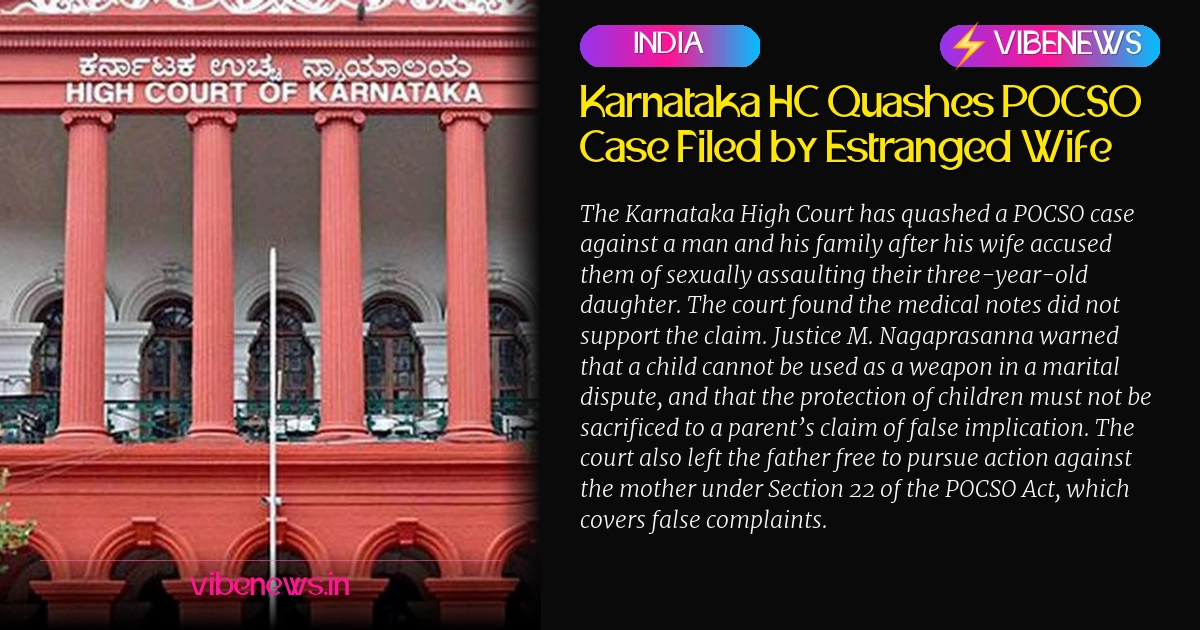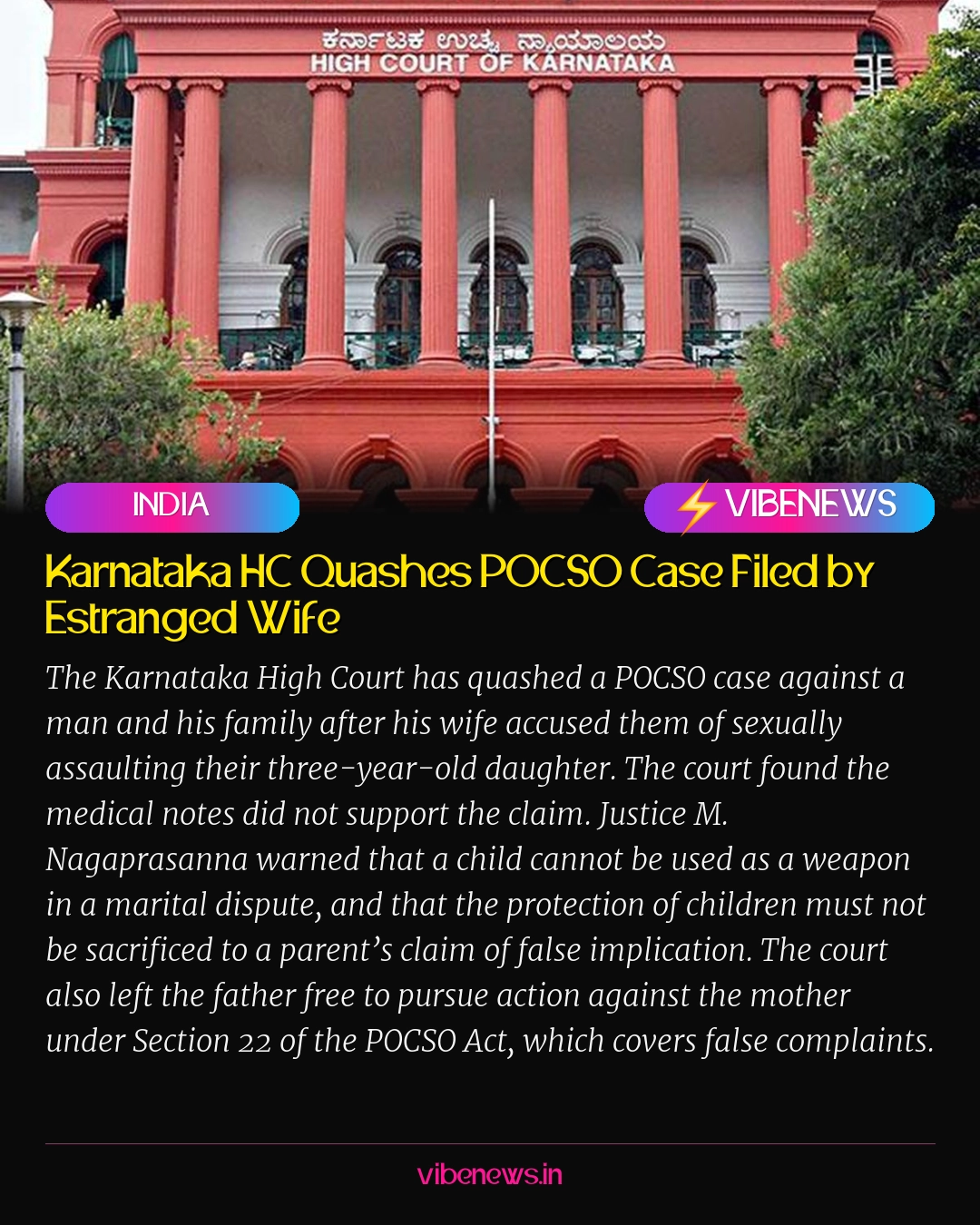

The Karnataka High Court has quashed a criminal case under the Protection of Children from Sexual Offences (POCSO) Act that a woman filed against her estranged husband, his father, mother and brother, accusing them of sexually assaulting their three-year-old daughter.
Justice M. Nagaprasanna passed the order while allowing a petition from the 35-year-old man and his three family members. The case was registered in May by his 33-year-old wife. The court did not stop at the legal technicalities. It went after the way the case was built.
A child caught in a marital fight
The court said the case grew out of a matrimonial dispute that dates back to 2024. By then, the father had secured visitation rights through orders from the Family Court and later the High Court. That history matters. The child was already moving between two households under court supervision, and the complaint landed in the middle of that arrangement.
The mother filed her complaint on May 18. She alleged that the child had redness and excoriation in her private parts after returning from visitation on May 16 and 17. Those are the details that turned a family dispute into a criminal case with a child at its center.
The mother had taken the girl to doctors at a private hospital in Bengaluru for a medical examination. The court relied on affidavits from two of those doctors. Both said the findings in their medical notes were “non-specific clinical findings.” The tests they ran were only to rule out a urinary tract infection.
“The medical opinion is thus made to speak what it does not say.”
That line from the bench cuts to the core of the ruling. The mother had read the medical notes as proof of sexual assault. The doctors who wrote them had never made that link. The court pointed out that neither doctor conducted a medico-legal examination of the child. In other words, nobody with the formal authority to test for sexual abuse had reached that conclusion. The entire accusation, the court said, rested on an inference the mother drew for herself.
No ingredients of an offence
The court also found that the complaint itself did not contain anything that could be called the ingredients of an offence under the POCSO Act. A serious criminal charge, with a three-year-old at the centre of it, had been built on a medical record that did not carry the weight placed on it.
For the family that was targeted, the impact is not abstract. A 35-year-old man, his father, his mother and his brother were all named in a case alleging sexual assault against a toddler. Each of them had to go to court to get it thrown out. The judgment does not describe how long that process took or what it cost them. What it does make clear is that the allegation carried enough weight to drag four people through the criminal process before the court looked closely at the medical evidence.
The court’s warning about both directions
Justice Nagaprasanna used the case to comment on a wider problem. He said courts are increasingly facing matrimonial disputes in which grave criminal allegations are tangled up with custody, visitation and parental access. In those cases, the child often sits at the point where two competing stories collide. Each parent says they are acting in the child’s paramount interest.
“A child cannot be reduced to a weapon in the armoury of an estranged spouse. The innocence of childhood cannot be made the currency with which matrimonial scores are settled.”
The judge was careful to point in both directions. He said the danger is not only that a parent may be falsely accused. It is equally that a genuine grievance of a child may be buried under the hostility between the parents. The court said both possibilities demand vigilance. Neither should be assumed just because a marriage has broken down.
“Equally, the protection of a child cannot be sacrificed at the altar of a parent’s claim of false implication.”
That is the sharpest tension in the ruling. A court that is too quick to dismiss a child’s complaint risks failing a real victim. A court that is too quick to accept a parent’s accusation risks destroying an innocent family and pulling a toddler into a criminal case built on a misreading. The judge refused to treat either outcome as the default.
The counter-move against the mother
The court did not stop at quashing the case. It granted liberty to the child’s father and his family members to start proceedings against the mother, if they are so advised, under Section 22 of the POCSO Act. That provision protects people against false complaints or false information. In practical terms, the men and their relatives now have a legal route to pursue the woman who filed the complaint.
The order does not say that the mother acted with deliberate malice. It says the complaint did not hold up under the medical evidence and that the accusation rested on an inference the doctors had not made. The door to a counter-action is left open, and the judge has put it in writing.
Why this case should worry every parent in court
The most troubling part of this story is simple. A three-year-old was at the centre of an allegation of sexual assault, and the allegation was built on medical notes that the doctors who wrote them said did not point to sexual assault. The ruling shows how easily the language of child protection can be turned into a tool in a divorce or custody fight.
The Karnataka High Court has now said that plainly. It has also warned that the same system must stay alert to real abuse hidden behind family hostility. Both messages land on the same child. The question for the courts, and for every family caught in a bitter separation, is how to keep a child out of the crossfire while still taking every real allegation seriously.
TL;DR
- Karnataka High Court quashes a POCSO case filed by a wife against her estranged husband and his family.
- The case alleged sexual assault on the couple’s three-year-old daughter, based on a complaint filed in May.
- Two doctors told the court their medical notes were non-specific and did not link the findings to sexual assault.
- The court said the medical opinion was made to speak what it does not say.
- Justice M. Nagaprasanna granted the father liberty to pursue action against the mother under Section 22 of the POCSO Act.