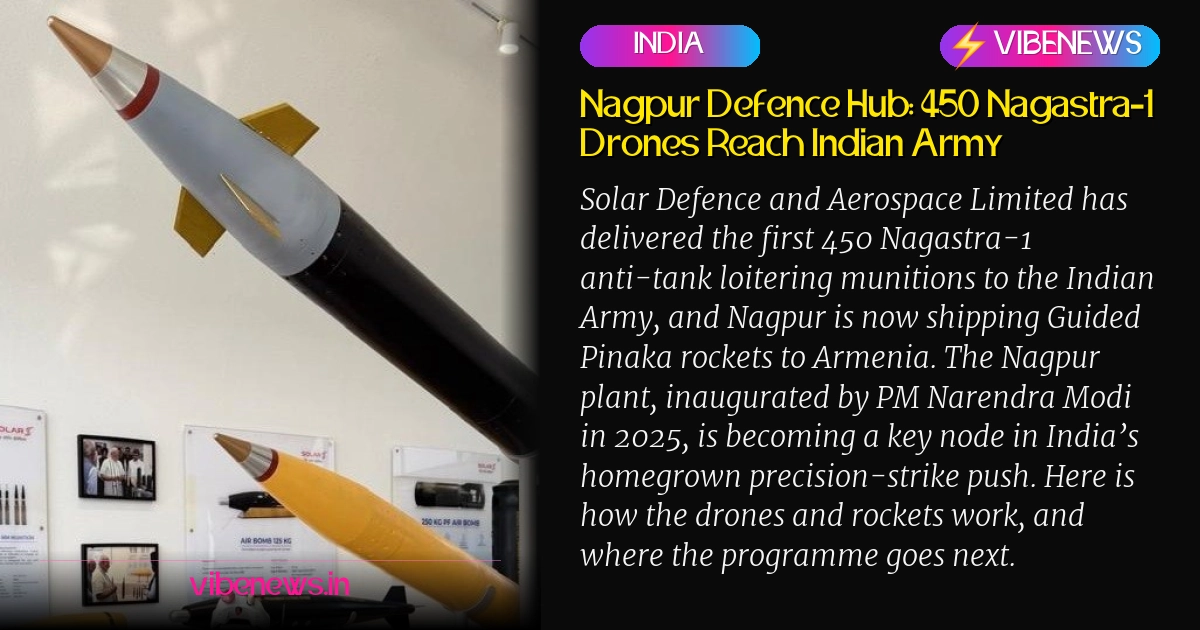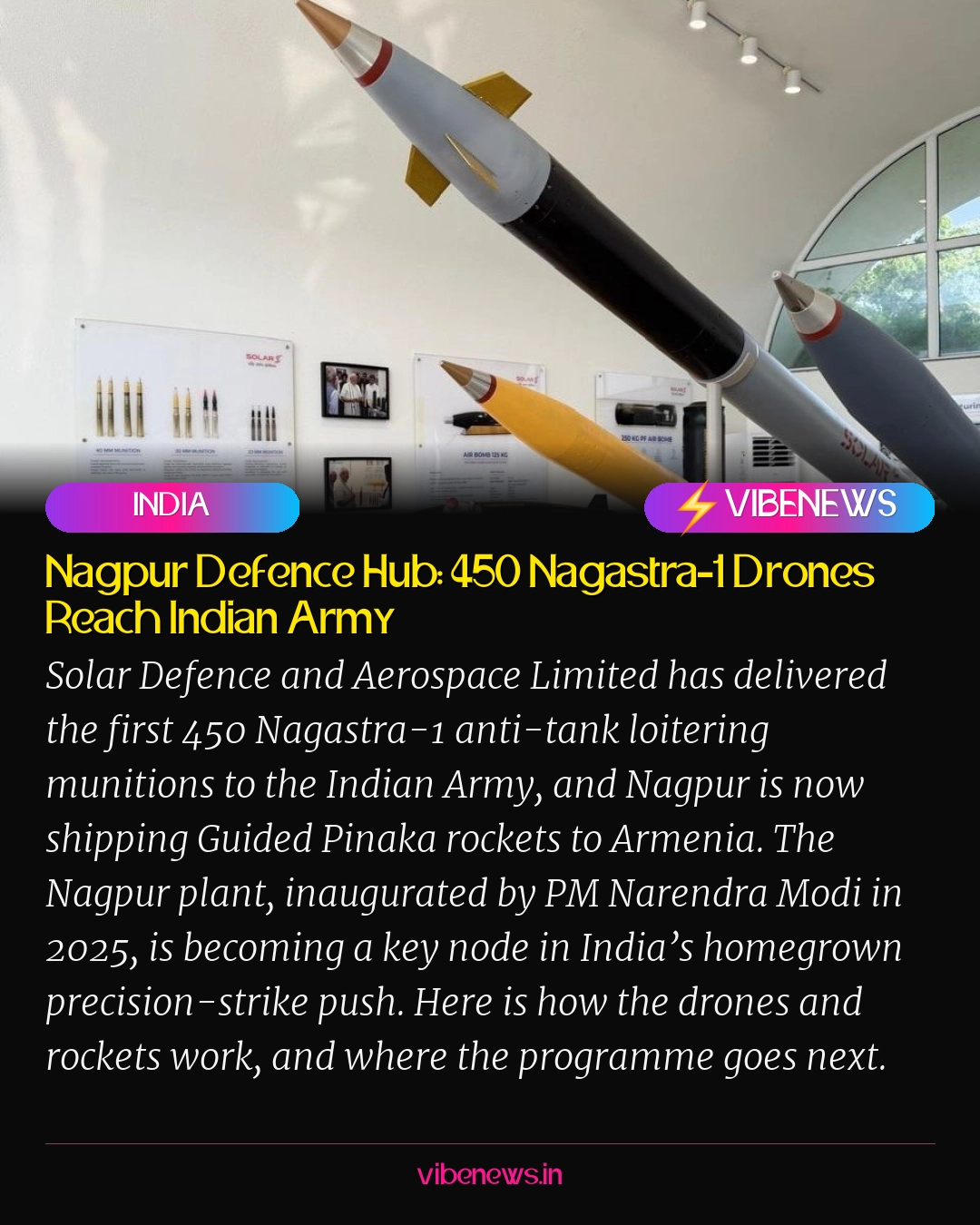
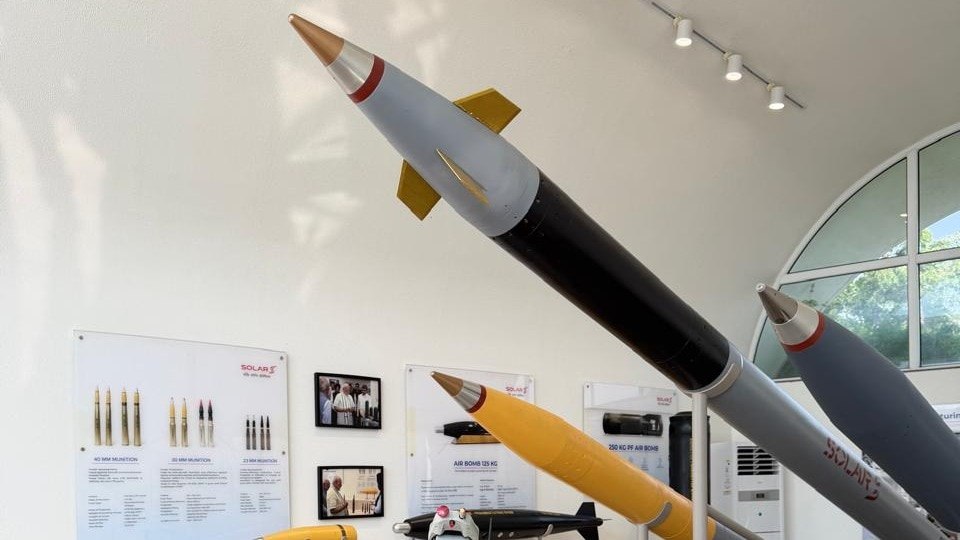
Solar Defence and Aerospace Limited has handed the Indian Army the first batch of 450 Nagastra-1 anti-tank loitering munitions, and its Nagpur facility has sent 1,000 Guided Pinaka rockets to Armenia this year. One year after Operation Sindoor, the Nagpur plant is turning into one of the country’s most important centres for indigenous defence manufacturing.
The delivery arrived in October. The Nagastra-1 is India’s homegrown suicide drone, and the Army’s new stock marks a clear shift in how the country fights at the tactical edge. The system was used during Operation Sindoor to strike terrorist targets in Pakistan, which put India’s loitering munition capability squarely in the spotlight.
Nagastra-1: A Drone Built to Hunt Tanks
The Nagastra-1 is an anti-tank loitering munition. Unlike conventional drones that only watch, it can hover over an area, monitor enemy movement and launch a precision strike once it locks onto a target. Tanks and armoured vehicles are its main prey.
Its latest delivery follows technical trials at Rajasthan’s Mahajan Field Firing Range in August 2026. With 450 units now in Army hands, the system moves into its next stage of deployment.
The drone works in two modes. In its recoverable and reusable mode, it has an operational range of up to 25 km. In fire-and-forget mode, it becomes a one-way kamikaze weapon and can travel up to 50 km to hit its target. It can stay airborne for up to 60 minutes, which gives operators time to surveil and track enemy positions before committing to an attack.
Nagastra-2 Aims at Heavier Armour
The company is already building the next version. Nagastra-2 is designed for heavily armoured targets, and its 4-kg tandem shaped-charge warhead is the headline feature.
The warhead can penetrate up to 650 mm of rolled homogeneous armour, the standard reference used to measure the protective capability of tank armour.
That figure comes from Solar Defence and Aerospace Limited chairman Satyanarayan Nuwal. It puts the weapon in a direct conversation with the armour on modern main battle tanks.
Nagastra-2 also carries high-resolution cameras that work in daylight and at night. That lets it identify and track targets whatever the visibility. The company has also tackled one of the toughest problems in unmanned warfare: electronic interference. Enemy forces increasingly use GPS jamming and communication disruption to knock drones off course. Nagastra-2 includes Electronic Counter-Countermeasure technology, and the company claims it can keep its targeting intact through jamming and spoofing attempts and continue toward its designated target.
The earlier Nagastra-1R order from the Army came in 2025. Those systems went through trials at locations ranging from Ladakh to Babina before reaching their operational role.
Pinaka: From Domestic Artillery to Export Product
Nagpur’s role extends beyond drones. The city is also a key producer of Pinaka rockets, one of India’s main indigenous artillery systems. The Defence Research and Development Organisation developed Pinaka, a multi-barrel rocket launcher that can fire several rockets in quick succession at enemy positions, bunkers and military installations.
For a long time, Pinaka ammunition came mainly from the public-sector defence production ecosystem. Private players have now moved in. Solar Defence and Aerospace Limited has taken on orders worth around Rs 6,000 crore and has carried out the manufacturing and testing of the high-tech rocket system.
The weapon has changed a great deal over time. Early versions had a range of around 37.5 km. Upgrades pushed that to 45 km and then 75 km, and DRDO and the Nagpur company are working on more advanced versions. The Army inducted the Pinaka Mk-I Enhanced after successful trials in April 2022, and that variant can strike targets beyond 75 km.
The latest Guided Pinaka variant has an operational range of up to 120 km. Its advanced guidance, navigation and control systems improve accuracy, so it can engage targets far more precisely than conventional unguided rockets. Recent trials at Pokhran showed what the upgraded system can do.
Armenia Order Puts India on the Export Map
The export is the clearest sign that Indian-made munitions are finding buyers abroad. In January 2026, Defence Minister Rajnath Singh flagged off the first batch of 1,000 Guided Pinaka rockets from the Nagpur facility for the Armenian ground forces.
The order matters for two reasons. It shows growing international acceptance of weapons designed and built in India. It also shows private-sector manufacturers taking a bigger share of the country’s defence exports, with Solar Defence and Aerospace Limited now producing ammunition for an overseas military customer.
The company says several other countries have shown interest in Pinaka after the Armenian order. According to the firm, its relatively lower cost, precision-strike capability and growing confidence in India’s defence manufacturing ecosystem have helped the system’s appeal abroad.
The Government Bet Behind the Factory Floor
Domestic demand is backing the export push. The Ministry of Defence has signed contracts worth more than Rs 10,200 crore with Solar Industries and Munitions India Limited for Pinaka launchers and ammunition.
The contracts are expected to strengthen the domestic manufacturing base and meet the armed forces’ requirements for rocket artillery. For a country that spent much of its history importing its heaviest firepower, that is a major change in direction.
Nagpur’s rise reflects a broader pattern. Drones, rockets and munitions that once came mostly from state factories are now being made by private firms that count the Army and foreign militaries among their customers. The Nagastra-2 programme and the latest Pinaka upgrades suggest the next stage will focus on longer reach, heavier warheads and tougher resistance to electronic warfare.
The last year has moved fast. A factory inaugurated in 2025 has delivered hundreds of drones to the Army, shipped rockets abroad and taken on contracts worth thousands of crores. Nagpur is no longer just a manufacturing city in central India. It is now part of the country’s strike capability, and its output is reaching both Indian soldiers and overseas buyers.
TL;DR
- Solar Defence and Aerospace Limited delivered the first 450 Nagastra-1 anti-tank loitering munitions to the Indian Army in October 2026.
- The Nagastra-1 can hover, track enemy movement and strike tanks, with a range of up to 50 km in kamikaze mode.
- The company is developing Nagastra-2 with a 4-kg tandem warhead that it says can penetrate 650 mm of RHA armour.
- Nagpur plant flagged off 1,000 Guided Pinaka rockets for the Armenian ground forces in January 2026.
- Latest Guided Pinaka variant has an operational range of up to 120 km, according to the report.
- The Ministry of Defence has signed contracts worth more than Rs 10,200 crore for Pinaka launchers and ammunition.