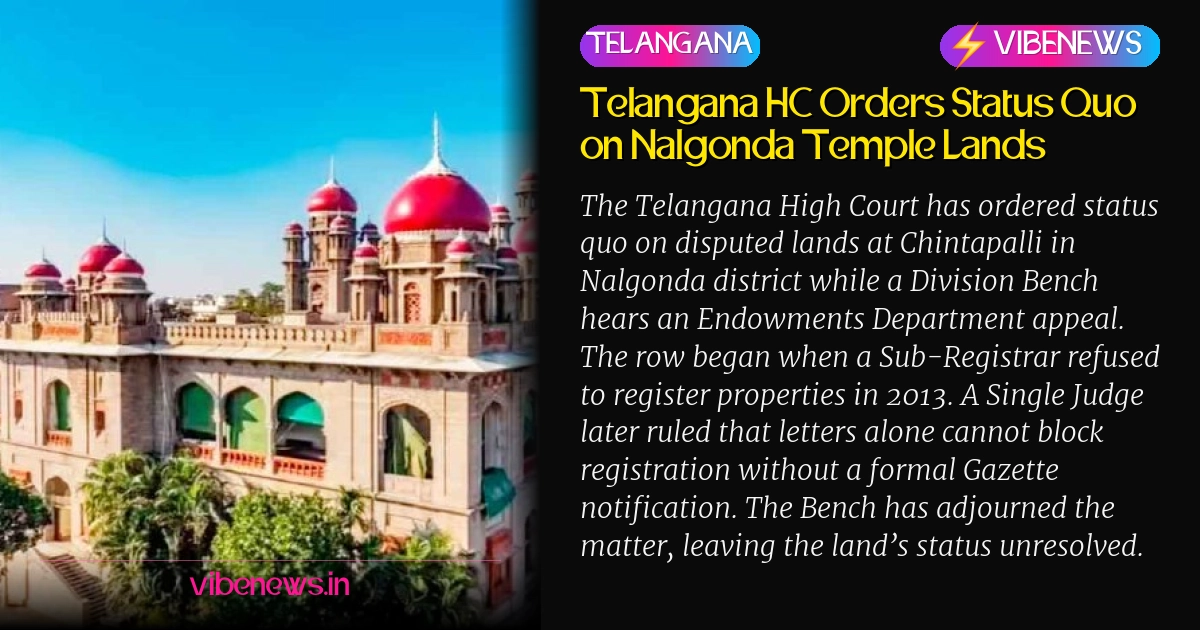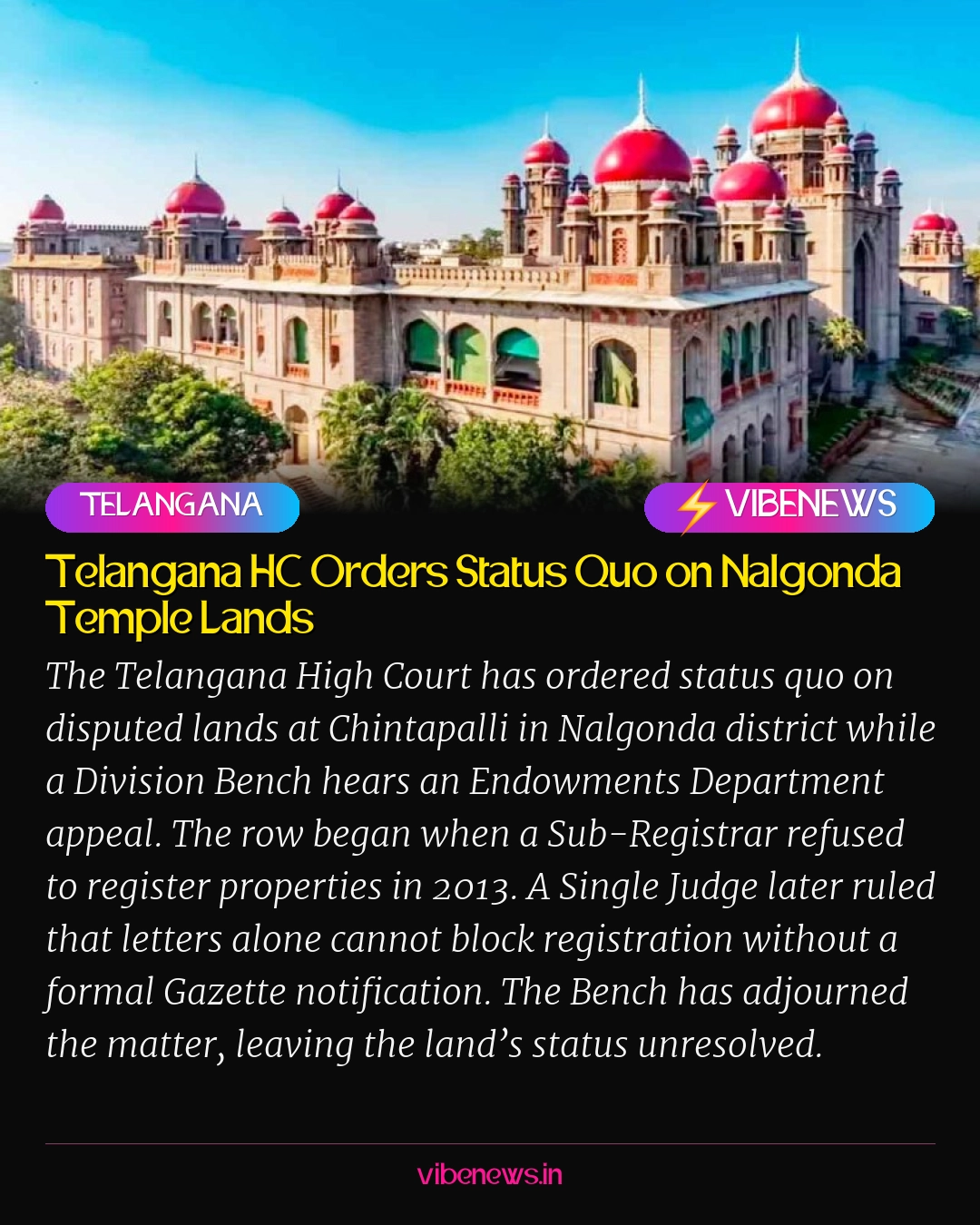
The Telangana High Court on Tuesday ordered status quo on disputed lands at Chintapalli village in Nalgonda district, freezing the situation on property that the Endowments Department says belongs to a temple. A Division Bench comprising Acting Chief Justice Sam Koshy and Justice Suddala Chalapathi Rao passed the order while hearing an appeal filed by the department.
The appeal targets a Single Judge’s earlier directions. Those directions told registration authorities to register sale deeds in favour of the petitioners. The Bench did not decide the appeal on Tuesday. It directed the parties to maintain status quo on the disputed lands and adjourned the matter for further hearing.
How the registration fight started
The petitioners are Nirmala and others, residents of Saroornagar in Hyderabad. They approached the High Court after the Sub-Registrar refused to register their properties situated at Chintapalli. Those refusals were not a single decision. The Sub-Registrar passed four rejection orders on March 28, 2013. The District Registrar later passed consequential orders on May 29, 2015, rejecting the appeals filed against them.
That is more than a decade of paperwork standing between the buyers and their property. For the families involved, the dispute has not been a quick administrative hiccup. It has been a long chain of rejected applications, appeals and court filings.
What the Single Judge found
The Single Judge sided with the petitioners on a central legal question. The court held that registration authorities could not refuse registration just because the Endowments Department had sent letters or information claiming the properties belonged to a temple. That point mattered because, according to the court’s observation, there was no formal Gazette notification as required under law.
The Single Judge also noted a clear split in the paperwork. Certain records of the Endowments Department claimed that the lands belonged to Gattupati Venkateswara Swamy Temple. The revenue records, however, indicated otherwise. Two government record sets pointed in different directions, and the registration office had to choose between them.
The court’s reasoning rested on that gap. In its view, the letters and claims from one department could not override the legal requirements for registration. The Court set aside the four rejection orders from 2013, along with the District Registrar’s 2015 orders. It directed the authorities to register the sale deeds, subject to the petitioners meeting other statutory requirements.
registration authorities could not refuse registration merely on the basis of letters or information furnished by the Endowments Department claiming the properties to belong to a temple, in the absence of a formal Gazette notification as required under law.
The temple claim and the missing notification
The core of this case is a simple question with complicated consequences. Who actually owns the land, and what proof is enough to stop a sale from being registered? The Endowments Department says the land belongs to a temple. The revenue records say otherwise. The Single Judge said a temple claim, without a formal Gazette notification, was not enough on its own to block registration.
That leaves the mystery at the centre of the story unresolved. The public record available so far shows competing claims, long-standing rejections and a court that has now frozen the land while the question is argued again before a higher bench. Nothing in the court’s order so far settles who owns the disputed land.
Why the status quo order matters right now
A status quo order is a pause button. It means neither side can change the position of the disputed lands while the appeal is pending. For the petitioners, that means the registrations they have been seeking since 2013 remain on hold for now, even after a Single Judge had directed that they go through. For the Endowments Department, it means its challenge to that direction is now before the Division Bench, and the land stays as it is until the court says otherwise.
The order is also a signal about how seriously the Bench views the dispute. A higher court does not usually freeze property unless it sees enough at stake to warrant caution while the arguments are heard in full.
A Nalgonda dispute with a Telangana paper trail
The land at the centre of this case sits in Nalgonda district, and the offices involved are all part of the state’s administrative machinery. The Sub-Registrar and District Registrar handle registration, while the Endowments Department oversees temple-linked property claims. That means a dispute over one village plot has pulled together state-level record-keeping, temple land claims and the courts in Hyderabad.
For residents of Nalgonda and nearby areas who own or are buying land, the case is a reminder of how much weight a single government record can carry. A temple claim, a revenue entry and a Gazette notification can decide whether a deed gets registered at all. The Bench’s final view on that question will matter well beyond the petitioners in this case.
What happens next
The matter now returns to the Division Bench for further hearing. The available report does not give a fresh hearing date, so the timeline for the final ruling remains open. Until then, the disputed lands at Chintapalli stay frozen, the rejection orders from 2013 and 2015 are under appeal in a different form, and the petitioners wait for a decision that could finally settle whether their sale deeds can go through.
TL;DR
- The Telangana High Court ordered status quo on disputed lands at Chintapalli village in Nalgonda district on Tuesday.
- A Division Bench is hearing an appeal filed by the Endowments Department against a Single Judge’s directions.
- The Single Judge had ordered sale deeds registered in favour of petitioners Nirmala and others from Saroornagar.
- Sub-Registrar rejection orders dating to March 28, 2013 were set aside by the Single Judge.
- The Endowments Department claims the land belongs to Gattupati Venkateswara Swamy Temple, but revenue records say otherwise.
- The Bench adjourned the matter for further hearing, and the disputed land remains frozen until then.