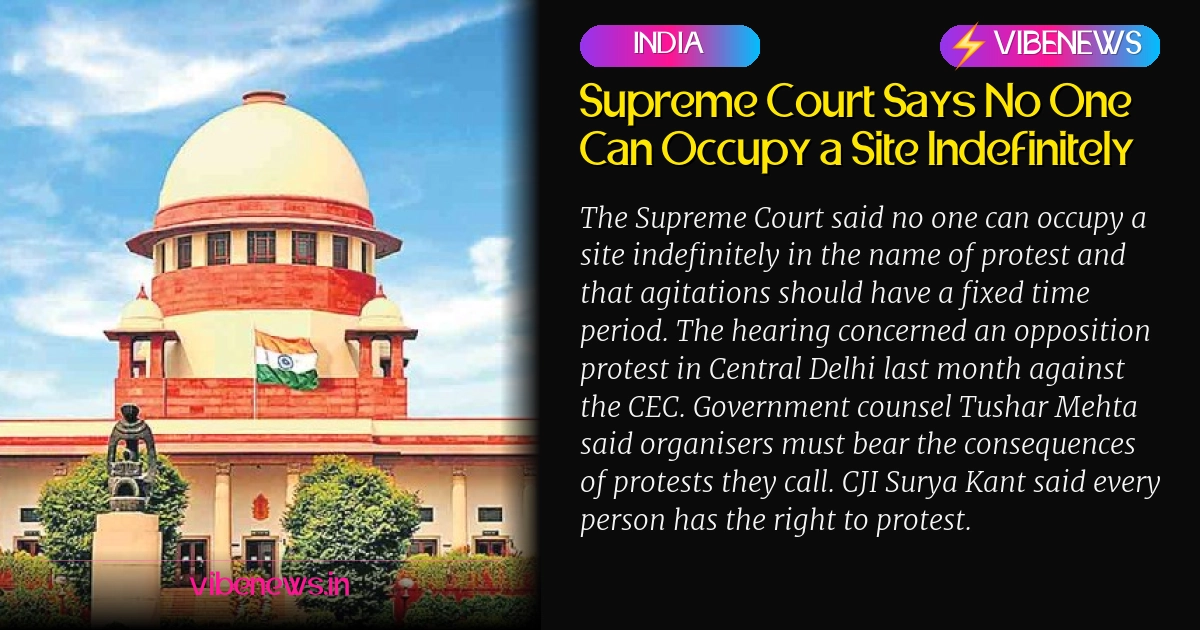
The Supreme Court said on Tuesday that no one can occupy a public site indefinitely in the name of protest, and that agitations at such locations should have a defined time period.
The remarks came during arguments before the apex court about a large opposition protest held in Central Delhi last month against the Chief Election Commissioner (CEC). The court heard submissions on the demonstration on November 3, 2026, and the observations were reported the same afternoon.
Government counsel Tushar Mehta told the court that whoever calls for a protest must face the consequences of that call. His position placed responsibility on the organisers rather than on the wider public or on the space itself.
The bench responded by drawing a firm line on occupation. A site, the court observed, cannot be held forever by any group. Protests, it said, cannot be treated as open-ended claims on public ground.
Chief Justice of India Surya Kant then struck a different note, pointing to the wider population that uses the same spaces to express dissent. Other people also want to protest there, he said, and asked where farmers and lawyers would go if a site stayed locked up by one group.
Every person has the right to protest.
That sentence set the tone of the exchange. The court was not saying that protest is suspect. It was saying that the right to protest belongs to everyone, and that one group holding one spot for an unlimited period can shut out everyone else.
Where the protest right sits in the Constitution
Freedom of assembly is protected under Article 19(1)(b) of the Indian Constitution, which guarantees citizens the right to assemble peacefully and without arms. The same Article, under clause 19(3), allows the state to impose reasonable restrictions in the interest of public order, among other grounds. The tension in Tuesday’s arguments sits right at that junction: the right to gather is broad, but it is not unlimited, and the question of how long a gathering can last in a shared public space is where courts are often asked to draw lines.
The phrase the court used, that agitations need a defined time period, points toward a practical test rather than a ban. It asks whether a protest remains a protest when it becomes a semi-permanent occupation that blocks others from using the same ground.
Why the Delhi protest is in the frame
The arguments were tied to the opposition’s demonstration in Central Delhi last month. That protest was aimed at the Chief Election Commissioner, and it was large enough to draw the legal scrutiny that reached the Supreme Court. The case, as reported, was about how the state and the courts should respond when a political demonstration in the capital raises questions about access, duration and responsibility.
Mehta’s argument placed the burden on those who issue the call to protest. If a rally is called, the people calling it answer for what follows from it. The court did not, in the reporting available, accept or reject that position outright. It instead highlighted the rights of other citizens who might need the same space.
What the court did not say
The reports available do not describe a formal final order, a set number of days after which a protest must end, or any directions to police or local authorities. The statements came during oral arguments, and readers should treat them as the court’s observations on the issue rather than a settled rule with fixed penalties.
That distinction matters. Observations from the bench often signal where judges are leaning and which principles they want to protect. They do not always translate into binding directions until a written order is issued.
What it means for public order and the right to dissent
For everyday citizens, the core message is simple. Protest is protected, but it is meant to be temporary and shared. A dharna that sits on a road or a plot of land for weeks changes who can use that space, and the court’s remarks suggest that this shift is what it is concerned about.
For governance, the question is how the state can enforce time limits without appearing to shut down dissent. Any future rule would have to balance policing needs with the constitutional guarantee of peaceful assembly. Farmers and lawyers, the groups the Chief Justice named, often rely on public spaces to make their case, which is why the court is treating the issue as one that affects many communities, not one political party alone.
The hearing also shows how quickly a single protest can become a constitutional question. A rally in the capital can move from the street to the courtroom, and the terms the court uses now, such as defined time periods and shared access, may shape how future demonstrations are handled.
For now, the Supreme Court has put the principle on the record. Protest is a right for every person. But no group can claim a site without end, and the people who call for a protest will be expected to answer for the consequences of it.
TL;DR
- The Supreme Court said no one can occupy a site indefinitely in the name of protest.
- Agitations at public sites should have a defined time period, the court observed.
- The arguments concerned an opposition protest in Central Delhi last month against the CEC.
- Government counsel Tushar Mehta said those who call a protest must face its consequences.
- CJI Surya Kant said every person has the right to protest and asked where farmers and lawyers would go.