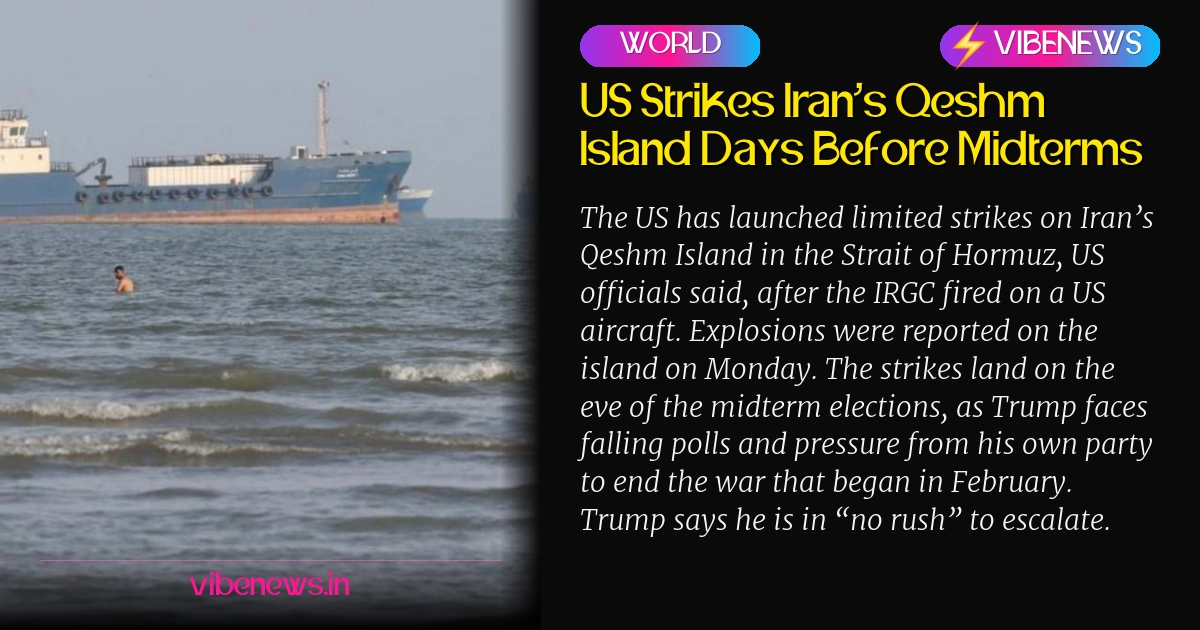
The United States has launched limited strikes on Iran’s Qeshm Island in the Strait of Hormuz, US officials told reporters, in response to Iran’s Islamic Revolutionary Guard Corps firing upon a US aircraft. Iranian state media reported several explosions on the island on Monday. The strikes arrived on the eve of the US midterm elections, a vote that will decide whether Republicans or Democrats control Congress.
US Central Command, the part of the US military responsible for operations in the Middle East, was contacted for comment on the strikes.
Limited strikes, a clear trigger
US officials describe the attack on Qeshm as limited. They framed it as a direct answer to the IRGC opening fire on an American aircraft, not as the start of a broader campaign. That distinction matters. Limited retaliation is a very different political and military act from a return to the sustained bombing that defined the early months of the conflict.
Iranian state media confirmed that explosions were heard on the island. The reporting available so far does not give a full damage assessment, and it does not say how many people were hurt. What is clear is that the Strait of Hormuz, one of the most sensitive shipping lanes in the world, is now the scene of active US military action.
A war that began in February
The strikes are part of a conflict that started when the United States and Israel attacked Iran in February. Since then, the fighting has become the central issue of a US political season that is already tense. Every new strike is now measured against the question voters will answer at the ballot box this week.
That is the context that makes Monday’s action so charged. A military move that might look routine in another year is landing in the middle of a national election campaign, with the war itself a major point of debate.
Midterms, falling polls and a party under pressure
Donald Trump has been facing falling polling numbers. He is also dealing with pressure from inside his own party to bring the war to an end. Those two forces help explain the timing. A president under pressure at home has every reason to project control abroad, but also every reason to avoid a widening conflict that could make a bad election night worse.
The midterms will determine who controls Congress, and the outcome will shape what any future president can do on Iran. For a White House that has been pushed to end the fighting, the Qeshm strikes present a difficult balance: show force in response to an attack, while signalling that the wider war is not about to restart.
“No rush” and a nuclear site on the list
Earlier on Monday, Trump told reporters he was in “no rush” to ramp up strikes on Iran. In remarks to Axios, he went further, saying the United States would act one way or the other, but without hurry. “One way or the other, we will do something, but there is no rush. We crippled them financially,” he said. “They have no money, no gasoline and their people are getting very tired of it.”
In an interview with Fox News on the eve of the midterms, Trump also said the US “might need to go after Pickaxe.” Pickaxe is described in the reporting as a site linked to Iran’s nuclear programme. Trump described such an operation as “not a big deal” and said it could be done in “one hour.”
That combination is what makes the moment dangerous. A leader who calls a nuclear-linked target a quick job, while saying there is no rush, is leaving both options on the table. Markets, allies and Tehran will all be reading those words closely.
There has also been mounting speculation in recent days that the US could resume significant strikes on Iran after the midterms. Asked directly on Monday whether that was the plan, Trump said “no.” The answer does not close the question entirely, but it does lower the immediate temperature in Washington.
Tehran says talks are intensive
Iran’s foreign minister, Abbas Araghchi, told IRNA that “very intensive” talks to end the war are under way with the United States through mediators. He said Tehran was prepared for both diplomatic and military scenarios “more than ever before.” He also set out the choice in stark terms, saying it was up to the US to pick between a “wise path” of negotiation and the “mistake of military aggression.”
Those comments show two tracks running at once. Diplomacy is active behind the scenes, while both sides are signalling readiness for force. The mediators involved, and what they can deliver, will be central to whether the next few weeks bring a settlement or another round of strikes.
What the timing means for security and markets
The immediate impact is on regional security. A strike on an island in the Strait of Hormuz touches one of the key arteries of global energy, and any hint of escalation in that waterway tends to ripple outward quickly. Governments and militaries in the region will be watching whether this stays a limited exchange or becomes the start of a wider confrontation.
The market question is the obvious next step. Oil prices and investor nerves are closely tied to developments around the Strait of Hormuz. The reporting available here does not include market figures, so the scale of any reaction remains unclear. But the combination of an active strike, an election on the calendar, and open talk of nuclear-linked targets is the kind of mix that moves traders.
For readers, the central fact is simple. The United States has struck Iran, the war that began in February is not over, and the most consequential decisions may come in the days right after the midterm votes are counted. Whether Monday’s strikes mark a pause, a warning or the first move in a larger round will depend on what Washington does next, and on whether the talks Tehran describes as intensive can produce a result before the shooting starts again.
TL;DR
- US officials say strikes on Qeshm Island were limited, a direct response to the IRGC firing on a US aircraft.
- Iranian state media reported several explosions on the island in the Strait of Hormuz on Monday.
- The strikes come on the eve of US midterm elections that will decide control of Congress.
- Trump faces falling polling numbers and pressure within his party to end the war that began in February.
- Trump said he was in “no rush” to ramp up strikes and that the US “might need to go after Pickaxe.”
- Iran’s foreign minister says “very intensive” talks with the US, through mediators, are under way.