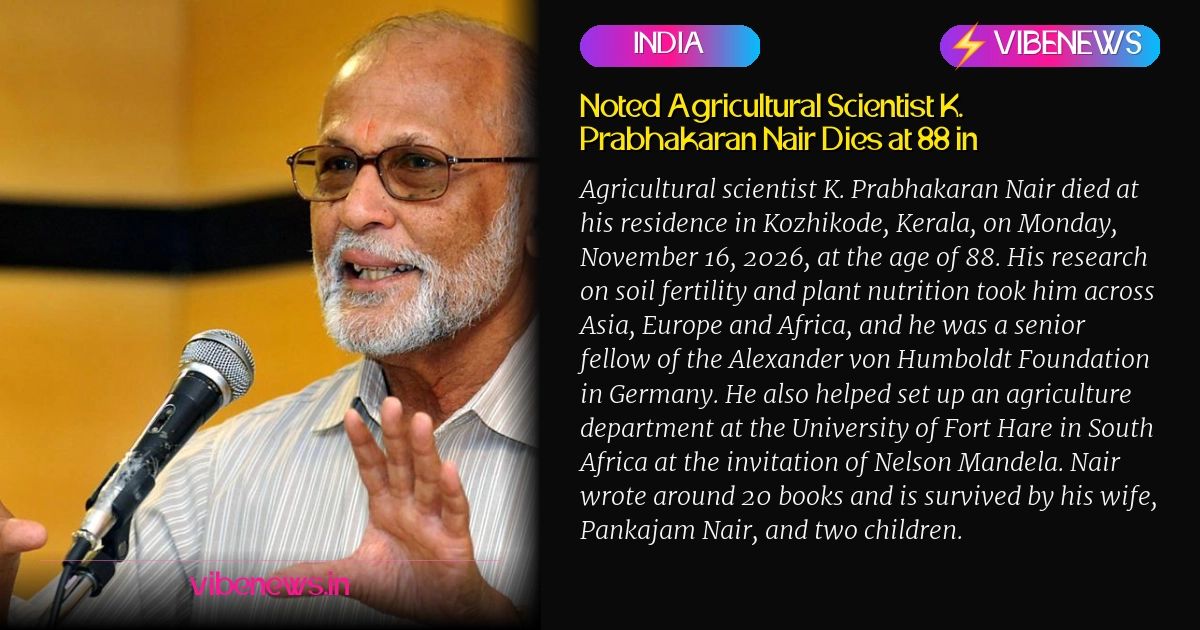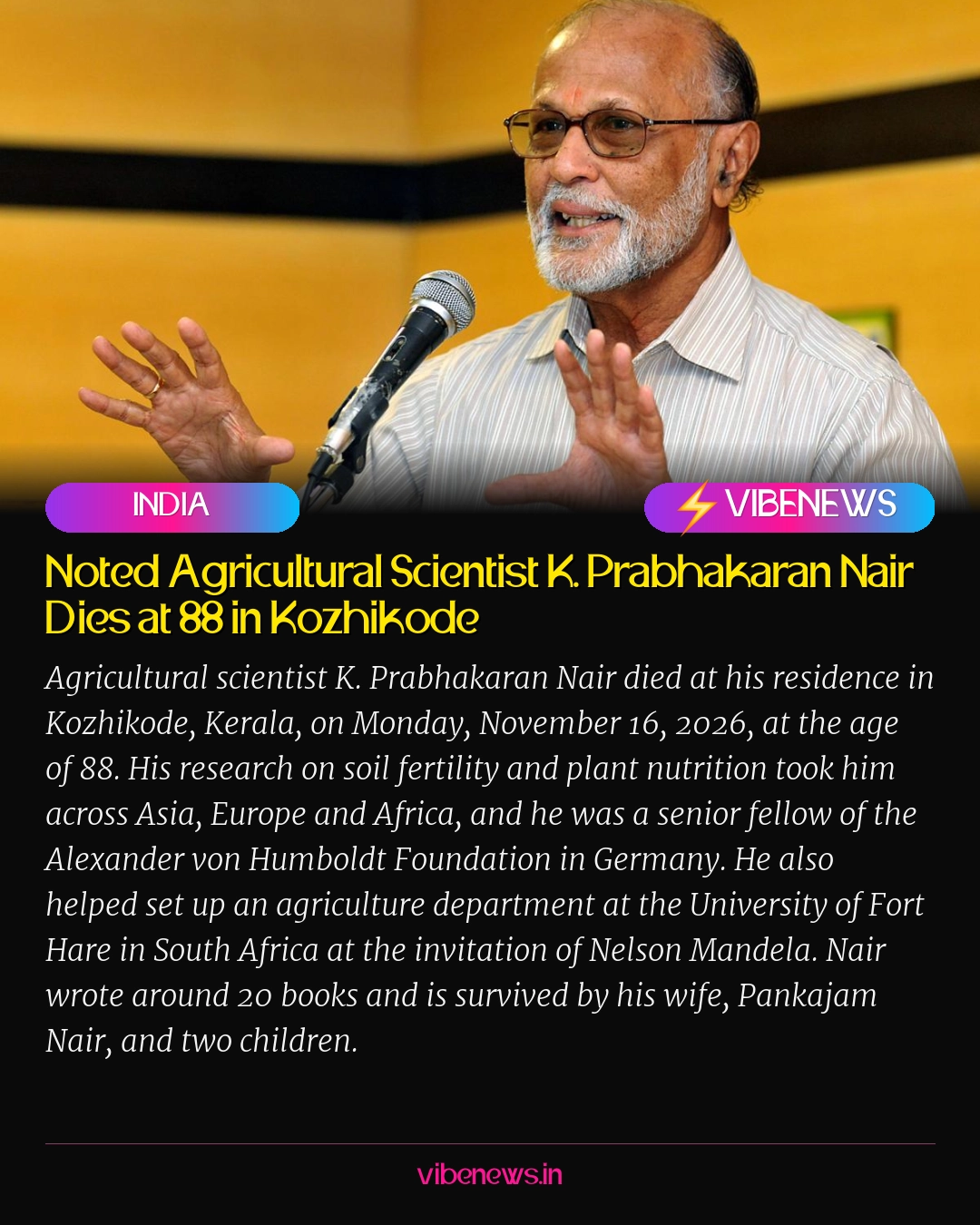
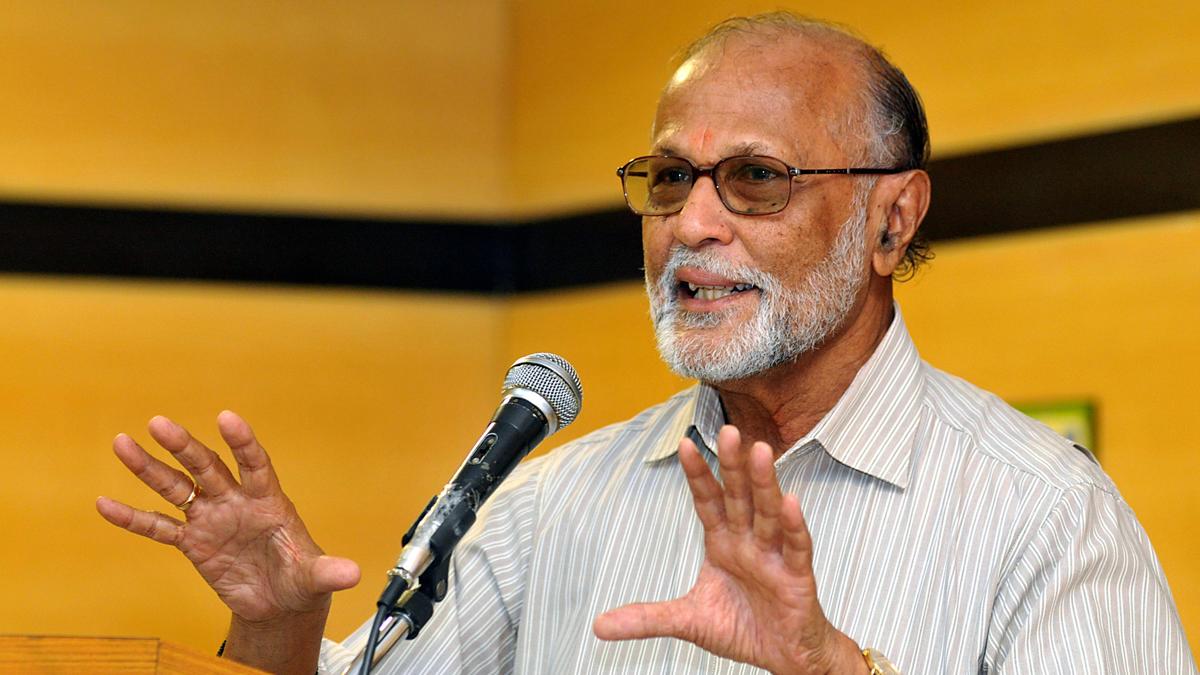
K. Prabhakaran Nair, a widely respected agricultural scientist whose work on soil and plant nutrition spanned three continents, died at his residence in Kozhikode, Kerala, on Monday, November 16, 2026. He was 88. His death closes a long career that shaped how researchers think about sustainable farming and the health of the ground beneath it.
He is survived by his wife, Pankajam Nair, and two children. Friends and colleagues across the research community now face the loss of a scientist who kept working in the field for decades, long after many of his peers had moved on to administrative roles.
Nair began his path in international research with a post-doctoral fellowship in Belgium. Before that, he earned his PhD in agronomy from the Indian Agricultural Research Institute in New Delhi in 1965. His doctoral work focused on soil fertility and plant nutrition, two areas that remain at the heart of food production. Farmers depend on them every season, even when they rarely think about the science behind them.
His contributions covered sustainable agriculture, soil science and agronomy. He spent decades conducting research in the field, not only in laboratories. That practical grounding showed in his work, which connected the chemistry of soil with the real-world question of how crops get what they need to grow.
Nair travelled widely in the course of his professional life. His assignments and research took him to other Asian countries, as well as Europe and Africa. He was also a senior fellow of the prestigious Alexander von Humboldt Foundation in Germany, a recognition that reflected the respect he earned among scientists far from home.
Africa became a especially important chapter. Nair served as a professor at the University of Fort Hare in South Africa, the alma mater of President Nelson Mandela. It was Mandela who invited him to the country to set up a Department of Agriculture at the university.
It was Mr. Mandela who invited him to the country to set up a Department of Agriculture at the university.
One of Nair’s most cited ideas came from a research paper he presented at an international colloquium in France. In it, he described the concept of nutrient buffer power, which explains the principles governing how nutrients become available in soil. Put simply, it looks at how soil holds on to and releases the minerals plants need. The idea gave researchers a clearer way to think about soil fertility, and it earned him recognition at the highest level of Belgian science. In 1984, he was appointed to the National Chair of the Science Foundation at The Royal Society of Belgium.
Nair was also a prolific writer. He authored around 20 books and regularly contributed to newspapers and magazines, which meant his ideas reached readers well beyond academic circles. Those writings made complex soil science accessible to people who worked the land or made decisions about it.
His voice carried into global policy debates as well. Antonio Guterres, United Nations Secretary-General, launched his book on global warming in New York. That moment showed how far his work on the relationship between farming, soil and the environment had travelled, from a village in Kerala to the halls of the United Nations.
Nair’s career moved between continents, classrooms, research fields and the printed page. Those who knew his work will remember a scientist who treated soil as serious science and who wrote about it so others could understand. His family and former students now carry that loss, and the field he helped build will carry his work forward.
TL;DR
- K. Prabhakaran Nair, a noted agricultural scientist, died at his Kozhikode residence on Monday, November 16, 2026, aged 88.
- He earned his PhD in agronomy in 1965 from the Indian Agricultural Research Institute in New Delhi.
- Nair specialised in soil fertility and plant nutrition, and spent decades researching sustainable agriculture.
- Nelson Mandela invited him to South Africa to set up a Department of Agriculture at the University of Fort Hare.
- In 1984, he was appointed to the National Chair of the Science Foundation at The Royal Society of Belgium.
- He authored around 20 books and is survived by his wife, Pankajam Nair, and two children.