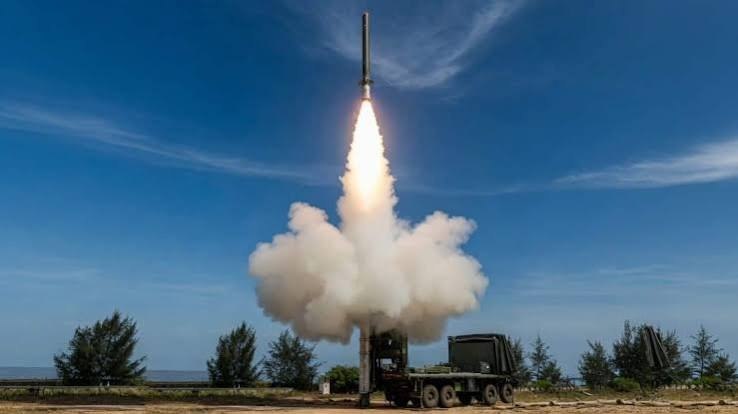
India's Defence Research and Development Organisation (DRDO) has successfully conducted the first test of its indigenous Long Range Land Attack Cruise Missile (LRLACM) off the Odisha coast, a development poised to significantly bolster the nation's strategic strike capabilities. This new weapon system, already being dubbed India's equivalent to the formidable US Tomahawk missile, boasts an estimated range of 1,000 to 1,500 kilometers. Such a reach means that, if strategically deployed in forward areas, the LRLACM could bring numerous critical military, economic, and political centers across Pakistan and China within India's striking distance, fundamentally altering regional power dynamics.
The Defence Ministry confirmed that the recent test met all operational and technical objectives, signaling a major leap forward for India's indigenous defense program. While the government has remained tight-lipped about the missile's full specifications, its potential to serve as a long-range stand-off weapon is clear. Stand-off weapons, which allow forces to engage targets from a safe distance without entering heavily defended airspace, have proven their critical importance in recent global conflicts, including the Russia-Ukraine war and the Iran conflict.
Unlike ballistic missiles, which arc high into space before descending steeply onto their targets, cruise missiles like the LRLACM fly at extremely low altitudes. This terrain-hugging flight path makes them exceptionally difficult for enemy radar and air defense systems to detect and intercept. This characteristic is a key reason why the US Tomahawk has been a cornerstone of American long-range strike capabilities since its induction in 1983, featuring in every US conflict since 1991.
The LRLACM is entirely indigenous, with its missile and subsystems developed by various DRDO laboratories in collaboration with Indian industry partners. The Aeronautical Development Establishment (ADE) in Bengaluru served as the nodal laboratory for this ambitious project. This focus on self-reliance is crucial for India's strategic autonomy and reduces dependence on foreign suppliers for critical defense technologies.
This new missile is believed to be an upgraded successor to the Nirbhay missile program, which faced several test failures since 2016. The LRLACM's successful test indicates that lessons have been learned and significant advancements made. Its versatility is another defining feature; the missile can be launched from multiple platforms, including ground launchers, warships, and submarines, providing strategic flexibility. Crucially, it can be armed with either conventional or nuclear warheads, adding a layer of deterrence to India's defense posture.
The strategic implications of the LRLACM's extended range are profound. On India's western front, the missile could potentially cover large swathes of Pakistan. This includes major cities like Islamabad, the capital; Rawalpindi, home to Pakistan's military headquarters; Lahore; Faisalabad; and Karachi, the nation's largest economic hub and a key naval facility. This capability would provide India with significant leverage in any future conflict scenario.
Similarly, if deployed along the northern or eastern sectors near the Line of Actual Control (LAC), the LRLACM could bring several strategic locations in China's western and central regions within striking distance. Cities such as Lhasa, which houses important Chinese military infrastructure; Chengdu, a major military hub; Urumqi, a strategically vital city in Xinjiang; and Kunming could all fall within its potential range. This capability would significantly enhance India's deterrence against potential aggression from its northern neighbor.
The US Tomahawk, often cited as the benchmark for such weapons, has various versions with ranges between 1,250 and 2,500 km, flying at high subsonic speeds of around 880 kmph. Its latest iteration, the Block IV Tactical Tomahawk, can even switch targets mid-flight and loiter for hours, changing direction instantly on command. While the LRLACM's exact capabilities are still under wraps, its comparison to the Tomahawk underscores its potential for precision and strategic impact.
However, the formal induction of the LRLACM into the armed forces is still approximately two years away, with more trials slated to be conducted. This period will be crucial for refining the missile's systems and ensuring its readiness for operational deployment. Once inducted, this indigenous long-range cruise missile will undoubtedly be a game-changer, providing India with a robust and flexible long-range strike capability that significantly enhances its strategic advantage and strengthens its position in the complex geopolitical landscape of the region.
TL;DR
- India's Defence Research and Development Organisation (DRDO) has successfully tested its indigenous Long Range Land Attack Cruise Missile (LRLACM).
- The LRLACM is being dubbed India's equivalent to the US Tomahawk missile, highlighting its advanced capabilities.
- It boasts an estimated range of 1,000 to 1,500 kilometers, potentially bringing key military and economic centers in Pakistan and China within striking distance.
- The missile's low-altitude flight path makes it difficult for enemy radar and air defense systems to detect and intercept.
- It is fully indigenous, developed by DRDO labs and industry partners, and can be launched from ground, naval, and submarine platforms.
- The LRLACM can carry conventional or nuclear warheads, significantly boosting India's long-range strike capabilities and strategic deterrence.
- Formal induction into the armed forces is anticipated within two years, following further trials and refinements.