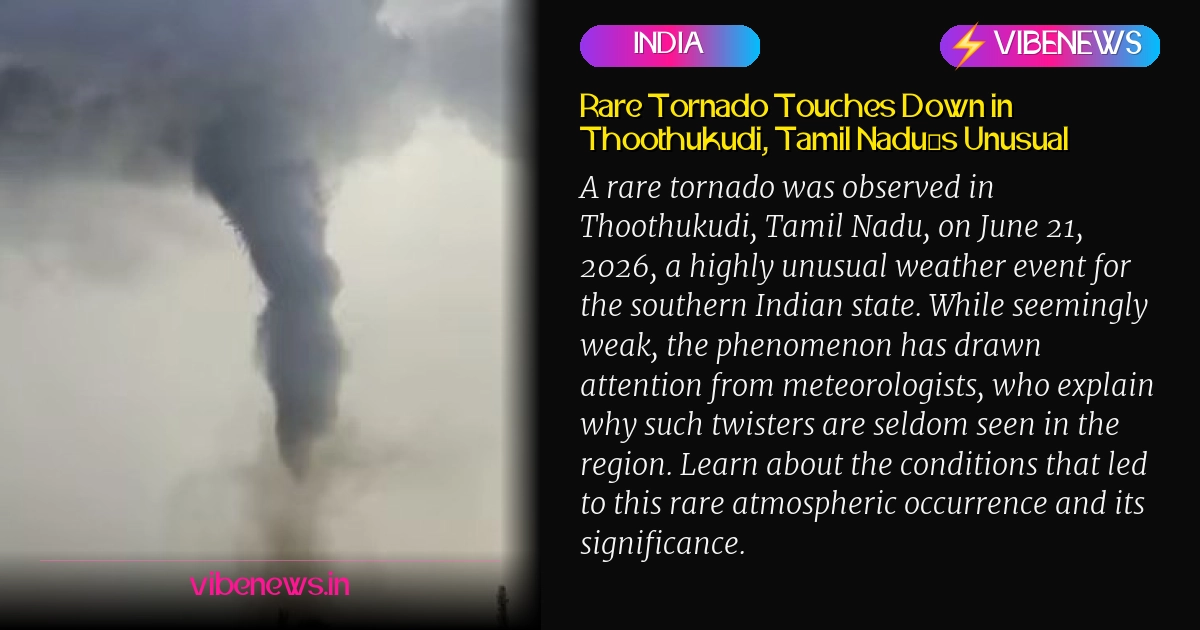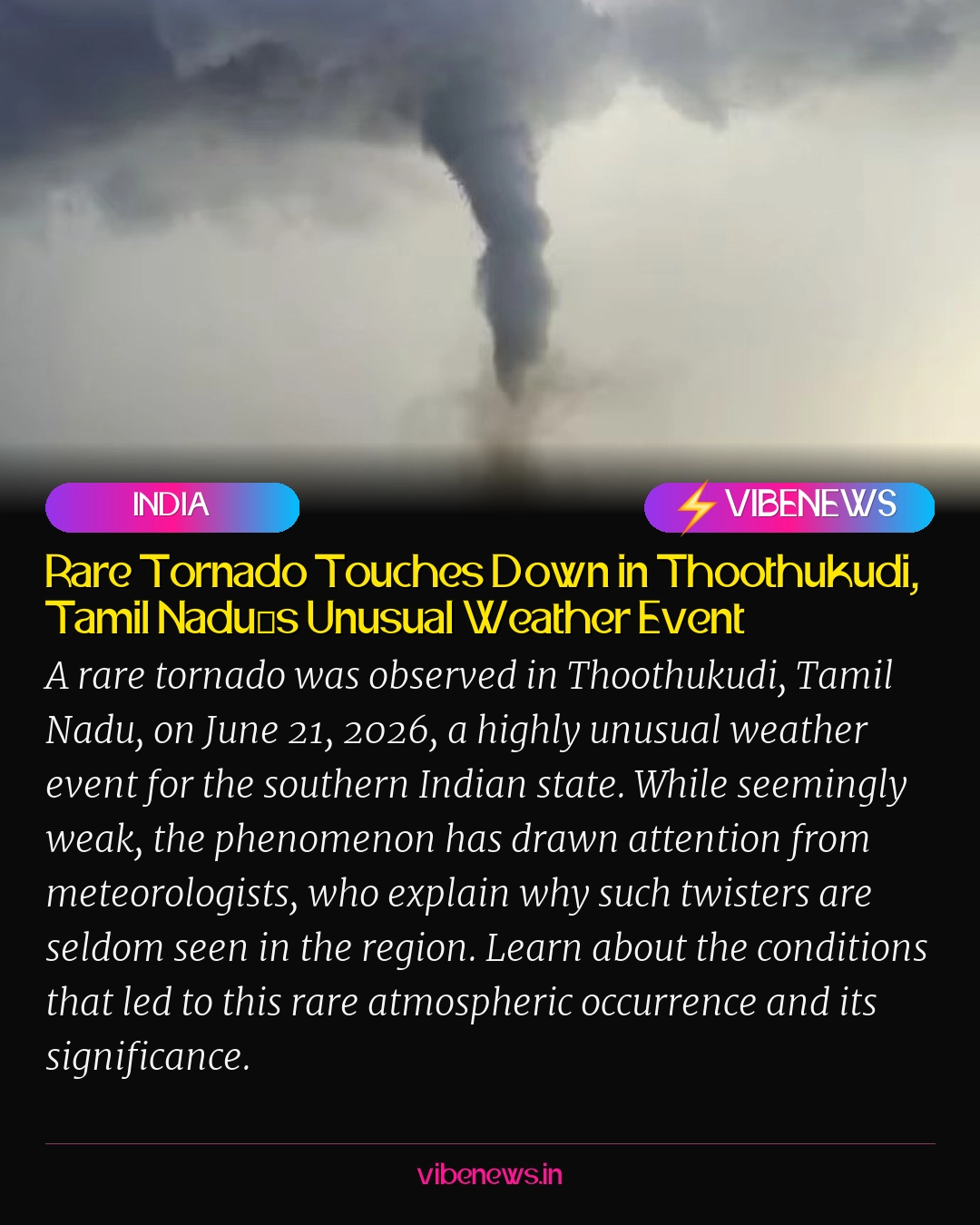

The southern Indian state of Tamil Nadu witnessed an exceptionally rare weather phenomenon on June 21, 2026, when a tornado touched down in Thoothukudi. This event, captured in videos and verified by meteorologists, marks a significant departure from typical weather patterns in a region where such powerful rotating storms are almost never observed. The funnel cloud, though described as narrow and weak, made clear contact with the ground, stirring up dust and briefly becoming a genuine tornado.
Meteorologist Navdeep Dahiya and local weather watchers, including the popular Tamil Nadu Weatherman, shared and confirmed visuals of the twister. While no major damage has been reported from the brief touchdown, experts emphasize that even a feeble tornado demands respect and scientific attention due to its unusual occurrence. This incident provides a unique opportunity to study atmospheric conditions in a region not typically associated with these violent storms.
A tornado is fundamentally a violently spinning column of air that extends from a thundercloud down to the ground. Its visible form comes from moisture within the funnel cooling into droplets, combined with dust and debris whirled up from its base. For a tornado to form, three specific atmospheric ingredients are crucial. First, an abundance of warm, moist air is necessary, a condition often met by the Bay of Bengal during monsoon seasons. Second, a powerful updraught, which is a strong rising current of air, must be present to fuel the storm. Finally, a degree of spin near the Earth’s surface is required, which the updraught then stretches vertically, much like a figure skater pulling in their arms to increase rotation speed.
Forecasters suspect the Thoothukudi event was a "landspout," a type of tornado that typically forms from ground-level rotation rather than from a pre-existing large rotating storm system. Landspouts are generally milder than their supercell-spawned counterparts but are still classified as true tornadoes. Their formation mechanism, while distinct, still relies on the fundamental principles of atmospheric instability and rotation.
Tornadoes are exceedingly uncommon in Tamil Nadu and most of southern India. The majority of Indian tornadoes typically strike the eastern parts of the country, particularly across West Bengal and Odisha, during the intense pre-monsoon storms that occur from March to May. Approximately 72 percent of India’s recorded tornadoes are concentrated in the northeastern regions. Tamil Nadu’s monsoon clouds, while bringing significant rainfall, rarely organize in the specific way that generates the powerful, rotating updraughts characteristic of tornado-producing storms, such as those famously seen in America’s Tornado Alley. This makes the Thoothukudi tornado a truly exceptional event, with only a handful ever documented in the state’s history.
The rarity of this event underscores the complex interplay of atmospheric conditions required for tornado genesis. While the Bay of Bengal provides ample warm, moist air, the specific shear and instability needed for sustained rotation are usually absent in southern India. Scientists will likely analyze this event to understand any localized factors or unusual atmospheric dynamics that contributed to its formation. The observation serves as a reminder that while rare, such powerful weather phenomena can occur even in regions where they are least expected, prompting continuous vigilance and meteorological study. This incident highlights the dynamic nature of India’s diverse weather systems and the ongoing need for advanced forecasting capabilities across all regions.
TL;DR
- A rare tornado touched down in Thoothukudi, Tamil Nadu, on June 21, 2026, an extremely unusual weather event for the region.
- Videos confirmed a classic funnel cloud making ground contact, though it appeared narrow and weak with no major damage reported.
- Tornadoes are violently spinning columns of air connecting a thundercloud to the ground, made visible by moisture and debris.
- Their formation requires warm, damp air, a powerful updraught, and surface-level spin.
- This Thoothukudi event is suspected to be a "landspout," a milder type of tornado originating from ground-level rotation.
- Most Indian tornadoes occur in the eastern states like West Bengal and Odisha during the pre-monsoon season, with Tamil Nadu rarely experiencing them.
- The rarity stems from Tamil Nadu’s monsoon clouds typically not organizing in the specific way required for tornado formation.
- Even weak tornadoes are considered significant by forecasters due to their unusual nature in this part of India.