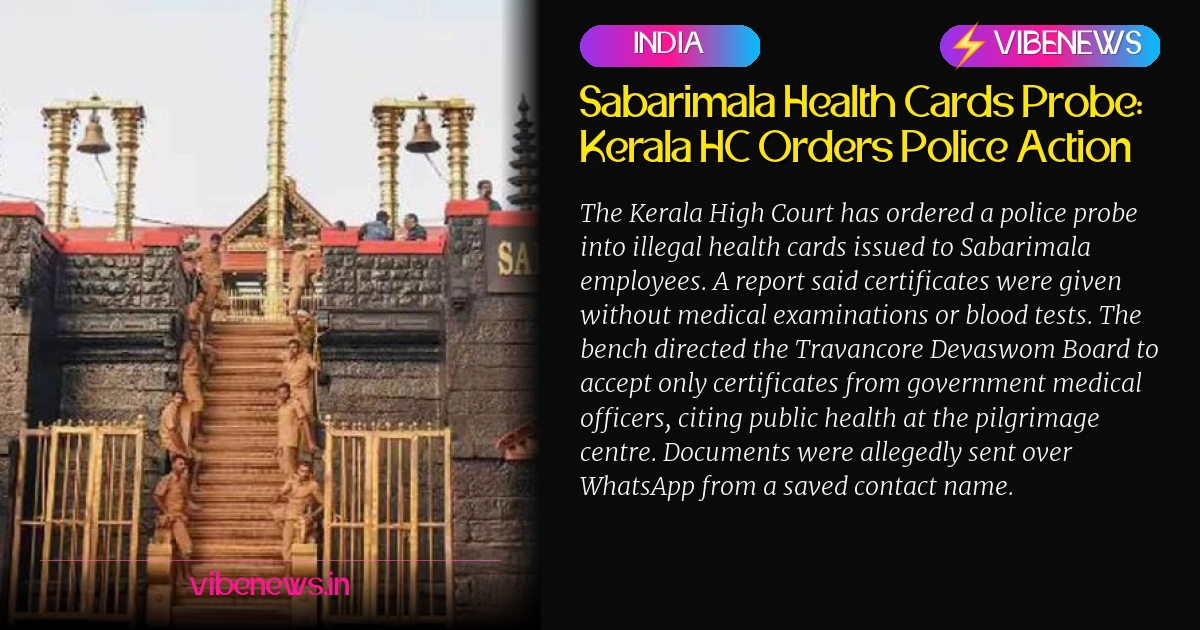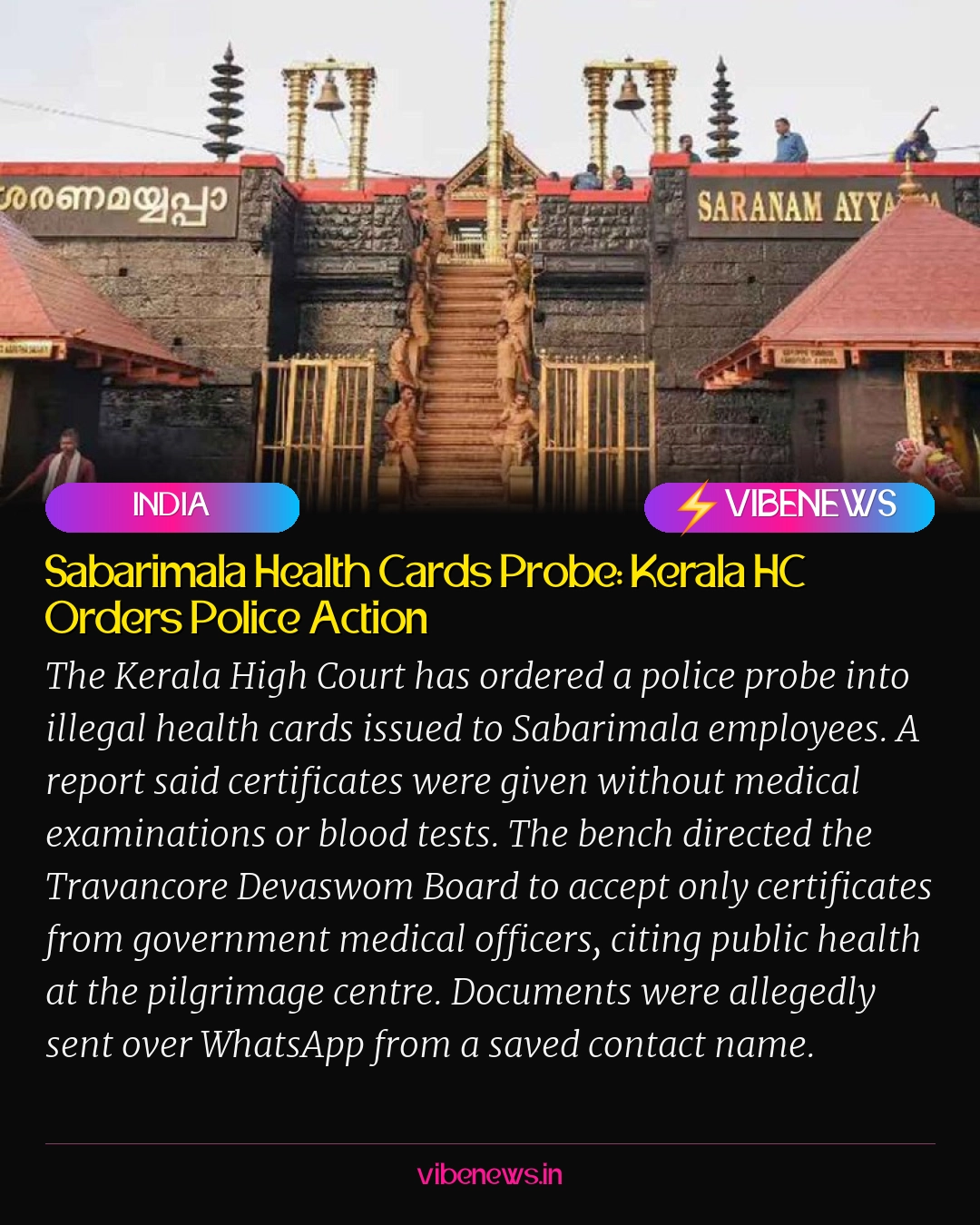

The Kerala High Court has ordered a police complaint into alleged irregularities in health cards issued to employees working at Sabarimala, and it has told the Travancore Devaswom Board to stop accepting certificates from anyone other than government medical officers.
A bench of Justices Raja Vijayaraghavan V and K V Jayakumar directed the Superintendent of Police, Pathanamthitta District, to make sure a complaint lodged by the Health Inspector of Sannidhanam is investigated properly. The court acted on a plea it had initiated itself, based on a report from the Sabarimala Special Commissioner. With those directions in place, the court disposed of the case.
A paper trail that leads nowhere official
The report describes a chain of alerts. The District Medical Officer (Health) in Pathanamthitta received a report from the Health Officer at Sannidhanam about serious irregularities in issuing health cards. Credible information had reached the authorities that cards were issued to certain employees at two establishments at Sannidhanam and to five persons at Nilakkal.
The cards carried a signature that was purportedly that of a medical practitioner. The court noted something that should make every pilgrim uneasy. The documents were circulated through a messaging app, not issued by a clinic or a government office.
“The said documents were forwarded through WhatsApp from a mobile number saved under the name ‘Manju Mahima’,” the court noted.
That detail is the heart of the problem. A health card is supposed to be a verified record. Here, it appears to have been a message on a phone, sent from a contact saved under a name.
No examinations, no blood tests
The report went further than paperwork. It claimed that health certificates were issued without conducting medical examinations or blood tests on the individuals concerned. In other words, the certificate may have certified nothing at all.
Health certificates exist for a reason. They are meant to confirm that a worker is fit to handle food, serve customers, or work in close contact with others. When that check is skipped, the document becomes a formality that protects no one. At a shrine where large numbers of pilgrims gather, that gap is not a small administrative lapse. It is a direct risk to public health and hygiene.
What the court now requires
The bench did not stop at the complaint. It issued directions that will change how employees are cleared to work at Sabarimala.
The Travancore Devaswom Board must ensure that only health certificates issued by government medical officers in Keralam are accepted when engaging employees. The rule applies to employees working under various exclusive arrangements. It also covers shops and other establishments under the Kerala Shops and Commercial Establishments Act, and any place where food safety standards are mandatory.
The Health Department’s inspection teams have also been given a clear job. During routine inspections, they must verify that employees in covered shops and establishments hold health certificates issued in line with the circular of the Director of Health Services. Inspectors cannot simply glance at a card and move on. They have to check that it complies with the circular.
The court told the authorities concerned to take appropriate steps to ensure strict compliance. That is judicial language, but the message is blunt. The earlier system failed, and the court expects it to be fixed.
The accountability question
The court’s language on consequences was careful. If the allegations are substantiated and the involvement of any person is established, appropriate proceedings will be initiated against the persons concerned in accordance with law.
So far, the material before the court does not name anyone publicly as having issued the cards. The only identifier mentioned is the saved contact name ‘Manju Mahima’, which the report links to the forwarding of the documents. Whether the investigation can trace that number to a real person, and whether any signing practitioner was involved, will decide whether this ends as a clean-up order or as genuine accountability.
Pilgrims who travel to Sabarimala assume that the people serving food, handling supplies, and working in shops around the shrine have been medically cleared. This case suggests that assumption was, at least in some cases, built on forged or unverified paperwork. That should trouble the Devaswom Board, the Health Department, and every official who signed off on employee lists without checking the certificates behind them.
Why this matters beyond one complaint
Sabarimala is one of the most visited pilgrimage centres in the state, and the court’s concern is clearly about crowds, shared spaces, and food safety. The order does not just target a few bad certificates. It exposes a system that accepted documents without verifying the process behind them.
The fix the court has ordered is simple in principle. Only government medical officers can issue the certificates that count. Inspectors must check them. Anyone found falsifying them faces proceedings. The harder test will be whether the Board and the Health Department enforce those rules every season, not just in the weeks after a court hearing makes headlines.
TL;DR
- Kerala High Court orders police complaint probe into illegal health cards issued to Sabarimala employees.
- Report says health certificates were issued without medical examinations or blood tests on the individuals.
- Documents were forwarded through WhatsApp from a mobile number saved under the name ‘Manju Mahima’.
- Travancore Devaswom Board must accept only health certificates issued by government medical officers in Keralam.
- Health Department inspection teams will verify employee health certificates during routine inspections.
- Court disposed of the plea but warned of proceedings if the allegations are substantiated.