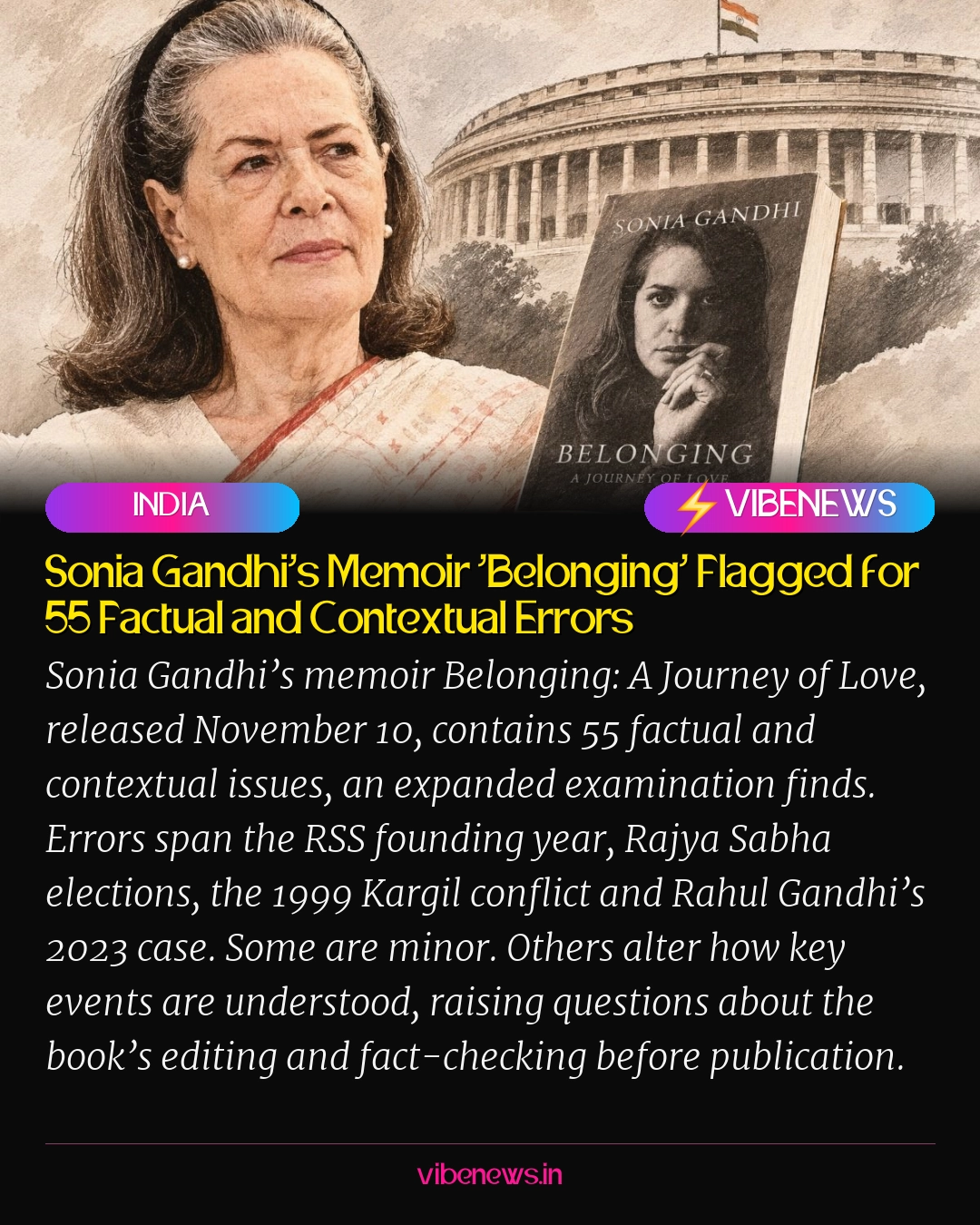
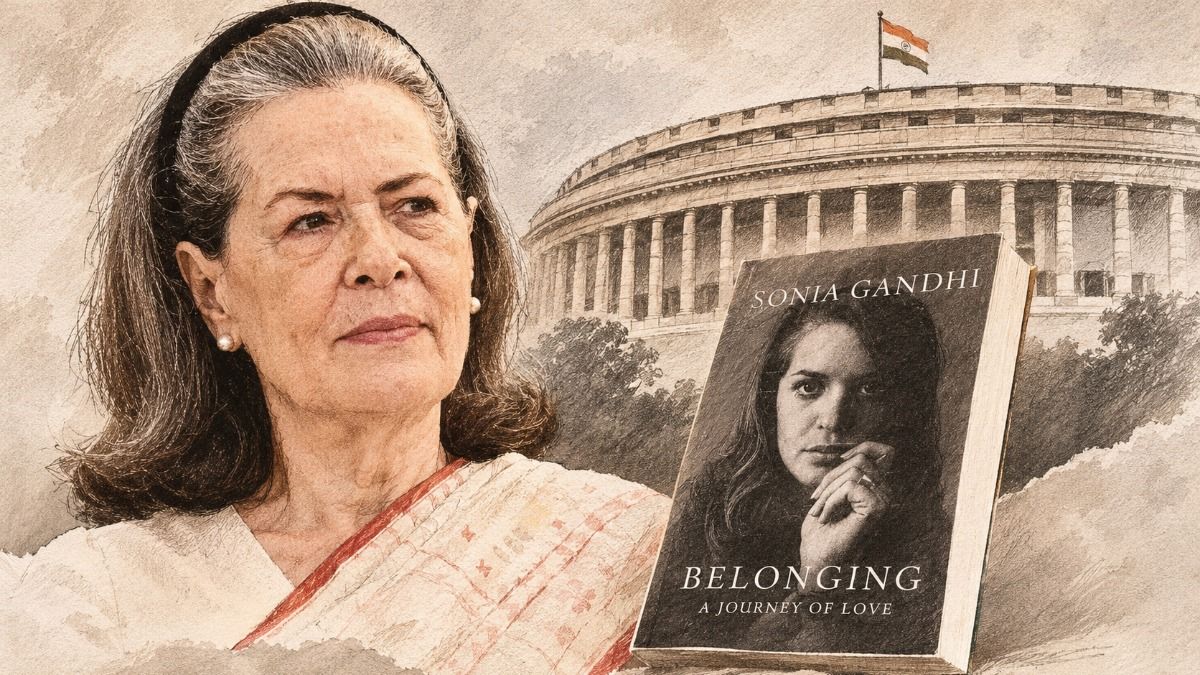
Sonia Gandhi’s memoir, Belonging: A Journey of Love, released on November 10, contains 55 factual and contextual issues, according to an expanded examination of the book. The errors range from simple date mistakes to misstatements that change how major political events are understood.
The memoir offers an intimate account of her move from a small Italian town into India’s most prominent political family. It covers her marriage to Rajiv Gandhi, the assassinations of her mother-in-law and husband, and her rise to one of the country’s most powerful political figures. Her personal recollections are the book’s strongest material. The political and historical framework around them is the problem.
Some of the mistakes are elementary. Gandhi writes that the Rashtriya Swayamsevak Sangh was founded in 1921. It was established by K.B. Hedgewar in Nagpur in 1925. She also places the death of Ahmed Patel, her long-serving political secretary, from Covid-19 in 2022. Patel died on November 25, 2020.
The 2002 Gujarat riots section has its own slips. She calls Ahmedabad the state capital, though Gandhinagar has held that role since 1970. She says four coaches of the Sabarmati Express were set on fire at Godhra. The fatal blaze involved coach S-6.
Election figures are also off. The memoir correctly notes that the BJP won 282 Lok Sabha seats in 2014, but it gives the National Democratic Alliance’s tally as 353. The NDA won 336 seats that year. The 353 figure belongs to the 2019 election, so the book effectively merges results from two general elections five years apart. Its account of the 1984 election gives Congress 405 seats in one passage and 404 in another.
The Kargil account and the 1999 government fall
The section on the 1999 Kargil conflict is among the most problematic. Gandhi writes that Prime Minister Atal Bihari Vajpayee was hosted in Islamabad by Nawaz Sharif when Ladakhi shepherd Tashi Namgyal spotted Pakistani infiltrators. Vajpayee’s peace visit was to Lahore, on February 20 and 21, 1999. Namgyal spotted the intruders on May 3, more than two months later. The Kargil conflict unfolded between May and July 1999, and India marks July 26 as Kargil Vijay Diwas.
The book also describes the fall of Vajpayee’s government in April 1999 as a defeat on a no-confidence motion. Technically, the government lost a confidence motion, 269 votes to 270. The difference matters, because the government itself had sought the House’s confidence.
Rahul Gandhi’s defamation case
Sonia Gandhi writes that the criminal defamation case against her son was brought in 2023 over remarks made three years earlier. The remarks were made during a campaign speech in April 2019, and the complaint was filed that year. A magistrate’s court in Surat delivered the conviction and sentence on March 23, 2023. The Gujarat High Court later declined to stay that conviction, so the memoir’s account of the High Court sentencing him is incorrect.
The memoir also says Rahul Gandhi was restored to Parliament a year later after the Supreme Court suspended his prison sentence. The Supreme Court stayed his conviction on August 4, 2023. His Lok Sabha membership was restored three days later, less than five months after his disqualification. Staying a conviction and suspending a sentence are legally distinct actions. They carry different consequences for parliamentary membership, and the book blurs that line.
International affairs and chronology
Errors appear in the memoir’s account of foreign affairs too. Gandhi dates Nelson Mandela’s visit to India to receive the Bharat Ratna to 1991. It took place in October 1990. She also names President R.K. Narayan as the leader of India’s delegation to Mandela’s 1994 presidential inauguration. The delegation was led by Vice-President K.R. Narayanan.
The 1985 Commonwealth Heads of Government Meeting in Nassau is described as the 49th such summit. It was the eighth. During Rajiv Gandhi’s landmark 1988 visit to China, the memoir calls Deng Xiaoping China’s president. Yang Shangkun held that office. Deng was the paramount leader and chairman of the Central Military Commission.
Even the opening story of her romance with Rajiv raises questions. The memoir describes Sonia as 19 and Rajiv as 21 when they first met at Cambridge. It places that meeting before June 1965 and recalls a January encounter. Sonia was born in December 1946 and Rajiv in August 1944. If the meeting happened in January 1965, she would have been 18 and he would have been 20. Either the ages or the timeline needs clarification.
Where the problem is omission
Some passages are less about outright error and more about incomplete history. Gandhi writes that the Supreme Court’s 2001 ruling effectively upheld Rajiv Gandhi’s position on the Muslim Women (Protection of Rights on Divorce) Act of 1986, which followed the Shah Bano controversy. The court did uphold the Act’s constitutionality. It also interpreted the law to require a reasonable and fair provision for a divorced woman’s future, extending beyond the iddat period. Leaving out that qualification makes a complex judicial settlement sound far simpler than it was.
None of this erases the emotional weight of the book. Her memories of Rajiv, her relationship with Indira Gandhi and her personal struggles after successive family tragedies offer a view most historians cannot provide. Those first-person experiences are what give the book its value. The trouble begins when personal memory moves into public records, where dates, election results and the actions of institutions can be checked independently.
A memoir is not expected to read like a history textbook, and memory is selective. Still, Belonging recounts defining moments in India’s political history through the eyes of someone who was close to many of them. That closeness is exactly why accuracy matters. The errors do not necessarily point to deliberate misrepresentation. Taken together, though, they show a pattern of avoidable mistakes involving historical facts and public records that could have been verified with ordinary checking.
The errors do not necessarily suggest deliberate misrepresentation. They do, however, reveal a pattern of avoidable mistakes involving historical facts and public records that could easily have been verified.
Not every one of the 55 issues carries the same weight. Some are a single wrong year. Others change how a parliamentary vote or a legal ruling should be understood. Readers who pick up the book for its personal story will find those distinctions matter, because the memoir presents its history with the same confidence as its memories.
TL;DR
- Sonia Gandhi’s memoir Belonging: A Journey of Love, released November 10, has 55 flagged factual and contextual issues.
- The book misdates the RSS founding, misstates Ahmed Patel’s death year and gets the 1999 confidence vote wrong.
- It conflates the 2014 and 2019 NDA seat tallies, and misdates Rahul Gandhi’s conviction and reinstatement.
- Some errors are minor slips. Others change how major political events and legal rulings are understood.
- The analysis says the mistakes are avoidable and could have been caught by ordinary fact-checking.