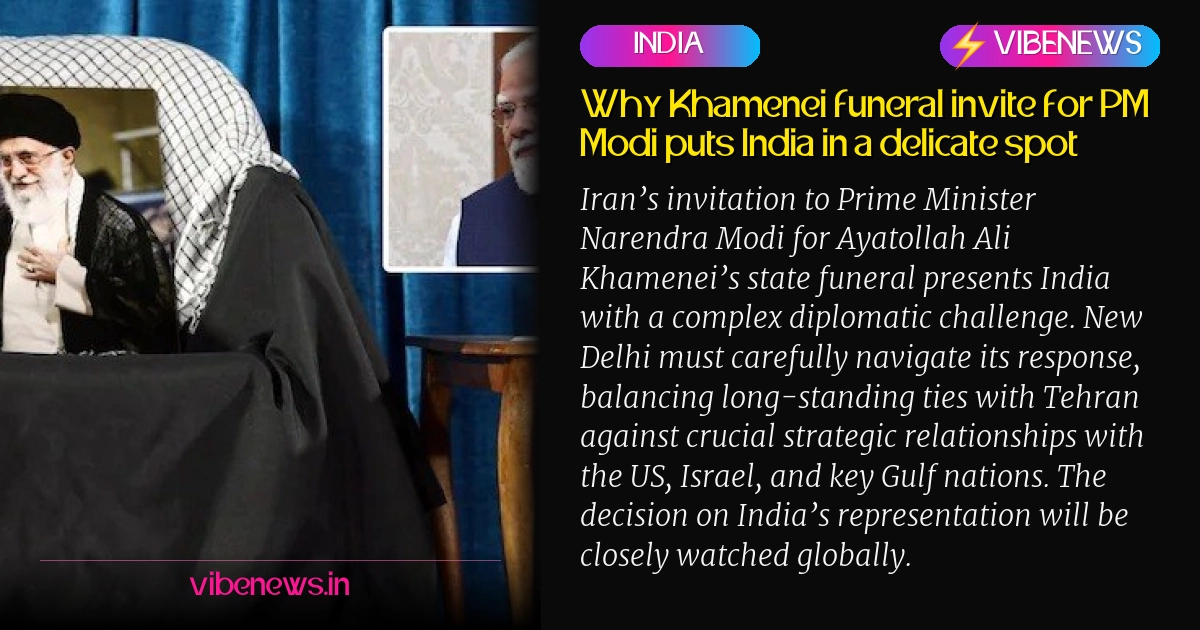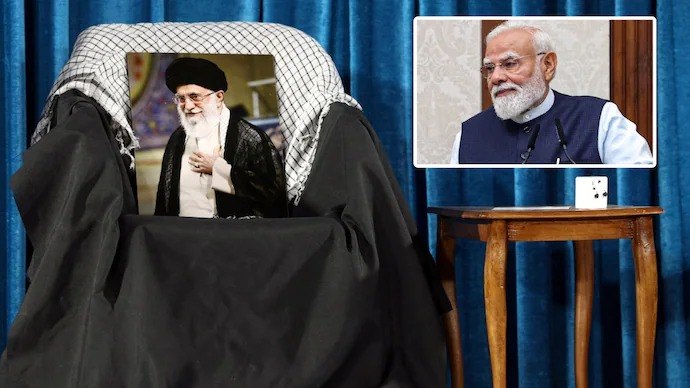
India faces a significant diplomatic tightrope walk following Iran’s invitation to Prime Minister Narendra Modi to attend the state funeral ceremonies for the late Supreme Leader Ayatollah Ali Khamenei. The circumstances surrounding Khamenei’s death, reportedly in US-Israeli strikes on February 28, amplify the sensitivity of New Delhi’s decision, which will be scrutinised by major global powers.
While reports suggest Prime Minister Modi is unlikely to attend personally, the level of Indian representation at the funeral, scheduled between July 4 and 9, will signal India’s approach to its intricate foreign policy balancing act. India maintains deep historical and strategic ties with Iran, encompassing energy, trade, connectivity through projects like the Chabahar Port, and significant cultural links, including housing the world’s second-largest Shia Muslim population after Iran. Simultaneously, India’s strategic partnerships with the United States, Israel, and influential Gulf states like the UAE have expanded considerably, making any perceived tilt a matter of intense observation.
This isn’t India’s first encounter with such a delicate situation. When Iranian President Ebrahim Raisi died in a helicopter crash in May 2024, India declared a day of national mourning and dispatched then-Vice President Jagdeep Dhankhar to Tehran for the funeral. That move underscored India’s commitment to its relationship with Iran while adhering to established diplomatic protocols. However, the context of Khamenei’s demise, occurring amidst a military confrontation involving the US and Israel, introduces an additional layer of geopolitical complexity.
India initially maintained a cautious silence following the strikes that killed Khamenei. Its first formal gesture was Foreign Secretary Vikram Misri signing the condolence book at the Iranian Embassy in New Delhi. Prime Minister Modi has consistently advocated for dialogue between Iran and the US, urging restraint and respect for national sovereignty, emphasising that military solutions alone cannot resolve conflicts. A decision to send a senior representative to Khamenei’s funeral would align with India’s past diplomatic gestures and reaffirm its commitment to maintaining ties with Iran, irrespective of external pressures.
Such a high-profile presence, however, could attract considerable attention in Washington and Jerusalem, given their alleged involvement in the events leading to Khamenei’s death. Geopolitics expert Brahma Chellaney highlighted this dilemma, stating that the multi-day state funeral places New Delhi in an “exceptionally delicate diplomatic position.” He noted that India faces a potential “diplomatic debt” for its silence after the assassination, yet a prominent presence risks antagonising the US and Israel. Chellaney also pointed out that sending a senior representative would signal India’s unwillingness to let its Iran policy be dictated by external powers, especially considering its substantial investments in the Chabahar Port.
Chabahar Port remains a cornerstone of India’s strategic investments, offering crucial access to Afghanistan, Central Asia, and Europe, bypassing Pakistan. Despite recent challenges, including the expiry of US sanctions waivers and broader regional conflicts, New Delhi continues to engage with both Tehran and Washington to ensure the project’s long-term viability. Energy security is another vital consideration for India; Iran’s proximity to the Strait of Hormuz means regional stability directly impacts India’s energy interests. The presence of millions of Indian expatriates across the Gulf further underscores the importance of a stable Middle East for New Delhi.
India’s relationships with the US and Israel are paramount. Defence cooperation with Israel has seen significant expansion, while the United States remains a key partner across defence, technology, trade, and Indo-Pacific strategy. India’s deepening engagement with Gulf countries further complicates its regional calculus. Against this backdrop, any prominent Indian presence at Khamenei’s funeral could be interpreted differently by various nations. Some might see it as a reinforcement of India’s independent foreign policy, while others could question New Delhi’s stance at a highly sensitive geopolitical juncture.
While Prime Minister Modi is reportedly not expected to travel to Iran, the final decision on India’s representation level is anticipated in the coming days. This choice will likely hinge on several factors, including the seniority of the delegate, the diplomatic messaging accompanying the visit, and the prevailing international environment. Indian Army veteran and author Pravin Sawhney described the decision as a “litmus test” for India’s foreign policy, which will be closely watched by world leaders. This invitation underscores the inherent challenges of conducting foreign policy in an increasingly multipolar world, particularly as India’s global profile continues its upward trajectory. New Delhi’s response will offer another clear example of how it seeks to navigate competing global interests while steadfastly upholding its strategic autonomy.
TL;DR
- Iran has invited Prime Minister Narendra Modi to attend the state funeral of Ayatollah Ali Khamenei, who was reportedly killed in US-Israeli strikes.
- India faces a diplomatic dilemma, needing to balance its long-standing ties with Iran against strategic relationships with the US, Israel, and Gulf nations.
- While PM Modi is unlikely to attend personally, the level of Indian representation will be closely watched globally.
- India’s past response to President Raisi’s death involved sending the Vice President, reflecting its commitment to ties with Tehran.
- The Chabahar Port project and energy security are key strategic interests for India in Iran, making continued engagement important.
- A high-level Indian presence could be seen as asserting independent foreign policy but might also draw scrutiny from Washington and Jerusalem.
- The decision will be a significant indicator of India’s approach to navigating complex geopolitical pressures in a multipolar world.