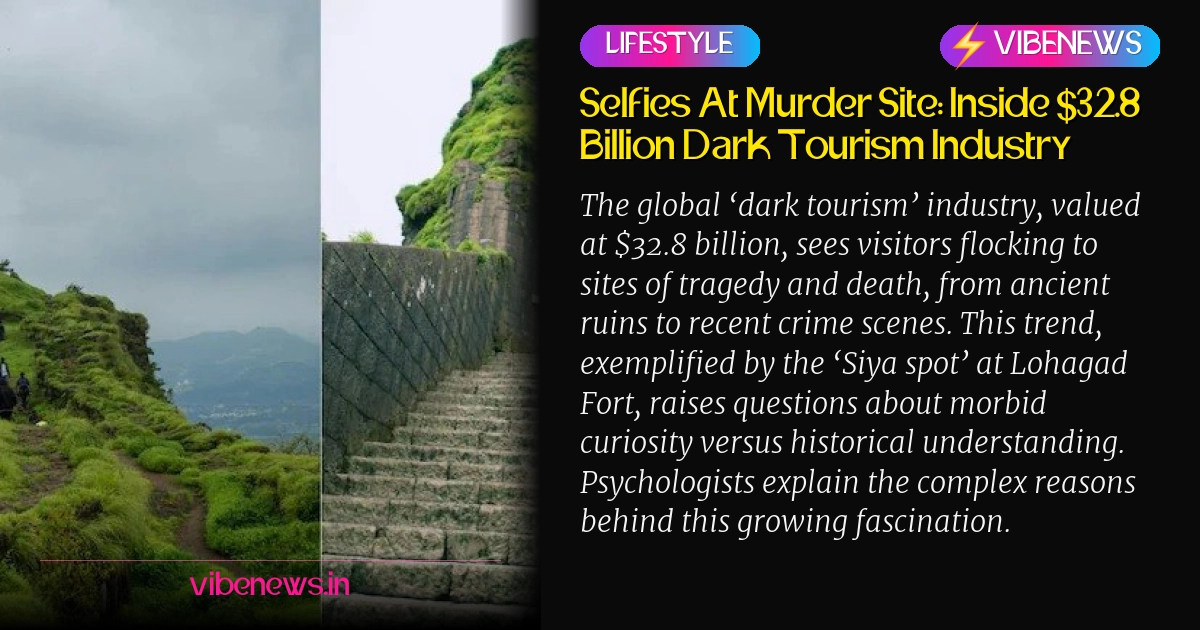
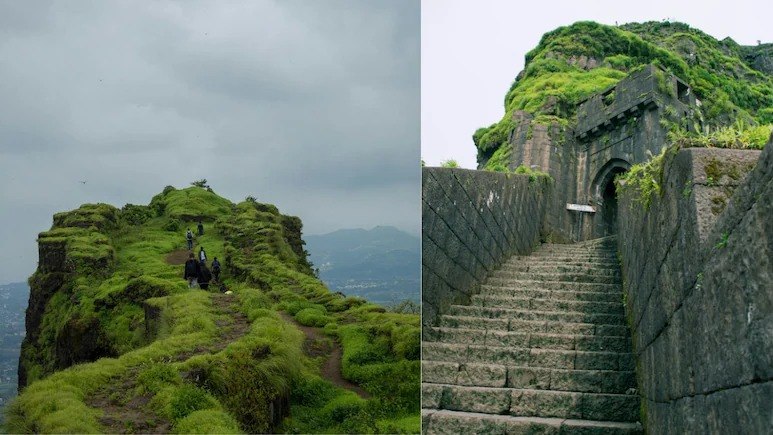
A disturbing trend has emerged at Maharashtra’s historic Lohagad Fort, where visitors are now actively seeking out the exact spot of a recent murder to take photographs. This phenomenon, dubbed "dark tourism," highlights a growing global industry that draws people to sites associated with death, tragedy, and suffering, prompting questions about human curiosity and ethical boundaries.
This fascination with macabre destinations has evolved into a significant economic force. The global dark tourism market is currently estimated at a staggering $32.8 billion, with projections indicating it could reach $40 billion by the early 2030s. This growth underscores a widespread human inclination to engage with the darker chapters of history and personal tragedy.
The term "dark tourism" was coined by researchers John Lennon and Malcolm Foley to describe this specific type of travel. While it might seem like a modern development, the concept has historical precedents, such as civilians observing American Civil War battles from a safe distance in the 1860s. Today, dedicated websites guide tourists to these somber locations.
Globally, some of the most visited sites are those marked by immense suffering. In 2024 alone, Italy’s Pompeii Archaeological Park, the ancient city buried by a volcanic eruption, attracted over 4 million visitors. The 9/11 Memorial & Museum in the USA has welcomed more than 14 million visitors since its opening, while Japan’s Hiroshima Peace Memorial Museum saw 2 million people pay respects at the site of the first atomic bombing. Poland’s Auschwitz-Birkenau Memorial recorded 1.83 million visitors, and the Pearl Harbor National Memorial in the USA drew nearly 1.6 million.
Psychologists offer several explanations for this complex human draw, moving beyond simple morbid obsession. One key driver is "Terror Management Theory," which suggests humans, acutely aware of their own mortality, visit sites of death in controlled environments to process their temporary existence. Paradoxically, confronting death can heighten an individual’s appreciation for life itself.
Another reason is the inherent human need to "see it to believe it." A 2016 study indicated that a direct interest in death is rarely the primary motivation. Instead, many travelers seek historical education, wish to pay tribute to victims, or simply need to verify that incomprehensible, terrible events actually occurred. This desire for tangible proof often outweighs other considerations.
The "rubbernecking" reflex also plays a role. Similar to how drivers slow down to observe a car crash, people are driven by a deep survival instinct. They want to understand what happened to others, hoping to learn how to protect themselves from similar fates. This primal urge to analyze danger is a powerful motivator.
However, the line between respectful remembrance and turning tragedy into a spectacle is thin. Dr. Makhan Shakya, an Assistant Professor of Psychiatry at GMC Sheopur, expressed concern over the rush to the Pune fort after the Ketan Agarwal murder. He noted that while natural human curiosity draws people to such spots, transforming places of real grief into social media backdrops risks eroding basic human kindness.
This phenomenon extends beyond physical travel to the booming "true crime" genre. Watching gruesome thrillers and documentaries from the safety of one’s home relies on the same psychological coping mechanisms: confronting horror in a controlled setting. Murder stories and serial killer documentaries dominate media because they trigger a potent mix of adrenaline, puzzle-solving, and survival psychology.
In the United States, over 50 percent of people enjoy true crime, with women making up 73 percent of podcast listeners. Researchers suggest women often consume this content as a form of subconscious survival training, learning to identify red flags and cautionary tales. The genre offers a "double-dipping" effect: the adrenaline rush of the crime followed by the psychological satisfaction of seeing justice served.
India is experiencing a rapid scaling of this trend. Industry data from Ormax Media shows that the Action, Crime, and Thriller (ACT) cluster accounts for 43 to 47 percent of all new content launched on major streaming platforms. OTT giants like Netflix, Amazon Prime, and JioHotstar are heavily investing in real-world horrors and true-crime documentaries due to their high viewer retention.
Shows such as *House of Secrets: The Burari Deaths* and *The Hunt for Veerappan* consistently achieve global top-tier rankings and generate significant revenue in the Indian market. Crime procedurals like *Dahaad*, *Delhi Crime*, and *Criminal Justice* have garnered international accolades and act as primary subscriber magnets, demonstrating the genre’s widespread appeal.
Whether one is standing in the solemn courtyard of Jallianwala Bagh, exploring the supposedly cursed Bhangarh Fort, or streaming a chilling thriller, the underlying motive remains consistent. People use "controlled terror" to build psychological resilience. The recently launched series *Raakh*, inspired by the infamous 1978 Ranga-Billa case in Delhi, exemplifies this. Audiences flock to watch it, despite knowing the tragic details, because it allows them to confront a notorious historical horror, feel an adrenaline rush, and yet remain completely safe.
Philosopher George Santayana famously stated, "Those who cannot remember the past are condemned to repeat it." Dark tourism, when approached with respect and a genuine desire for understanding, transforms sites of tragedy into powerful spaces for learning and reflection. The challenge lies in ensuring that curiosity does not overshadow empathy and historical reverence.
TL;DR
- The global "dark tourism" industry, which involves visiting sites associated with death and tragedy, is valued at $32.8 billion and is projected to reach $40 billion by the early 2030s.
- A recent example at Maharashtra’s Lohagad Fort, where visitors took selfies at a murder site, highlights the ethical complexities of this growing trend.
- Major dark tourism destinations include Pompeii Archaeological Park, the 9/11 Memorial & Museum, Hiroshima Peace Memorial Museum, Auschwitz-Birkenau Memorial, and Pearl Harbor National Memorial, attracting millions annually.
- Psychologists explain the phenomenon through "Terror Management Theory" (confronting mortality), the need for historical education, and a "rubbernecking" reflex to understand danger.
- Experts warn against the trivialization of tragic sites, emphasizing the risk of losing human kindness when grief is turned into a spectacle or social media backdrop.
- The popularity of the true crime genre, particularly in India, mirrors dark tourism’s psychological drivers, offering a safe space to confront horror and build resilience.
- When approached with respect, dark tourism can serve as a vital tool for historical learning and preventing the repetition of past mistakes, as articulated by George Santayana.