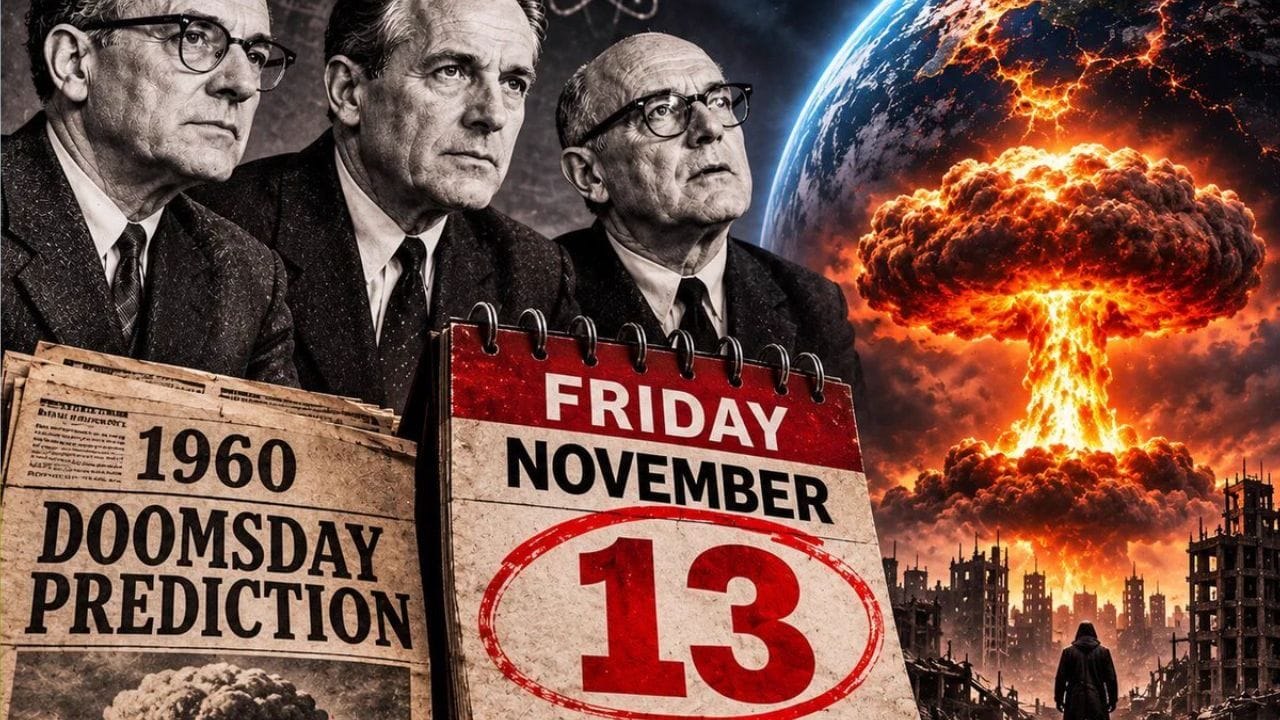
A research paper published in the journal Science in 1960 named Friday, 13 November 2026 as a doomsday date, and the study is back in circulation as that day approaches. Its title, ‘Doomsday: Friday, 13 November, A.D. 2026,’ still reads like a warning sign more than six decades later.
The paper was written by Heinz von Foerster, an Austrian-American professor and cybernetics expert, along with two of his students, Patricia M. Mora and Lawrence W. Amiot. In 1960, concern was growing about how fast the world’s population was rising. People were asking whether the planet’s food, water and housing could keep up, and whether humanity was heading toward a serious crisis.
The math behind the warning
The researchers looked at 24 estimates of world population covering the last 2,000 years. They concluded that human population had grown faster than earlier thinking suggested. Their explanation centered on human ability. People share information with one another and organize into groups to solve problems, and the authors argued that these skills gave population growth even more momentum.
Using those figures, they built a mathematical model to project the future. If the same pace continued, they said, world population would reach an unlimited level around 2026. In plain terms, growth would slip out of control and threaten human survival.
The team also left behind a line that caught attention at the time:
Our great-great-grandchildren will not die of hunger. They will be crushed by the pressure of one another.
The authors were not only worried about food. Their concern was that the sheer number of people on Earth would become a problem in itself, creating strain that could not be eased simply by producing more.
A debate that lasted decades
Reaction to the paper split into two camps. Some readers treated it as satire aimed at population growth. Others took the equations seriously and wanted to test them.
Critics, including mathematicians and population researchers, said the estimates were unrealistic. They argued the model did not reflect actual conditions on the ground. The authors pushed back and defended their mathematical approach, and the exchange kept the so-called doomsday equation in conversation for years.
From the 1960s through the 1980s, the work turned up in books on population science, the environment and genetics. It became a reference point for anyone trying to explain why population forecasting is so difficult.
Where the forecast started to break
The story takes its most interesting turn around 1993. Before then, the researchers’ estimates appeared close to real population figures. Their calculations in the 1970s and 1980s seemed to be pointing in the right direction.
After 1993, however, global population growth began to fall behind their projections. The main reason was a drop in birth rates. Today, the global birth rate is less than half of what it was in 1960.
According to the source, several changes helped bring that about. Greater awareness of family planning, rising education levels, urbanization, expanding education for women and more job opportunities all played a part. The world did not follow the unlimited path the researchers described. Instead, countries and communities adjusted in ways that slowed the increase the paper had feared.
So what happens on November 13?
As the date gets closer, the 66-year-old paper is circulating again. But there is no scientific evidence that the world will end on November 13, 2026. The forecast the paper made about an unlimited population has not come true, and its doomsday date is a mathematical claim tied to a model that did not hold up over time.
The story has one more layer. Von Foerster had worked as a stage magician. He knew how to make an ordinary thing look astonishing, and the source says he used a similar showy style in his research to draw attention to population growth. Whether that was a deliberate theatrical choice or simply the way he communicated, the effect was to make a serious issue hard to ignore.
The paper’s lasting value, as the source frames it, is not the date. It is the idea that population growth and the use of natural resources need to be spotted early and addressed before they become a crisis. The forecast was wrong about the outcome, but the question it raised about the limits of growth has stayed with people for more than sixty years.
TL;DR
- A 1960 Science journal paper was titled ‘Doomsday: Friday, 13 November, A.D. 2026,’ predicting a catastrophe on that date.
- Authors Heinz von Foerster, Patricia M. Mora and Lawrence W. Amiot built their model on 24 population estimates spanning 2,000 years.
- Their projection claimed world population would reach an unlimited level around 2026, sparking debate among mathematicians and experts.
- After 1993, population growth fell behind the forecast, mainly because global birth rates dropped sharply.
- Today’s global birth rate is less than half its 1960 level, according to the source.
- There is no scientific evidence that the world will end on November 13, 2026.