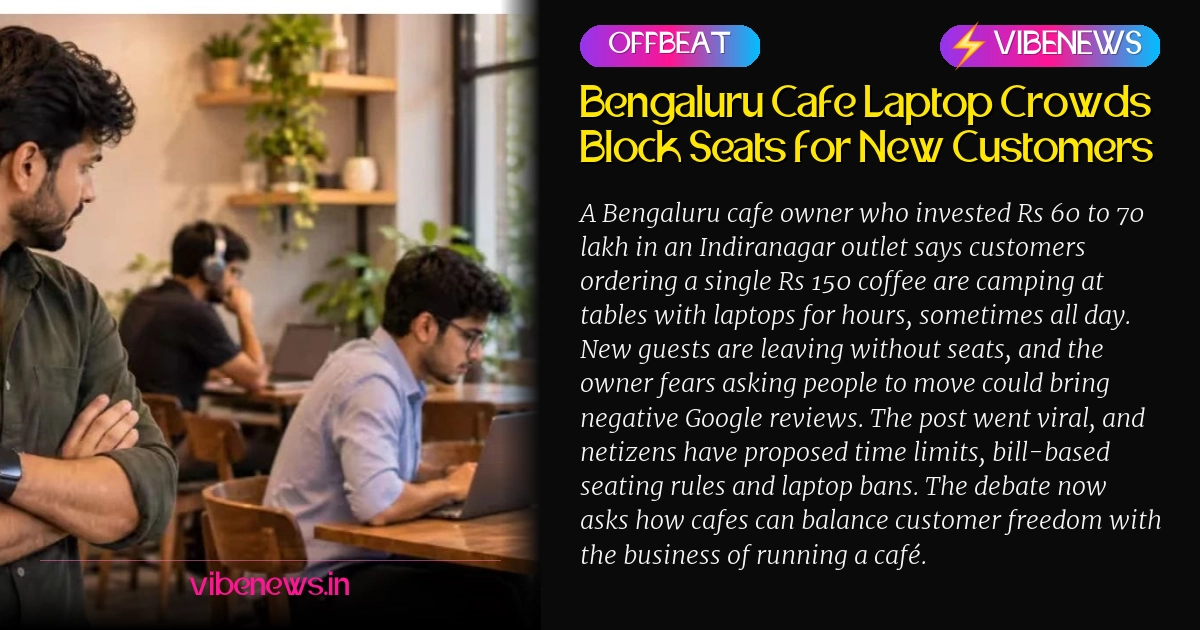
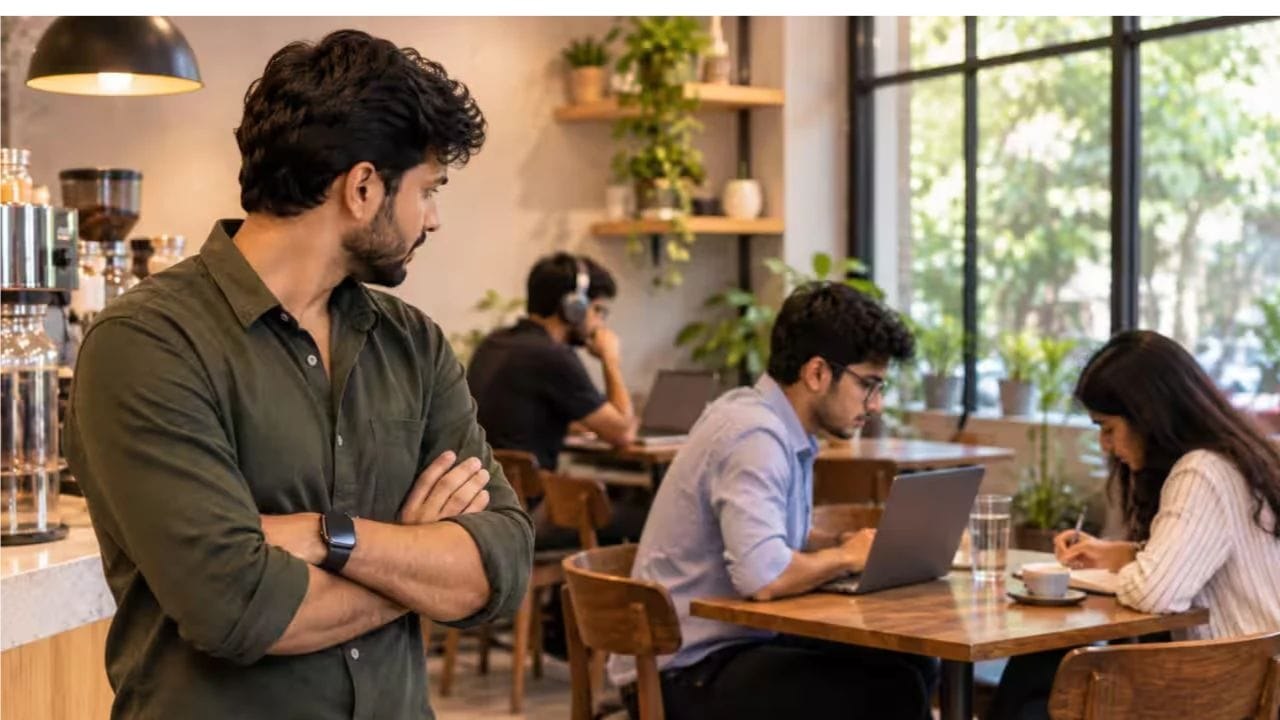
A cafe owner in Indiranagar, Bengaluru, says customers who order a single Rs 150 coffee are taking over tables with open laptops for hours, and the complaint has spread widely online.
The owner invested between Rs 60 and 70 lakh to open the cafe. Within a few days of launch, the business ran into a problem that no spreadsheet had predicted: the seats were full, but the revenue was not keeping pace with the occupancy.
The pattern is simple. A guest walks in, orders one cup of coffee worth about Rs 150, opens a laptop and stays. Some of these customers remain for hours. On certain days, they occupy tables from morning until closing, and the cafe’s seating never turns over.
The result is a queue of people who never get in. New customers arrive, look for a place to sit, find none, and walk out. Every empty-handed exit is a lost sale that the owner cannot recover.
The owner’s dilemma is not about the coffee. It is about the rules. Asking a paying customer to leave is awkward, and in the owner’s view, it carries a real commercial risk. An unhappy guest can post a negative review on Google, and for a new cafe trying to build its name, a few harsh ratings can do lasting damage. So the owner stays quiet, the tables stay full, and the new guests keep leaving.
Why the bill matters more than the cup
The post struck a nerve because it exposes an uncomfortable truth about cafe pricing. Chains such as Starbucks, CCD and Third Wave Coffee are known for relatively high prices on coffee and snacks. Customers, however, are not only paying for the drink. They are also paying, indirectly, for the chair, the table, the air conditioning and the hours they spend there.
Seating is part of the product. When a single coffee buys several hours of workspace, the economics of the cafe start to tilt. A cup of coffee cannot cover the cost of a table that is occupied all afternoon by someone who is not ordering again.
What netizens are proposing
Once the post went viral, commenters began offering fixes, and several of them are specific enough to test in practice.
One suggestion was a minimum spend tied to time. Under this rule, a guest who stays longer would be required to order at least one coffee for each hour spent in the cafe. The logic is that seating should be sold, not given away.
Another commenter argued that cafes should charge for time itself. Instead of selling only coffee and snacks, a cafe could sell access to a seat, with better seating, coffee and snacks offered to customers who pay a higher amount.
A third suggestion was a sliding scale of time limits based on the size of the bill. According to the proposal, a bill between Rs 150 and Rs 750 would get up to an hour and a half of seating. A bill between Rs 750 and Rs 1,500 would get up to two hours. The rule would tie the length of a visit to what the customer has actually spent.
A fourth idea was to split the day. Under this proposal, laptops would be allowed during weekday mornings, when cafes are typically quieter, while evenings and weekends would come with restrictions. The aim is to protect the work-from-cafe crowd without locking out regular customers during peak hours.
Some cafes have already gone further. According to the post, a number of outlets have banned laptops entirely, which removes the working crowd and the problem with it, though it also removes a segment of customers many cafes have courted.
The question nobody has settled
The cafe in Indiranagar sits at the center of a larger question about public space and private business. Remote workers and freelancers have turned cafes into makeshift offices. Owners, meanwhile, are running businesses with rent, staff and inventory to cover. The two needs do not always line up.
The post does not say whether the owner has already introduced any time limits or laptop rules. What it does show is the pressure of a single cup of coffee being asked to pay for a full afternoon of desk space.
The online discussion has turned that tension into a debate. Should customers have the freedom to stay as long as they like once they have ordered? Or should owners set time limits and pricing rules to keep seats moving? For now, the cafe’s tables remain occupied, the new guests keep leaving, and the question has moved from a single cafe in Bengaluru to the rest of the country’s coffee shops.
TL;DR
- A Bengaluru cafe owner who invested Rs 60 to 70 lakh says laptop customers buying Rs 150 coffees are hogging tables for hours.
- New customers are leaving because no seats are free, and the owner fears negative Google reviews if asked to move.
- Netizens have proposed minimum orders per hour, time limits based on bill size, and weekday-only laptop access.
- Some cafes have reportedly banned laptops altogether to keep seating moving.
- The debate now asks whether customers should have unlimited seating time or whether cafes should set pricing rules.