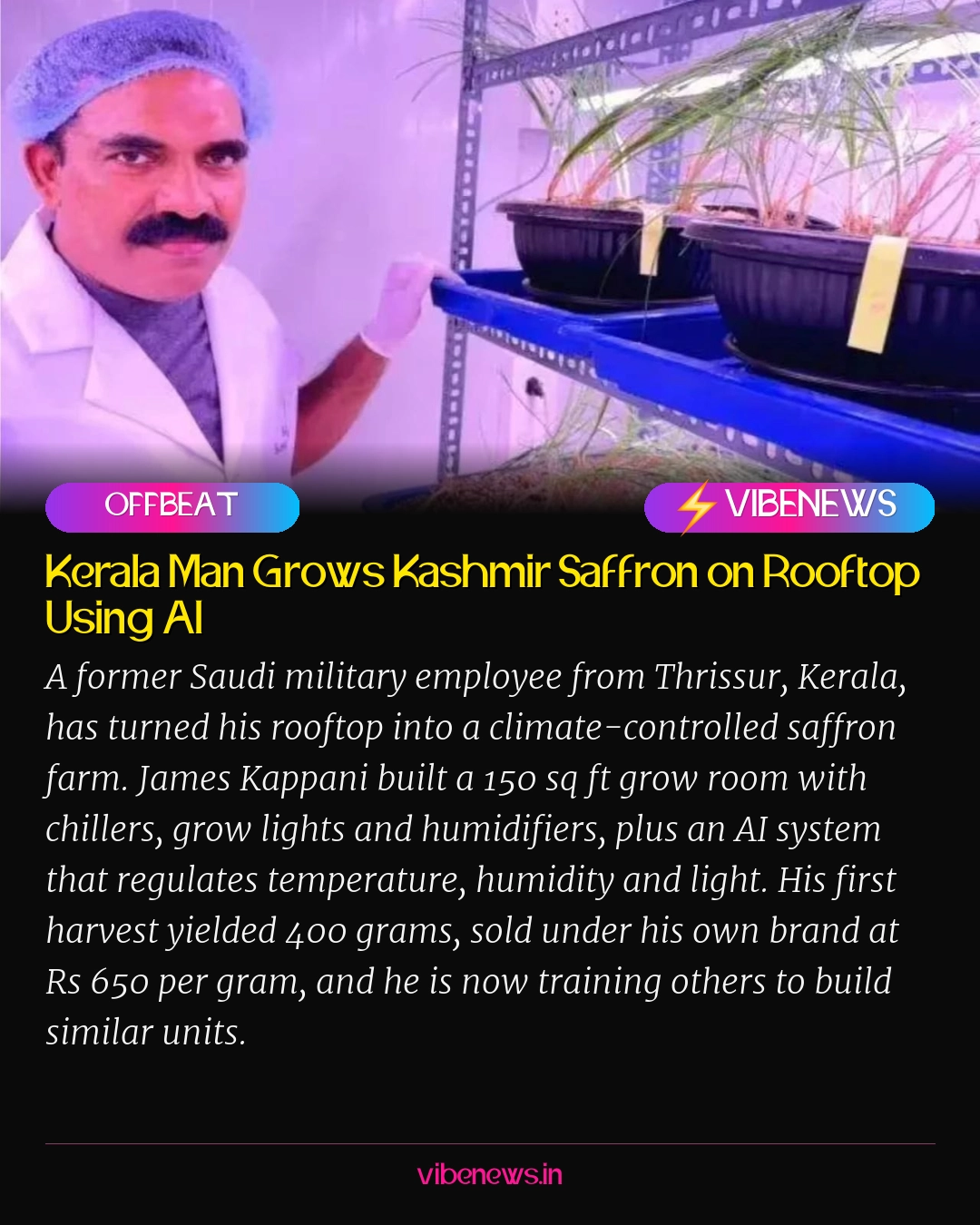
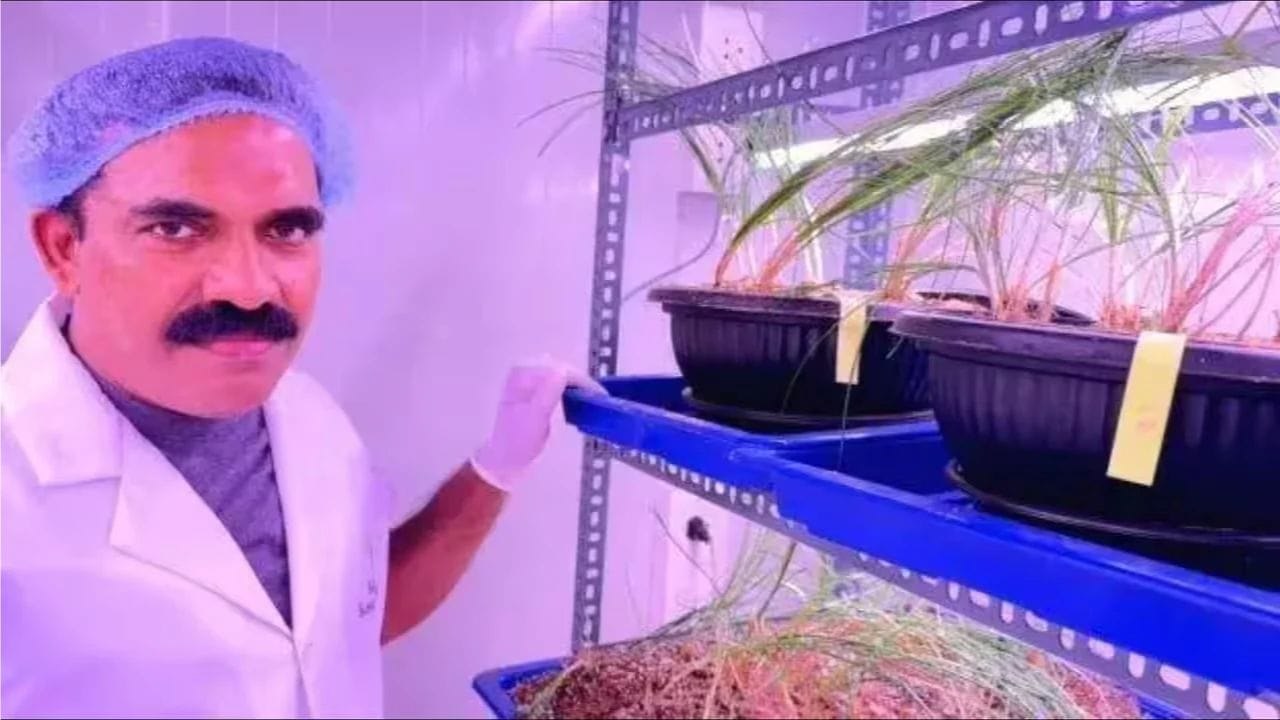
A former Saudi military employee from Thrissur, Kerala, has grown Kashmir’s expensive saffron on the roof of his own home, using an AI-controlled grow room to replace the conditions the crop normally gets from nature. James Kappani’s first harvest came to 400 grams, and he is now expanding the operation.
The story starts with a business that didn’t work out. Kappani spent 20 years in a military division in Saudi Arabia before returning to India in 2022. He wanted to run his own company, and he first tried exporting vegetables from Kerala. Local supply was not enough to meet demand, so he had to bring produce in from Mumbai and Tamil Nadu. He dropped the idea.
A Trip to Pampore Changed the Plan
That same year, Kappani travelled to Pampore in Jammu and Kashmir for business. He found the fields there covered in purple flowers in November. Locals told him the flowers were saffron. The red parts inside each bloom are harvested and processed into saffron, one of the most valuable spices in the world.
The question that set him off was simple, and it is the one that drives the entire project:
Why shouldn’t saffron grown in Kashmir be grown in Kerala?
A Failed First Attempt
Kappani bought one kilogram of saffron corms, the underground bulbs the plant grows from, in Kashmir. He had no real knowledge of how to cultivate them, and the first try failed.
He did not walk away this time. He researched what the crop needs to grow and found that the temperature, humidity and light had to be supplied artificially in a place like Kerala. That was the turning point. The problem was no longer whether saffron could grow in his home state. It was how to build the right environment for it.
Building a Rooftop Grow Room
In 2025, Kappani set up a dedicated growing room measuring 150 square feet on the roof of his Thrissur house. He fitted it with a chiller to bring temperatures down, grow lights to give the plants the light they need, humidifiers to add moisture to the air, and dehumidifiers to remove it when levels climbed too high.
Each piece solves a different problem. Together, they turn a rooftop in humid Kerala into a space that can be tuned to suit a Himalayan-region crop.
The AI Layer That Runs It
Kappani did not stop at equipment. With help from his sons, he built an AI-based automated system to manage the room. It controls temperature, humidity and light inside the grow chamber. Before this, each of those factors would have needed to be checked by hand, again and again. The system has cut down that constant manual monitoring.
Growing method matters too. Kappani uses aeroponics, a technique in which water and nutrients are delivered to plant roots as a fine mist. Unlike traditional farming, which relies on soil and open fields, this method keeps the crop in a controlled environment from start to finish.
Family members pitch in on the work. They help with the harvest, separate the saffron from the flowers and handle processing.
The First Harvest: 400 Grams
Once the grow room was ready, Kappani bought 150 kilograms of saffron corms from Pampore. He paid between Rs 2,500 and Rs 3,000 per kilogram. The corms were planted in 180 vertical trays.
The first crop produced 400 grams of saffron. Kappani sold it under his own brand at Rs 650 per gram. For a spice that has long been expensive and hard to find outside its traditional growing regions, the result is a strong early sign that the method works.
In 2026, he started another growing cycle. He expects a harvest of 500 grams.
Beyond the Flower
Kappani has also found ways to earn more from the same plant. Petals left over after the saffron threads are removed would normally go to waste. He uses them to make baby oil and baby bath soap. He also sells honey infused with saffron.
He says one crop can support several products, which opens more ways to bring in income. His products are sold both online and in physical stores. He has also signed an agreement to sell his brand’s products in Russia, which he describes as an opportunity to reach international markets.
Training Others and Looking Ahead
Kappani is now sharing what he has learned. He trains people who are interested in growing saffron and helps them set up automated growing units.
He has also laid out what it takes to build a large setup. A 250 square foot unit costs about Rs 15 lakh. According to him, 240 to 300 vertical trays in that space can produce about one kilogram of saffron. His equipment came from Pune, Bengaluru and Kochi.
The numbers are still small by commercial standards. But they show how far one retired military employee has moved from a failed vegetable export idea to a working, AI-run saffron farm on a rooftop in Kerala. Kashmir’s most famous crop is now being grown in a city home thousands of kilometres away, and the person doing it says the next harvest will be bigger.
TL;DR
- A former Saudi military employee from Thrissur, Kerala, is growing Kashmir saffron on his rooftop.
- James Kappani built a 150 sq ft AI-controlled grow room in 2025.
- His first harvest produced 400 grams, sold under his own brand at Rs 650 per gram.
- He planted 150 kg of Pampore corms across 180 vertical trays.
- He uses aeroponics and sells saffron honey, soap and oil made from leftover petals.
- Kappani now trains others and expects 500 grams from his 2026 cycle.