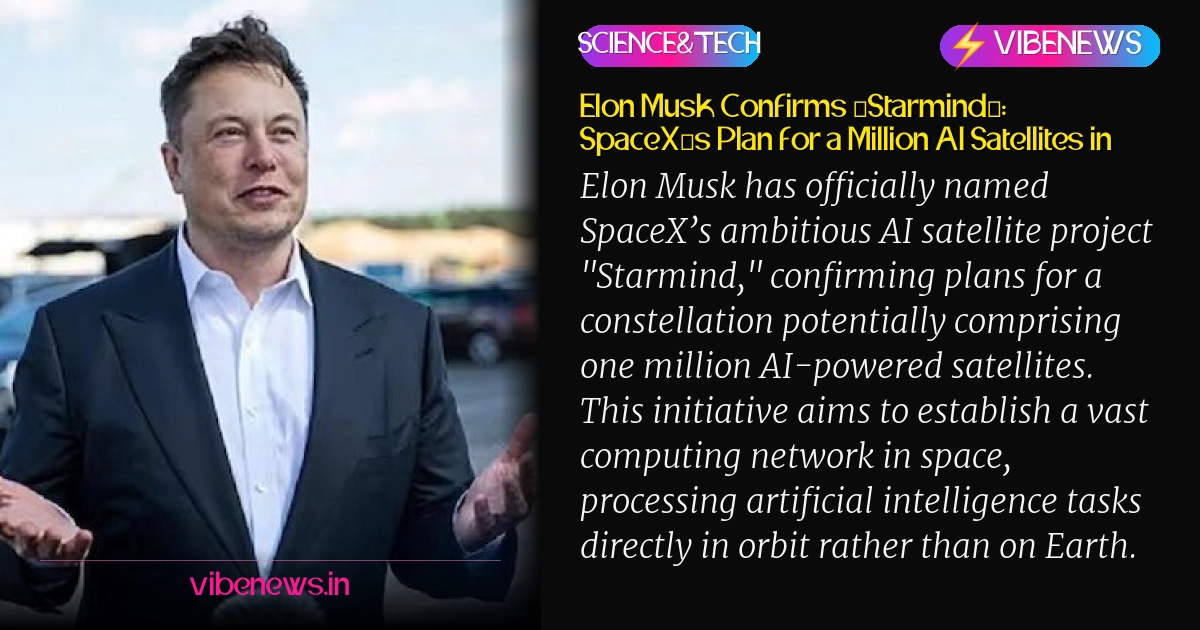

Elon Musk has officially confirmed "Starmind" as the name for SpaceX’s ambitious project to deploy a massive constellation of AI-powered satellites. This revelation came through a direct response on X (formerly Twitter) to a user’s query about a recent xAI trademark filing, signaling a significant step forward for the futuristic space-based computing initiative.
The project envisions placing up to one million artificial intelligence satellites into Earth’s orbit, creating a vast network designed to perform complex AI computing tasks directly in space. This concept marks a distinct departure from SpaceX’s existing Starlink constellation, which focuses on providing global internet connectivity.
Unlike Starlink, whose satellites act as communication relays for data transmission, Starmind satellites are being designed as a giant computing network. These orbiting platforms would be equipped with powerful onboard processors and large solar arrays to generate the substantial energy required for intensive AI workloads. The core idea is to enable users to send AI requests that are processed in space, with results transmitted back to Earth within milliseconds.
This innovative approach could allow AI models to handle a wide array of tasks, including answering queries, running inference workloads, and generating responses, without the sole reliance on traditional terrestrial data centers. The potential for rapid deployment is also being considered, with reports suggesting that SpaceX’s Starship rocket could carry between 30 and 50 AI-focused satellites per launch, facilitating a swift expansion of the constellation once production scales up.
One of the primary motivations behind Starmind is to circumvent the growing challenges associated with building large-scale AI data centers on Earth. Terrestrial facilities face significant hurdles related to land availability, immense electricity consumption, substantial water requirements for cooling, and complex local regulatory approvals. Space, by contrast, offers a unique environment where satellites can harness abundant solar power and benefit from the natural cooling provided by the vacuum of space.
Musk has previously hinted that space-based computing could emerge as one of the most cost-effective methods for deploying AI infrastructure in the coming years. This vision underscores a strategic shift towards leveraging the advantages of the orbital environment for advanced computational needs.
SpaceX is reportedly planning to launch two prototype satellites, designated AI1, in early 2027. Following these initial tests, larger-scale manufacturing is expected to commence later that year at a dedicated facility known as Gigasat. This phased approach suggests a methodical progression from conceptualization to operational deployment.
Beyond supporting xAI’s own chatbot, Grok, the Starmind network could potentially serve a much broader customer base. Businesses, developers, and various organizations globally could theoretically utilize this orbiting AI infrastructure to run their computing workloads, reducing their dependence on ground-based cloud facilities.
While the project remains in its early stages, facing numerous technical and regulatory challenges, Musk’s confirmation of the Starmind name provides the clearest indication yet of SpaceX’s serious commitment. The company is actively pursuing the ambitious goal of transforming space into the next frontier for artificial intelligence computing. If successful, Starmind could represent one of the most groundbreaking space technology endeavors ever conceived, integrating satellite infrastructure, advanced AI computing, and reusable rocket technology on an unprecedented scale.
TL;DR
- Elon Musk confirmed "Starmind" as the name for SpaceX’s AI satellite constellation.
- The project aims to deploy up to one million AI-powered satellites in orbit.
- Starmind will function as a space-based computing network, processing AI tasks directly.
- This differs from Starlink, which provides global internet connectivity.
- The initiative seeks to overcome challenges faced by terrestrial AI data centers, leveraging space for power and cooling.
- SpaceX plans to launch AI1 prototype satellites in early 2027, with larger manufacturing at Gigasat.
- The network could support xAI’s Grok and offer AI computing services to a wide range of customers.
- Technical and regulatory hurdles remain as the project is in its early stages.