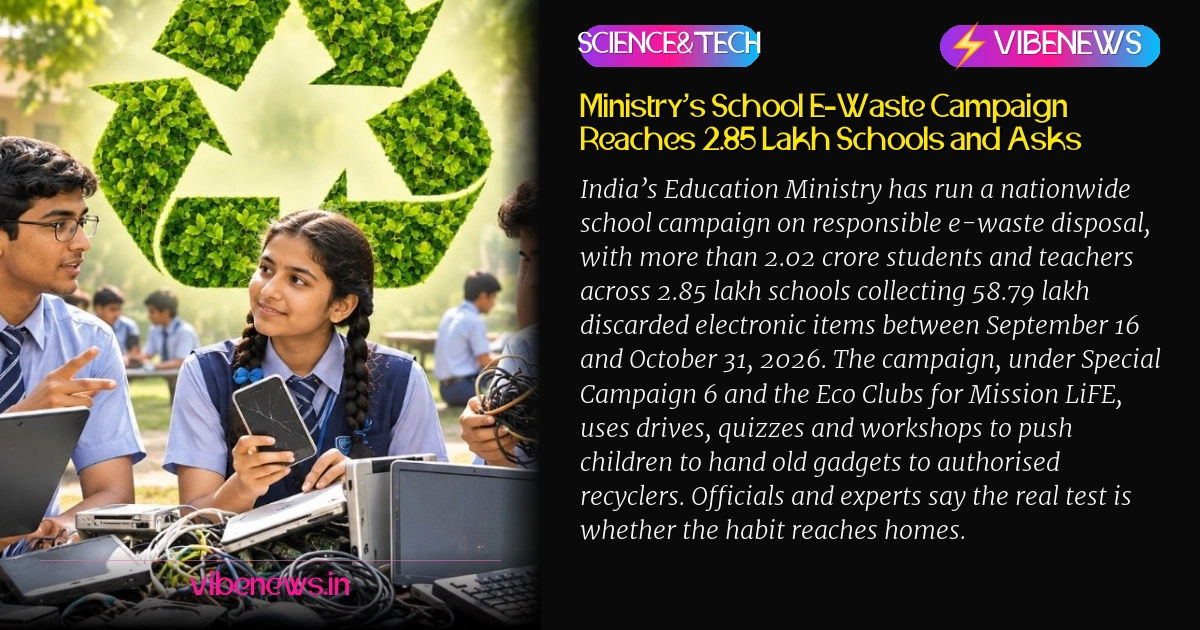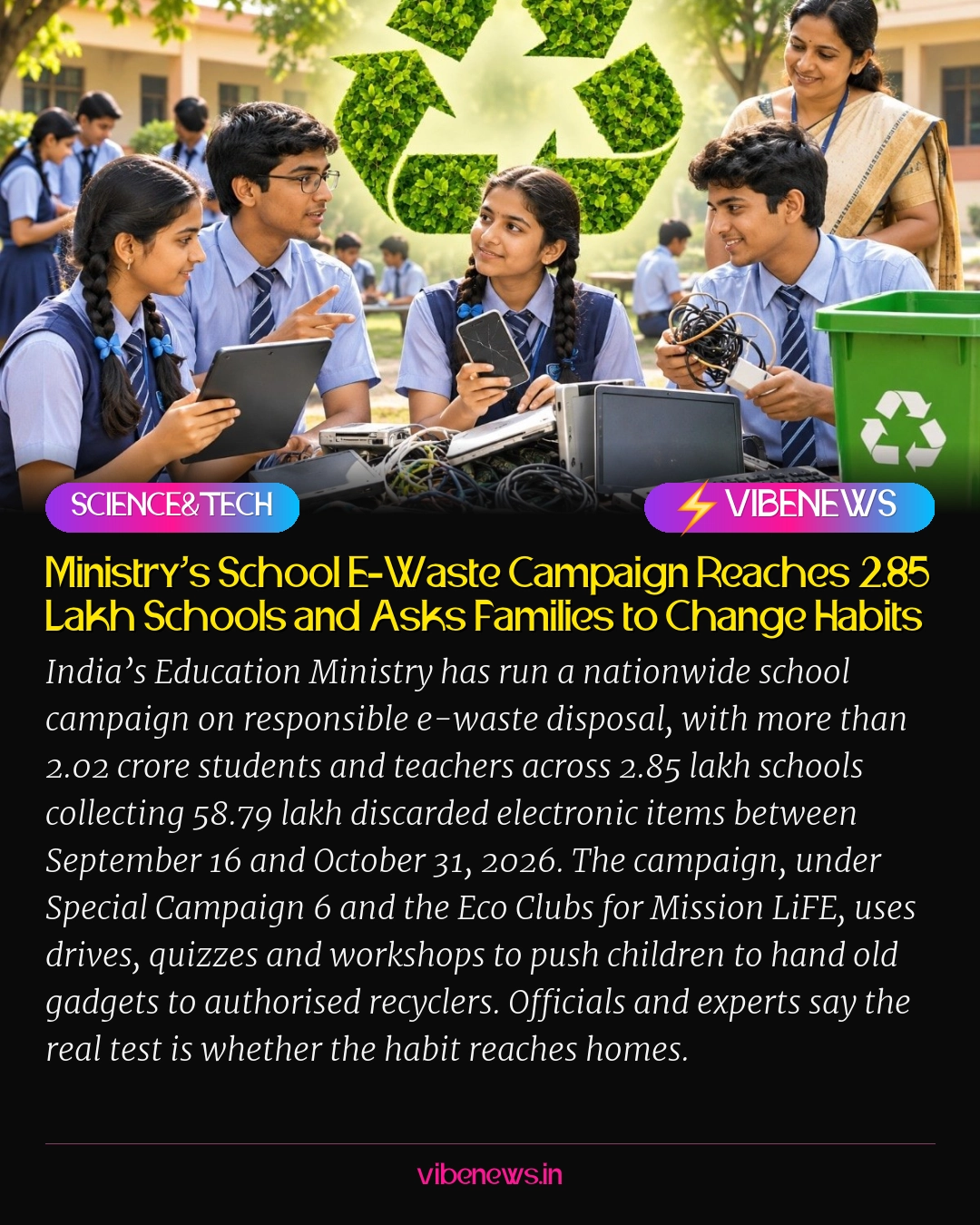
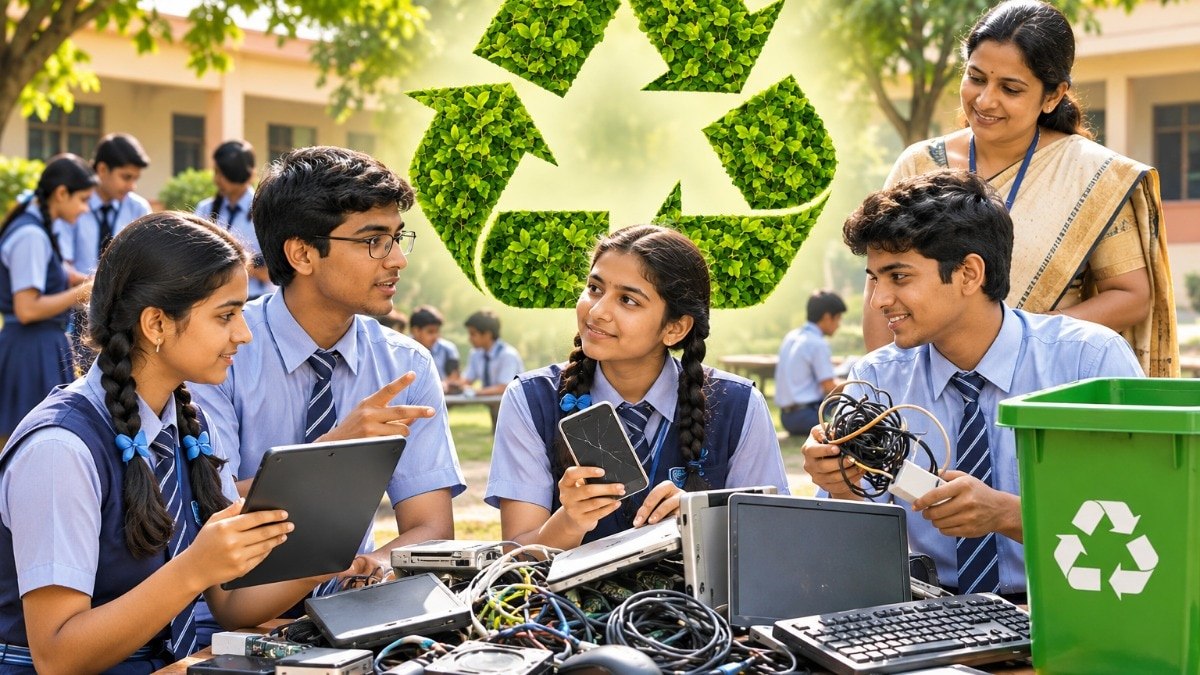
The Education Ministry has rolled out a nationwide campaign that teaches students to collect and manage electronic waste, and the reach is large. According to the Ministry, more than 2.02 crore students and teachers across 2.85 lakh schools collected 58.79 lakh e-waste items during the preparatory and implementation phases of Special Campaign 6, held between September 16 and October 31, 2026.
The Department of School Education and Literacy under the Union Ministry of Education is behind the drive. It runs under Special Campaign 6 and the Eco Clubs for Mission LiFE, and its aim goes beyond classroom lessons. Officials want children to carry the message home and turn it into routine behaviour.
Old phones, broken toys with blinking lights, dead chargers and television sets that no longer work often end up in drawers or corners of the house. They are easy to ignore until someone decides to throw them out. Once discarded, they become part of a waste stream that India can no longer afford to overlook.
The campaign has gone beyond posters and lectures. Schools have organised collection drives, quizzes, workshops and exhibitions. Students have been asked to identify discarded electronic items at home and make sure they reach authorised recyclers or refurbishers. The Ministry also shared a video on X showing two students discussing how to handle e-waste properly.
The Ministry reported that over 6.29 lakh e-waste awareness workshops were held during the preparatory phase. A nationwide collection drive took place on October 28, with schools across states and Union Territories taking part.
Why the problem is growing
The numbers behind the campaign are hard to brush off. Data placed before Parliament by the Ministry of Environment, Forest and Climate Change shows that India generated an estimated 13.97 lakh metric tonnes of e-waste in 2024-25. About 11.59 lakh metric tonnes of that was reported as recycled. The country has made progress in pushing more waste into formal recycling channels, but the gap still shows how much material remains outside the system.
Shohini Dutta, Chief Philanthropy Officer at Bajaj Foundation, told this publication that the first step is changing how people handle unwanted electronic goods. Awareness alone, she said, will not matter unless it changes what people do every day.
“Segregation is the first and the most important step,” Dutta said.
Electronic waste, she explained, has to be kept apart from ordinary household rubbish. Without that separation, it becomes hard to make sure the material reaches the right channel, whether that is reuse, refurbishment or recycling. Mixed waste often ends up with informal scrap collectors who may not have the means to process it safely.
Repair before recycling
Dutta also pushed back on a common assumption, that any electronic item no longer in use must go straight to a recycler. She called recycling the last resort. An old phone, laptop or other device may still have a useful life if it can be repaired, refurbished or sold through a responsible platform. Recycling makes sense when the item has truly reached the end of its life.
The distinction matters because electronic goods contain materials that can be recovered and used again, including precious metals and plastics. When these items are burnt, dismantled carelessly or processed through unsafe methods, those resources are lost and harmful substances can enter the environment. Dutta said a responsible recycler should focus on recovering these materials and returning them to the production cycle. That is the basic idea behind a circular economy, which aims to keep resources in use for as long as possible.
What a household should do
Dutta’s advice to families is simple. First, check whether the item can be repaired, reused or refurbished. If it has reached the end of its life, keep it separate from regular waste and hand it over to an authorised recycler.
She acknowledged that finding the right channel can still be hard for many households. There are more collection services and online platforms than before, but many people still do not know which ones are verified. Resident welfare associations, local collection drives and verified recycling services can help fill that gap.
This is where schools come in. Children may not make every decision at home, but they can ask questions. Why is an old phone going to an informal scrap dealer? Can it be fixed? Is the person collecting it an authorised recycler? Dutta described the process as two-way. Schools introduce the subject to students, and students carry it back to their parents, who often make the disposal decisions in the house.
She pointed to Delhi’s Green Diwali campaign as an example of how steady school-based awareness can gradually change household practices. She also cautioned that the e-waste campaign is still at an early stage and will need time before these habits become normal.
Beyond the big cities
The problem does not stay in metros. Small electronic toys, household appliances, chargers and other gadgets are now common in homes across the country. Their eventual disposal concerns urban and rural communities alike, which makes the school-level effort relevant far beyond city limits.
India’s E-Waste (Management) Rules, 2022, require producers, refurbishers and recyclers covered by the rules to register with the Central Pollution Control Board. The framework also places responsibility on producers through the Extended Producer Responsibility system. Still, rules and recycling plants can only do so much if households keep mixing electronic waste with everyday garbage.
That is the gap the Ministry’s campaign is trying to close. Its success, as the Ministry itself frames it, will not depend only on the number of workshops or collected items. It will depend on whether students, parents and communities learn to separate, reuse and dispose of electronic goods responsibly. The lesson has to leave the school gate and enter the kitchen, the storeroom and the drawer where old devices sit waiting.
TL;DR
- Education Ministry’s nationwide campaign has reached 2.85 lakh schools and collected 58.79 lakh e-waste items.
- More than 2.02 crore students and teachers took part in Special Campaign 6, held between September 16 and October 31, 2026.
- India generated an estimated 13.97 lakh metric tonnes of e-waste in 2024-25, with about 11.59 lakh metric tonnes reported as recycled.
- Bajaj Foundation’s Shohini Dutta says repair and reuse should come before recycling, and segregation is the first step.
- The campaign aims to carry responsible disposal habits from students into their homes.