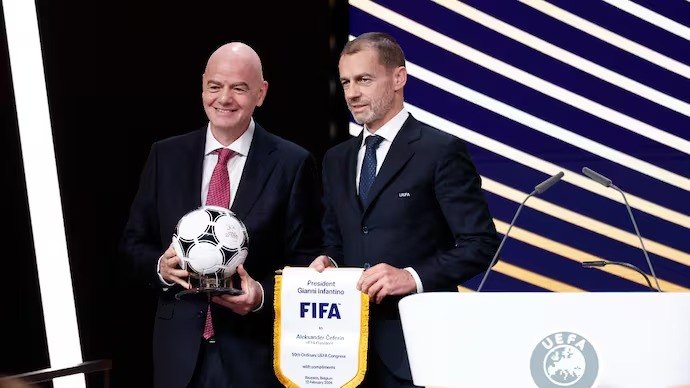
European football’s governing body, UEFA, has reacted with profound indignation to recent reports suggesting FIFA, under President Gianni Infantino, is exploring the sale of minority stakes in the men’s FIFA World Cup to private investors. Describing the proposal as one that "crosses a line," UEFA has emphatically stated that the tournament is "not FIFA’s to sell," signaling a significant escalation in the ongoing power struggle within global football.
Reports from the Financial Times and The Times indicate that FIFA is considering a new commercial structure. This framework would allow the global governing body to retain majority control of its flagship tournament while divesting minority stakes to its 211 member associations and external private investors. The ambitious initiative is reportedly part of a broader strategy to significantly increase football development funding worldwide, aiming for more than $10 billion.
The Proposed Investment Structure
The alleged plan envisions a scenario where FIFA would continue to oversee the operational aspects of the World Cup, yet open its doors to substantial outside capital. This move, if confirmed, would represent a fundamental shift in how the sport’s most lucrative and prestigious event is financed and potentially governed. The infusion of private investment is intended to unlock new revenue streams, ostensibly for the benefit of football development across all confederations.
According to the reports, the proposed investment could be spearheaded by Joshua Kushner through his Thrive Eternal fund. Thrive Eternal, a permanent capital investment strategy launched by venture capital firm Thrive Capital, focuses on acquiring long-term stakes in established franchises and cultural institutions. The fund recently acquired a minority stake in Major League Baseball’s San Francisco Giants, indicating its strategic interest in high-profile sports assets. Joshua Kushner is notably the brother of Jared Kushner, and former Walt Disney chief executive Bob Iger serves as an adviser to Thrive Eternal, adding a layer of high-profile connections to the potential deal.
UEFA’s Vehement Opposition
UEFA’s response has been swift and unreserved, underscoring deep-seated concerns about the commercialization and governance of the sport. In a strongly worded statement, UEFA declared, "This crosses a line that football’s governing institutions should never cross." The European body emphasized the gravity of the situation, urging all national football associations, leagues, clubs, players, supporters, and governments to take it "extremely seriously."
The core of UEFA’s objection lies in the belief that "The soul and governance of football are not assets to trade, especially with zero transparency as to who gains financially." This statement highlights a fundamental philosophical divide regarding the ownership and stewardship of football’s heritage. UEFA’s assertion, "None of us are the owners of football. It is not FIFA’s to sell," challenges FIFA’s perceived authority to unilaterally alter the financial structure of the World Cup, a tournament widely considered a global public trust.
A History of Friction and Governance Debates
This latest controversy is not an isolated incident but rather another chapter in a long-standing and often contentious relationship between FIFA and UEFA, particularly under Gianni Infantino’s leadership. Over recent years, the two powerful bodies have clashed on various issues, including proposals for a biennial World Cup, the expansion of club competitions, and the overall direction of global football governance. UEFA has consistently positioned itself as a bulwark against what it perceives as FIFA’s attempts to centralize power and commercialize core aspects of the game without adequate consultation or transparency.
The reports also suggest a potentially lucrative future role for Infantino himself. The Times indicated that the proposal could pave the way for him to become "commissioner" of the World Cup after his presidency concludes in 2031. Such a role would grant significant influence and financial benefits, raising further questions about the motivations behind the proposed restructuring.
Infantino’s Recent Challenges and Public Image
The timing of these reports is particularly sensitive, coming just days after the conclusion of the 2026 FIFA World Cup. Infantino recently defended FIFA’s handling of the tournament in a lengthy statement published across social media and the FIFA website. In his 900-word post, he lauded the event as "the best show in the world" and criticized "those behind their pens and papers, behind their screens spreading hate and false rumours."
Throughout the 2026 World Cup, FIFA and Infantino faced considerable criticism on a range of issues. These included controversies surrounding Iranian team officials, a Somali referee, fan entry denials in the United States, allegations of political influence regarding player suspensions, record ticket prices, and the introduction of commercial breaks midway through each half of all 104 matches. These accumulated criticisms contribute to a climate of scrutiny around FIFA’s leadership and its commercial decisions.
Editorial Context
This development transcends a mere financial transaction; it strikes at the very heart of football’s identity and governance. The potential sale of World Cup stakes to private investors raises profound questions about who truly owns the sport’s most iconic event and whose interests it ultimately serves. While FIFA champions the need for increased development funding, the lack of transparency cited by UEFA, coupled with the prospect of private entities holding a financial stake in the World Cup, could fundamentally alter the game’s ethos. It risks shifting the focus from sporting integrity and global accessibility towards profit maximization, potentially alienating fans and national associations who view football as a cultural institution rather than a mere commodity. The long-term implications could reshape the power dynamics within global football, setting a precedent for how major sporting events are managed and financed for decades to come.
TL;DR
- UEFA has strongly condemned reports of FIFA planning to sell minority stakes in the men’s World Cup to private investors.
- The European governing body stated the proposal "crosses a line" and that the World Cup is "not FIFA’s to sell," citing concerns over transparency.
- FIFA’s alleged plan, reported by Financial Times and The Times, aims to raise over $10 billion for global football development.
- Thrive Eternal, led by Joshua Kushner, is identified as a potential lead investor, with Bob Iger serving as an adviser.
- The controversy underscores a long-standing power struggle between FIFA and UEFA, and broader concerns over the commercialization of sports.
- Reports also suggest a potential future "commissioner" role for Gianni Infantino post-presidency, adding another layer to the debate.