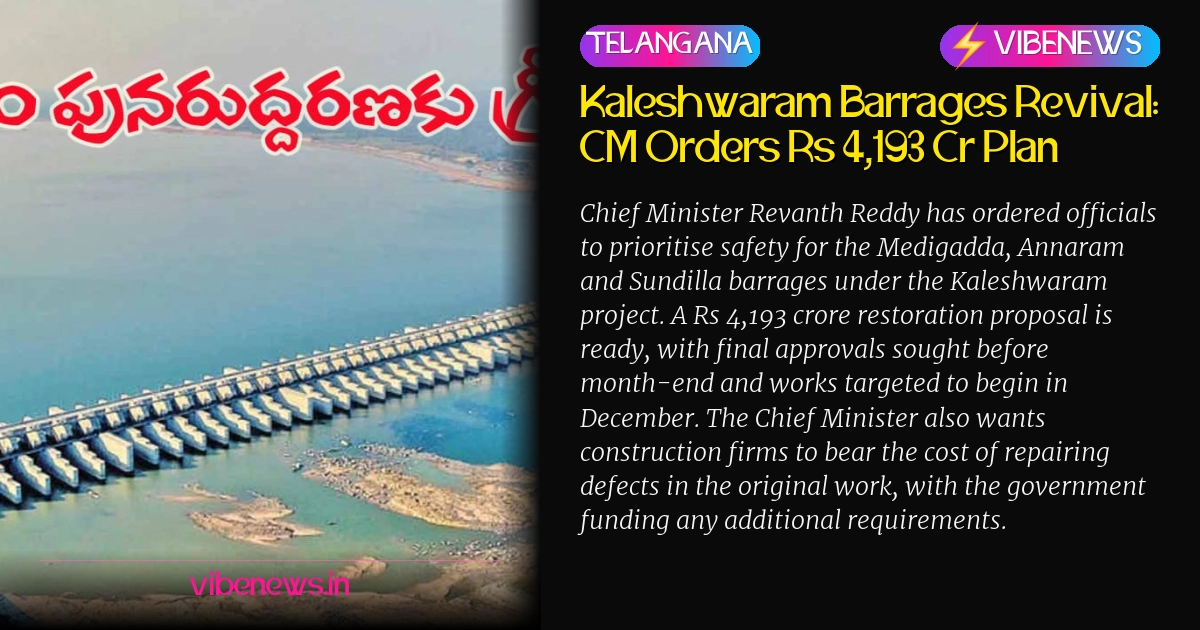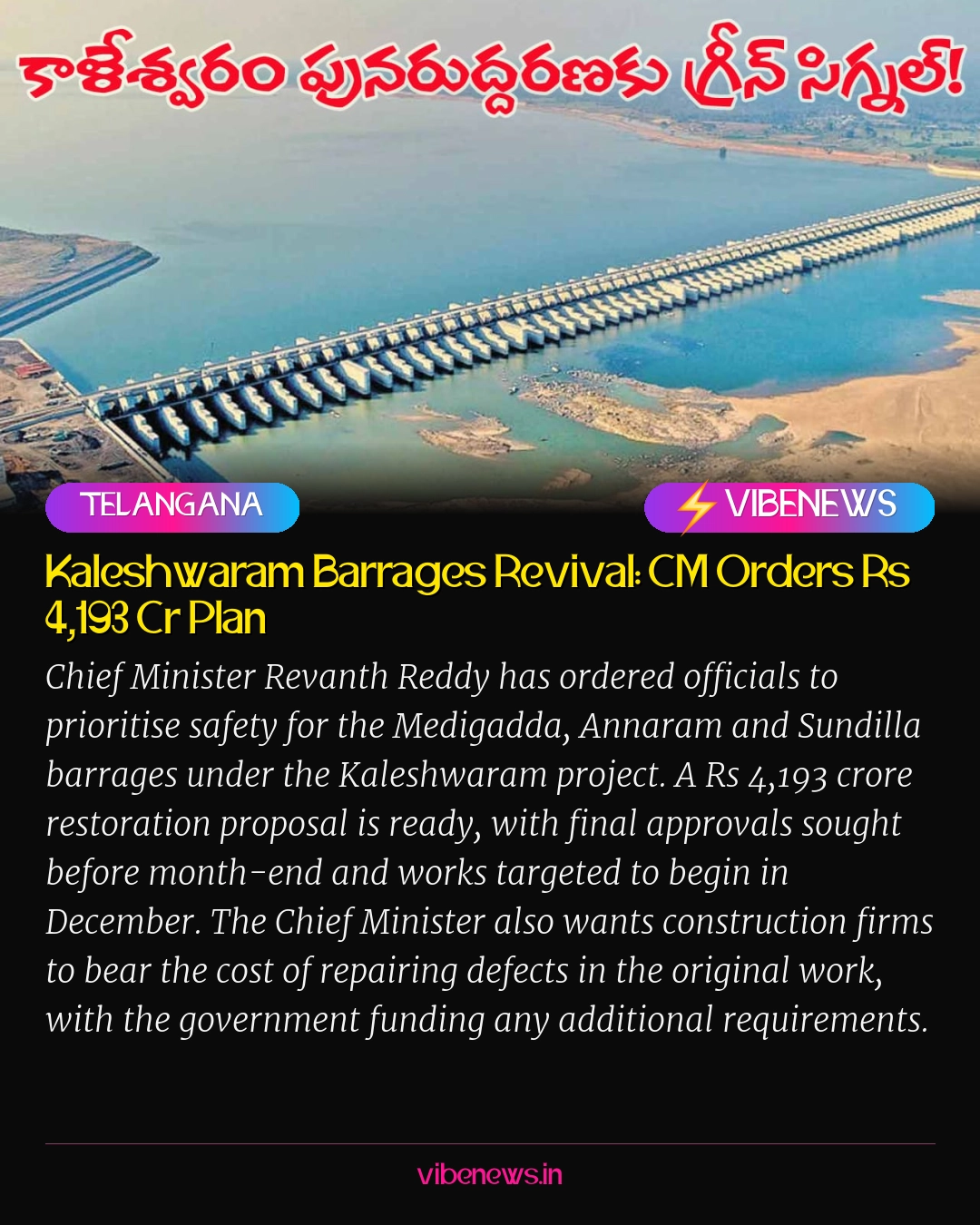
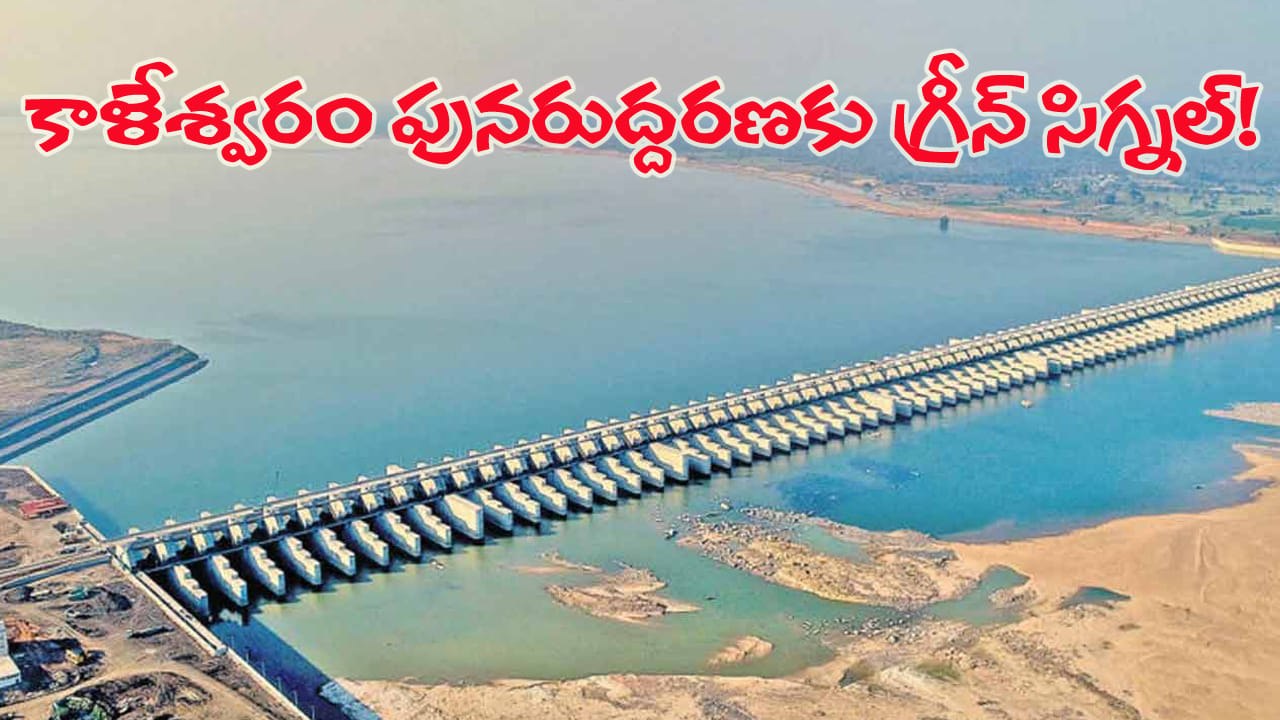
Chief Minister Revanth Reddy has ordered officials to put the safety of the Medigadda, Annaram and Sundilla barrages first as Telangana moves to restore the Kaleshwaram project, and he made clear that the work must follow expert advice and guidelines from central government agencies. The directive came during a state cabinet meeting where ministers discussed several key issues.
Officials presented a proposal estimated at Rs 4,193 crore to restore the three barrages. The Chief Minister wants final approvals secured before the end of this month, and he has asked the administration to make arrangements so that restoration work can begin by December.
There can be no compromise when it comes to the safety of the barrages.
Who pays for the repairs
The Chief Minister has asked that the proposals be drawn up so that construction companies bear the cost of repairing defects that arose during the original construction. Any additional works, however, will be funded by the government under a plan the administration is directed to prepare.
The split matters because the barrages have been at the centre of the Kaleshwaram debate for a long time. Placing repair liability on the builders while the state carries the extra work sets a clear line between faults in construction and new spending the public has to cover.
Why water still sits in Medigadda
A public argument has been building over claims that water is stored in the Medigadda barrage while the government is not lifting it. The Chief Minister asked ministers to push back on that narrative.
Officials, however, told him that lifting water from Medigadda is not technically feasible under current conditions. Moving water from Medigadda to Yellampalli would require closing the gates of the Annaram and Sundilla barrages, they explained.
That is where the problem sits. The National Dam Safety Authority, known as NDSA, had earlier warned against closing those gates. The Chief Minister reminded the meeting of that warning, which effectively rules out the quickest route for moving the stored water.
Downstream Godavari water
The government also used the meeting to highlight how it is putting downstream Godavari water to use through the Devadula and Seetharama lift irrigation schemes. Over the past three years, the Devadula project has lifted an average of 18.13 TMC of water.
Under the previous government, that average stood at 9.57 TMC. The state says current usage is 89 per cent higher.
Up to October, Devadula had lifted 16.71 TMC and Seetharama had lifted 8.10 TMC. Together, the two projects have used 24.81 TMC of Godavari water to provide irrigation and drinking water across the command areas of the undivided Warangal, Nalgonda and Khammam districts.
Pranahita and the blame over past decisions
Revanth Reddy also argued that a barrage at Thummidihatti, built as part of the Pranahita project, would have prevented the kind of difficulties the state is facing during the current drought conditions. He said Pranahita water could have been moved to Yellampalli at a lower cost.
He further stated that the sinking of the Medigadda barrage was caused by mistakes made during the previous government’s tenure. Those remarks tie the restoration effort directly to decisions taken under the earlier administration, and they set the tone for how the current government is framing the fix.
For readers following the project, the sequence of events is the story. A cabinet discussion produced a Rs 4,193 crore estimate, that estimate now needs final sanction this month, and the plan is to start physical work in December. Each step depends on the one before it, and any slippage on approvals will push the December start date further out.
The cost-sharing directive adds another layer. If construction firms are required to fund repairs for defects, the government will be watching closely how the proposals are drafted before they are sent for approval. The Chief Minister has asked officials to prepare those proposals with that outcome in mind.
The Godavari figures also show why the government is pressing its case on water use. By pointing to 24.81 TMC lifted through two lift schemes this year, the administration is making the argument that water is already reaching farmland and households in three districts, even as the Medigadda question remains unresolved.
What happens next depends on whether the proposals clear final approval by the end of November. The Chief Minister has made clear that safety will not be traded away for speed, and that position will be tested as the timeline tightens.
TL;DR
- CM Revanth Reddy has directed officials to prioritise safety for the Medigadda, Annaram and Sundilla barrages.
- A Rs 4,193 crore restoration proposal has been prepared for the three barrages.
- Final approvals are to be sought before the end of this month, with works targeted to start in December.
- Construction firms are to bear repair costs for defects, while the government funds additional works.
- Officials say lifting water from Medigadda is technically not feasible now, as it would require closing gates the NDSA had warned against.
- Devadula and Seetharama schemes have lifted 24.81 TMC of Godavari water up to October.