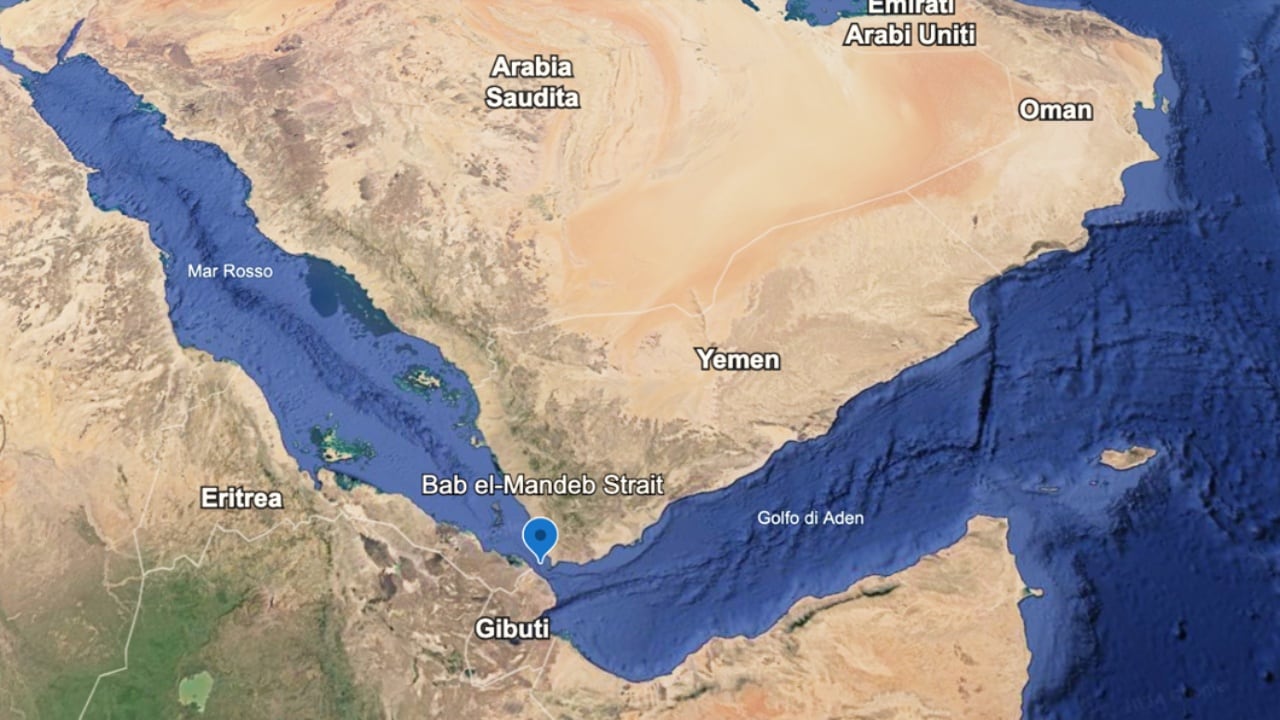
The Strait of Hormuz remains choked amid the war on Iran, with reports of Iran blocking the passage of several cargo ships. The Bab el-Mandeb Strait faces potential closure as the Houthis have warned their "fingers are on the trigger" and are "ready to respond at any moment should developments warrant it." Iran's semi-official Fars News Agency reported that the Houthis and other "resistance groups" were on full alert and might join Tehran's ongoing fight, warning that it could lead to closure of the Bab el-Mandeb Strait. A senior Iranian military official suggested that Iran could expand its maritime campaign to a second strategic chokepoint, warning that Tehran still had "many cards to play," including the possibility of extending pressure to the Bab el-Mandeb strait.
If the Bab el-Mandeb is blocked, a huge share of the world's oil and the Asia-Europe trade could be disrupted. The route handles roughly 12% of global trade and significant volumes of liquefied natural gas (LNG). Ships unable to pass through the Suez Canal via the Bab el-Mandeb must reroute around the Cape of Good Hope, turning a typical 20-25-day Asia-Europe voyage into roughly 30-40 days, adding about 10-15 extra days to the journey. Electronics, machinery, food products, and consumer goods moving between Asia and Europe would face delays and higher shipping costs. In 2023 alone, around 8.8 million barrels of oil per day and large LNG shipments transited the route, according to the US Department of Energy.
The Strait of Hormuz disruption has already hit oil exports and prices, with the rate of crude oil hovering near the $100 mark. If the Bab el-Mandeb is choked too, oil prices might see a dramatic rise. Crude oil prices in global markets have surged, jumping by more than 40% in just two weeks as the escalating war involving the United States, Israel, and Iran rattled energy supplies and disrupted key shipping routes. Circumnavigating the African peninsula would result in a surge in insurance premiums for ships, and some routes could effectively become uninsurable, slowing down cargo flows dramatically.
Shipping giant Maersk announced it was formally halting some export shipments from the Gulf, meaning goods sitting on ships would be unloaded. During the Gaza War in 2023, the Houthis launched more than 100 attacks on commercial vessels, forcing dozens of shipping companies to reroute vessels around Africa, adding days to journeys and billions in extra costs. The attacks have typically relied on a mix of drones, anti-ship missiles, and fast-attack boats, often described by analysts as "swarm tactics." The Houthis, a militant group long backed, armed, and nurtured by Tehran as part of its "Axis of Resistance," have threatened to join the war on Iran. Houthi leader Abdul Malik al-Houthi said his forces had "fingers on the trigger" and were prepared to intervene if the conflict widened.
Experts have suggested Houthis to be part of "Iran's three-stage strategy" in the region. Western officials believe the Houthis receive intelligence and weapons support from Iran, including targeting information relayed by surveillance ships in the region. The Houthis have attempted to choke the Bab el-Mandeb before and have repeatedly warned they could do so again. Lebanese-Australian podcast host Mario Nawfal warned on X that the war's about to get wider and uglier. Youssef Cherif, Director of the Columbia Global Centre in Tunis, posted on X that after attacks by Iran blocking Hormuz and on Lebanon distracting Israel, the Houthis will block Bab el-Mandeb next.
TL;DR
- Iran has blocked the Strait of Hormuz, choking oil and gas supplies.
- Houthis threaten to close Bab el-Mandeb, controlling Red Sea access to Suez Canal.
- The route handles 12% of global trade and major LNG shipments.
- Ships must reroute around Africa, adding 10-15 days to Asia-Europe journeys.
- Oil prices have surged near $100 per barrel after 40% rise in two weeks.
- Maersk has paused Red Sea transits and some Gulf exports.
- Houthi leader Abdul Malik al-Houthi said forces are "ready to respond at any moment."
- Iran’s military official said Tehran has "many cards to play" including Bab el-Mandeb.
- The closures are linked to the US-Israel-Iran war and Iranian retaliation.
- Disruptions have led to force majeure declarations by energy firms in Bahrain, Qatar, and Kuwait.