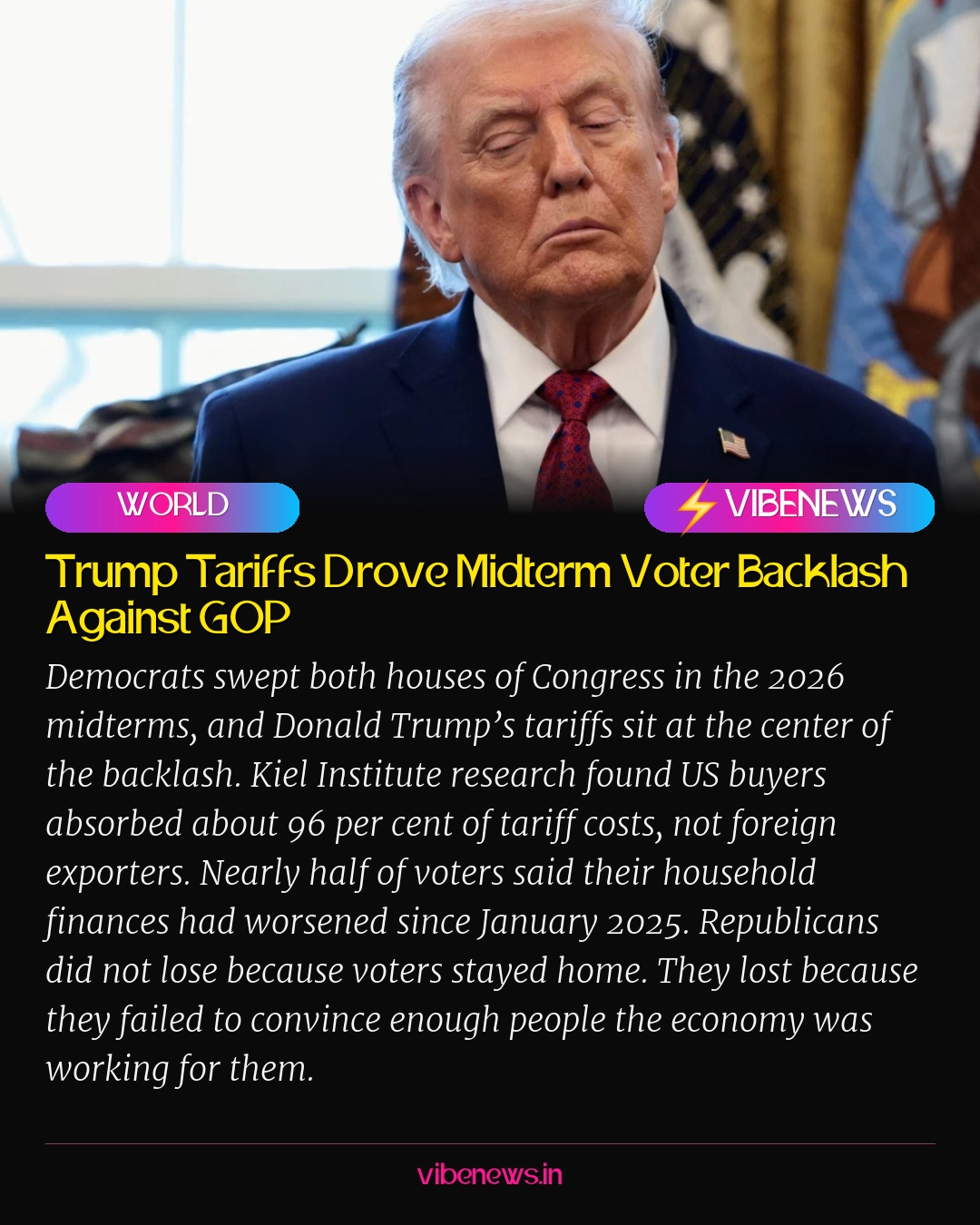
Democrats won both houses of the US Congress in the 2026 midterm elections, handing Donald Trump one of the heaviest political defeats of his second term. The Democrats secured a 54-44 win in the Senate and captured at least 30 new seats in the House of Representatives. According to the latest count, they lead 240-147 in the House, with some races still uncounted.
GOP leaders, including Vice President JD Vance, were quick to blame Trump himself. They pointed to the war in Iran and US policy on Israel as major reasons why many Republicans turned against the party. That explanation does not hold up. The more revealing question is why voters who backed Trump and the Republican Party just two years ago decided to punish them this time.
Texas Senator Ted Cruz offered a clue in his own words. Citing research from the Georgetown Blood and Plasma Research Group, he wrote on X:
“Americans made more than 75 million paid plasma donations in 2026. That’s another record. That means 200,000 Americans every single day, with a needle in their arm, just to pay for groceries.”
Cruz pointed to a squeeze that Republicans could not escape at the ballot box. Americans were struggling with daily expenses, and Trump’s sweeping tariff strategy sits at the heart of that squeeze.
Tariffs arrived early and hit hard
Trump returned to the White House on January 20, 2025, promising to put “America First.” Within weeks, he launched a full-blown tariff war. On April 2, 2025, he announced reciprocal tariffs, including baseline 10 per cent duties on products imported from other countries. He argued that foreign nations had been exploiting America for decades.
The administration sold the policy as a way to make foreign countries pay and protect the US market. Research from the Kiel Institute for the World Economy says the opposite happened. American consumers and businesses absorbed almost all of the tariff burden.
The Kiel Institute analysed more than 25 million shipment records, covering almost USD 4 trillion worth of US imports. Its researchers found that foreign exporters absorbed only about 4 per cent of the tariff cost. Roughly 96 per cent flowed through to US buyers.
A tariff is collected by US customs when goods enter the country, and the importer pays it at the border. From there, the cost gets absorbed, passed through supply chains, or pushed onto the final price on the shelf. In this case, most of it landed on American households. US customs revenue rose by about USD 200 billion in 2025. That windfall did not translate into a benefit for ordinary Americans. The tariff functioned like a consumption tax.
Everyday goods got more expensive
Credit rating agency ICRA said major US retailers faced sharply higher wholesale costs for cotton apparel, ready-made garments and home linens. The pressure was acute because the US relies on India for roughly a third of its imported textiles.
The jewellery trade felt it too. The Gem & Jewellery Export Promotion Council (GJEPC) said American jewellers faced higher prices for polished diamonds and fine gold jewellery. India accounts for nearly 90 per cent of the world’s diamond polishing.
At the grocery store and in restaurants, imported frozen shrimp, Basmati rice and spices saw sharp retail price increases, according to trade data. The tariffs also reached the auto repair bay. The Automotive Component Manufacturers Association of India (ACMA) flagged higher input costs for engine parts, castings and replacement components in the US.
India became part of the experiment
India’s role in this story is hard to ignore. The Trump administration initially set a 26 per cent reciprocal tariff on Indian goods, later revised to 25 per cent. In August 2025, Trump added another 25 per cent levy over India’s continued purchases of Russian oil. That pushed total US duties on many Indian imports to 50 per cent.
Did Indian exporters slash their prices to soak up the extra cost? No. According to the Kiel Institute, shipments to the US fell sharply instead. Exporters sold less. When foreign suppliers do not absorb a tariff, it does not vanish. It moves through the American economy. Importers pay more, businesses face higher costs, supply chains adjust, product availability narrows, and consumers pay the difference.
What voters said at the polls
A pre-election poll found that 48 per cent of registered voters named the cost of living as the biggest issue shaping their vote. Democratic norms ranked second at 26 per cent, and immigration came third at 13 per cent.
The finding that should worry the White House most came next. Nearly half of voters, 49 per cent, said their household finances had deteriorated since Trump returned to office in January 2025. Only 13 per cent said their finances had improved, and 37 per cent said they were roughly unchanged.
Among Hispanic voters, the picture was worse for Republicans. Fifty-four per cent said their household finances had deteriorated. Only 10 per cent said they had improved.
Cruz’s own breakdown of Kansas voting points the same way. He said cost of living, energy and groceries were the top issue for 30.6 per cent of voters there. Corruption followed at 18.5 per cent, and the cost of the Iran war came in at 10.1 per cent. Voters were not walking into polling booths thinking mainly about war or Israel. They were thinking about groceries, fuel, insurance and whether their paycheque could keep up.
A referendum Trump asked for and lost
Trump worked to make himself the central figure in these midterms. Presidents often try to nationalise midterm races because voters otherwise focus on local candidates and issues. That strategy carries real risk. When voters are unhappy, a referendum on the president gives them a clear target.
Trump had effectively asked voters to judge his record. They did. Cost of living, affordability and the economy became the measuring stick, and Republicans could not persuade enough voters that the economy was working for them.
TL;DR
- Democrats won both houses of Congress, with a 54-44 Senate win and at least 30 new House seats.
- A Kiel Institute analysis found American buyers absorbed roughly 96 per cent of Trump’s tariff costs.
- Indian goods hit hard: total US duties on many Indian imports reached 50 per cent after August 2025.
- Nearly half of voters, 49 per cent, said their household finances had worsened since January 2025.
- Cost of living was the top voting issue for 48 per cent of registered voters in a pre-election poll.
- Republicans lost because they failed to persuade voters the economy was working for them.