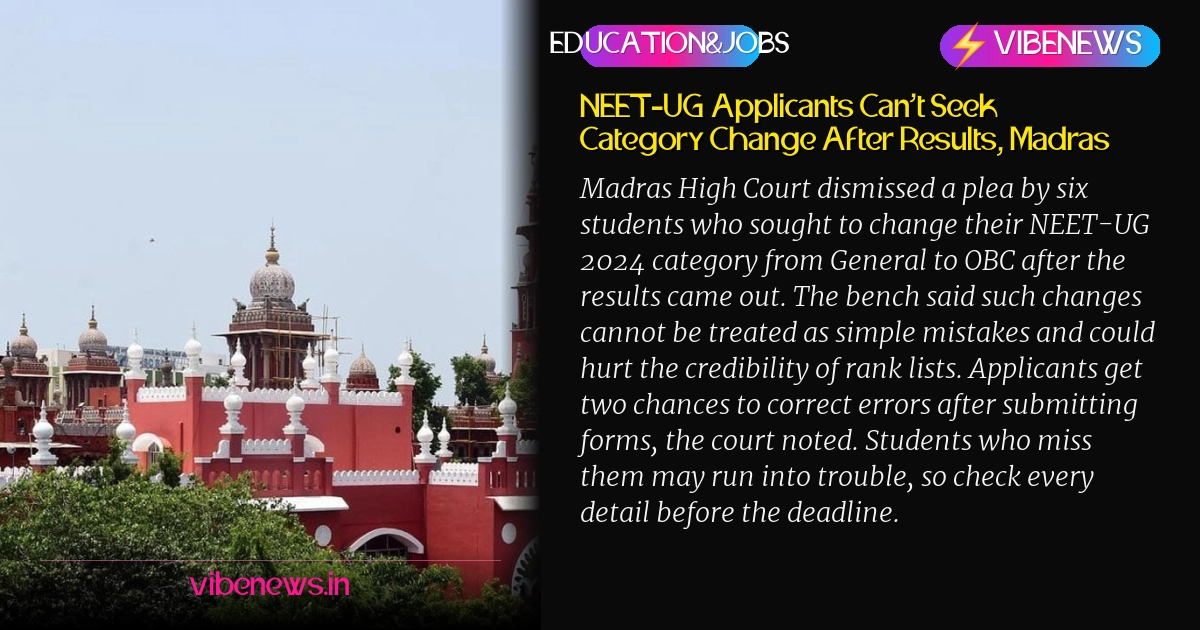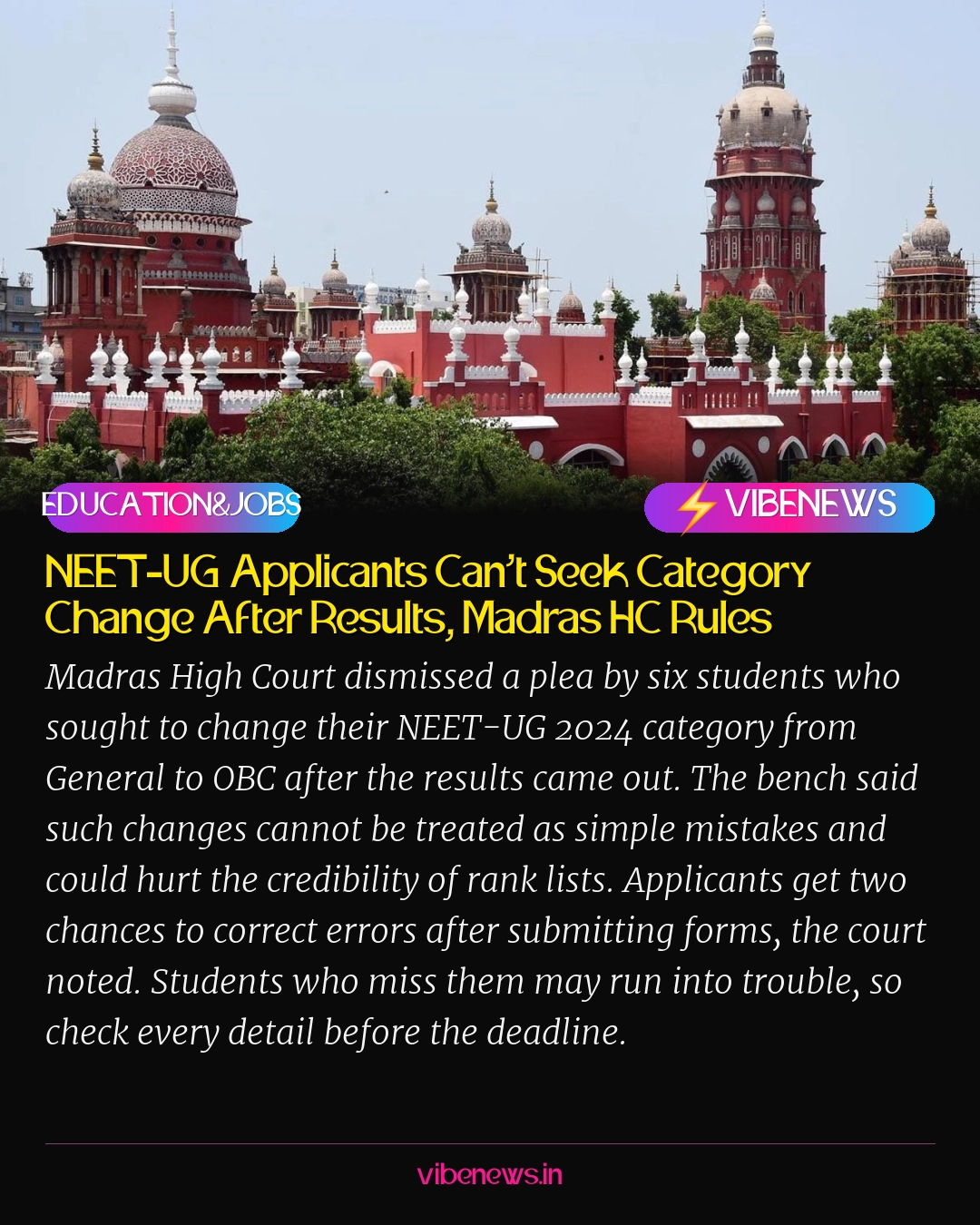
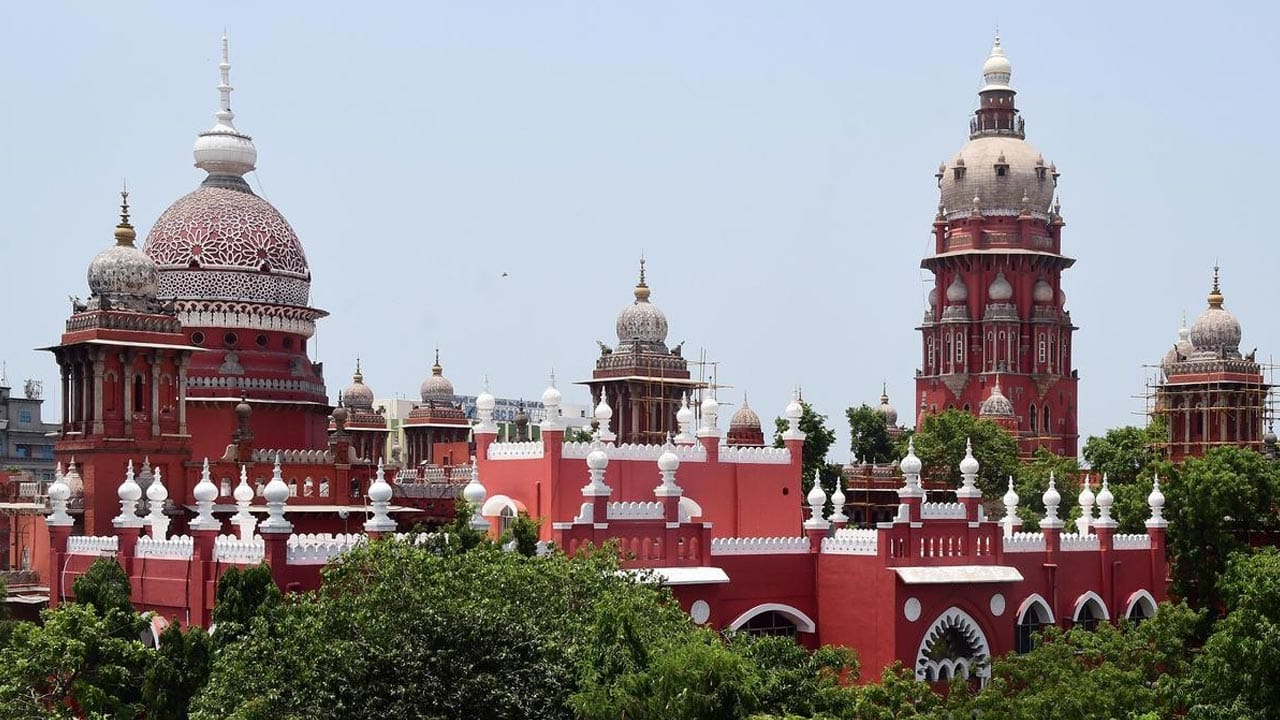
The Madras High Court has dismissed a petition from six NEET-UG 2024 applicants who wanted their category changed from General to OBC after results were declared. The bench made it clear that students cannot expect sympathy from the court for mistakes made on their own application forms.
The six students said they belong to the OBC category but accidentally selected General while filling in the form. They asked the court to correct the entry, treat them as OBC candidates and allow them to take part in medical admission counselling.
A bench of Justice S.M. Subramaniam and Justice Rajesh Vivekanandan heard the plea. The judges did not treat the request as a routine clerical slip. Changing the social category listed in an application, they observed, is not a simple error that can be brushed aside.
What the bench said
The court warned that allowing such changes in a national-level competitive exam would affect the credibility of the examination process and the rank lists that follow from it. Every candidate sitting for a national test is bound by the same rules, the bench said, and those rules cannot bend for one group because of a personal oversight.
Allowing category changes after results would hurt the credibility of the examination system and the rank lists, and rules meant for every candidate cannot be relaxed for individual errors.
The judges pointed to the process that already exists. Candidates get two opportunities to correct errors after they submit their applications. Waiting until results are out and then asking for a category change, the court said, is not a reasonable way to use those opportunities. The students had those chances and did not use them in time.
The bench also recalled that the Supreme Court had earlier made clear that the High Court cannot modify examination rules through its own orders. That point carried weight in the decision. A court that bends rules for some students out of sympathy, the bench said, would be violating the rights of other candidates who followed the rules properly and filled in their forms correctly.
Why the petition failed
The students argued that their category was wrong only because of a mistake, and that the error should be fixed in their favour. The court did not accept that framing. It held that a personal mistake, however genuine it may feel to the applicant, does not create a special exemption from the exam rules that apply to everyone.
That reasoning leaves little room for appeals based on hardship. The six students asked for two specific outcomes: recognition as OBC candidates and permission to join counselling. The court rejected the petition as a whole, which means neither request was granted through this order.
The case turned on timing as much as on the mistake itself. Corrections done during the window set by the exam process are one thing. Corrections sought after results, when rank lists are already in circulation, are another. The bench treated the second situation as a serious problem for the fairness of the entire exam.
What applicants should take from this
For students and parents, the message is blunt. A wrong entry on the application form is treated as the candidate’s responsibility. The court is not prepared to step in and fix it after the fact simply because the mistake was unintentional.
The case also shows what needs careful checking before submission. Name, date of birth, category and educational qualifications all appear on the form, and each one can affect a candidate’s standing later. If a mistake is spotted, it should be corrected within the correction window the exam body provides. Leaving changes until the final stage may lead to difficulties, and this case shows how hard it can be to reverse them.
Families often assume that a genuine error will be forgiven by the courts. This ruling suggests otherwise, at least where the error relates to category and the request comes after results. Students who are unsure about their category, or who notice a mismatch between their certificates and their form, should act early rather than wait.
The report does not describe any penalties beyond the dismissal of the petition, and it does not lay out the exact correction dates for the exam. Students who want to confirm deadlines and procedures should rely on the official notices issued for the examination, rather than on secondhand accounts of court proceedings.
TL;DR
- Six NEET-UG 2024 applicants approached the Madras High Court seeking a change from General to OBC category after results were declared.
- The students said they belong to OBC but mistakenly selected General while filling in their application forms.
- The bench refused to treat the category change as a simple error and dismissed the petition.
- The court said post-result changes could weaken the credibility of the examination process and the rank lists.
- Applicants get two chances to correct form errors, and the court said waiting until results is not a reasonable option.
- Students should check name, date of birth, category and qualifications carefully before the correction deadline.