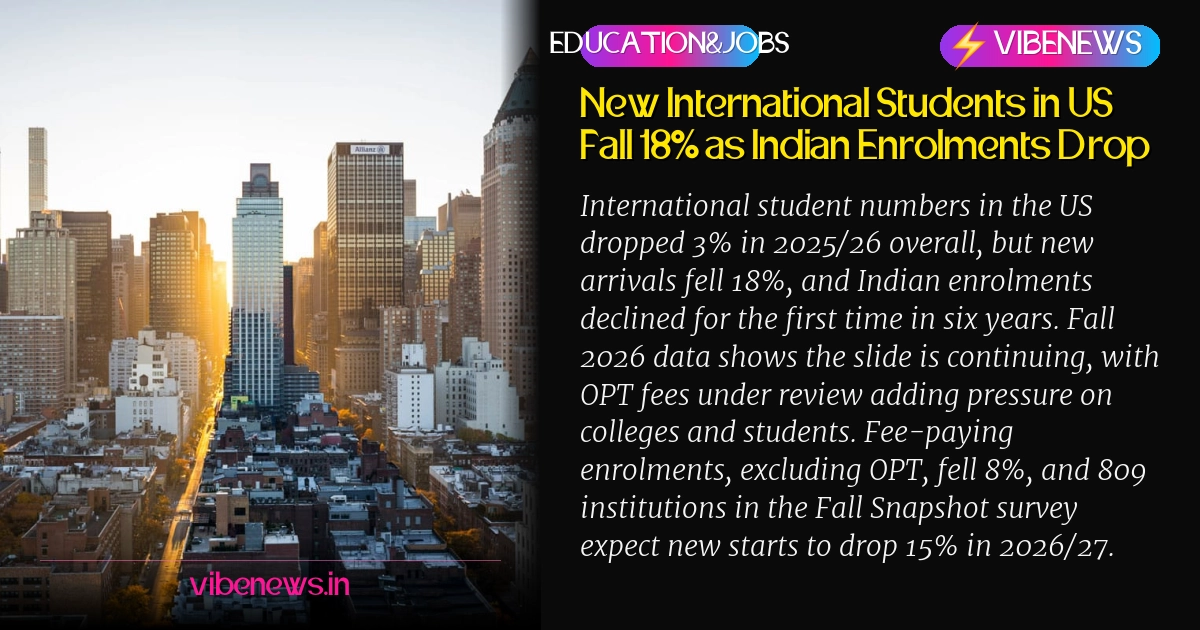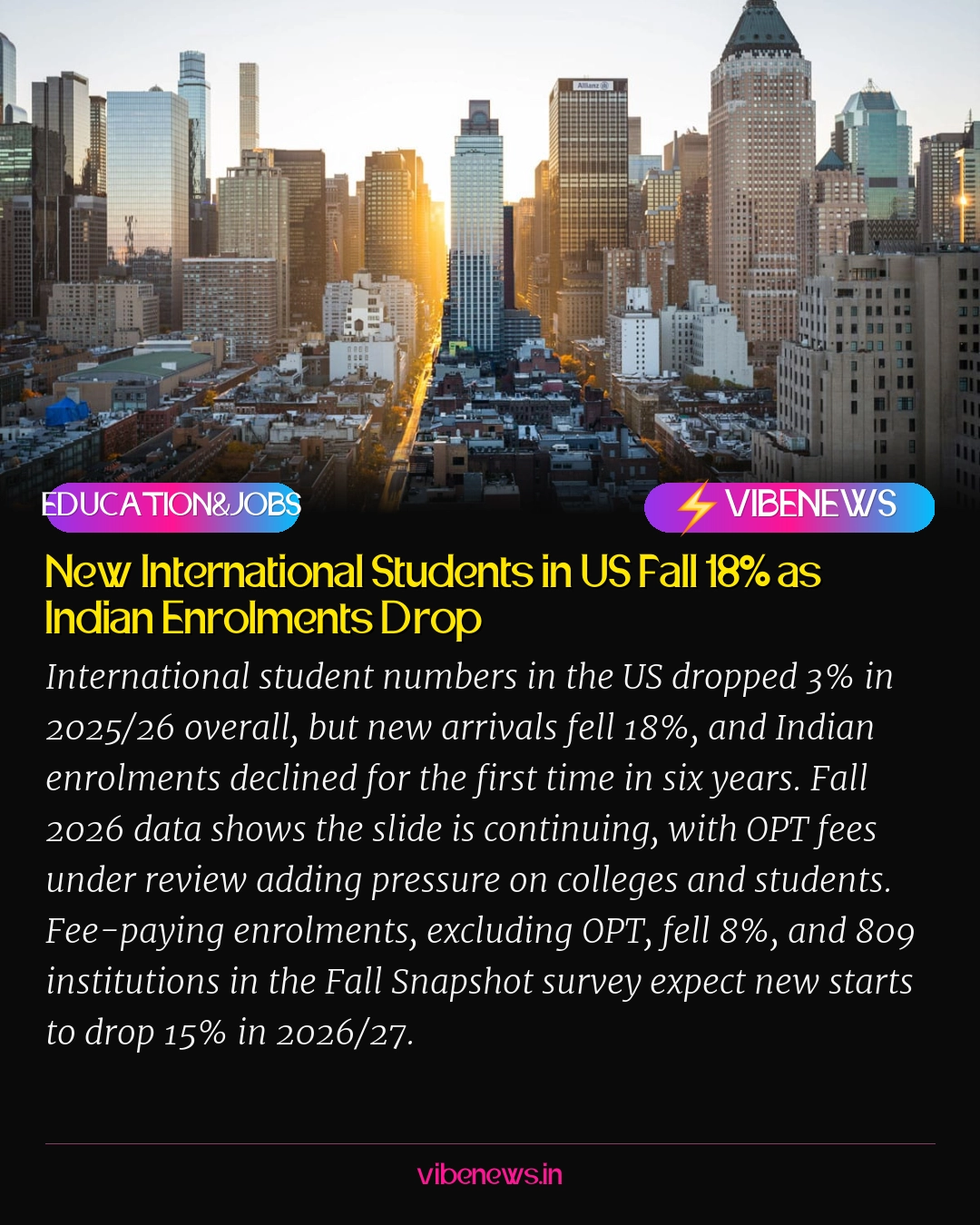

New international student enrolments in the United States fell 18% in 2025/26, according to the Open Doors 2026 Report from the Institute of International Education (IIE), and the slide is expected to continue through the current academic year. The report counts students who began their studies for the first time in the US, and that group fell from 277,118 to 228,120.
The headline figure for all international students is less dramatic. Total enrolment, including students on Optional Practical Training (OPT), reached 1,146,160, a 3% decrease from the previous year. That gap between the two numbers is where the real story sits. Commencements have fallen 7% in 2024/25 and then 18% in 2025/26, and colleges are feeling the pressure of fewer new students arriving each autumn.
Stripping out OPT changes the picture
OPT is a temporary work permit that lets students stay in the US after finishing their programme. Those students still hold F-1 visa authorisation, but they are not really enrolled in a course. IIE’s figures include them anyway, which makes the overall decline look smaller than it is.
Remove OPT participants and the count of fee-paying students drops from 883,513 in 2024/25 to 810,378 in 2025/26. That is an 8% fall in a single year, more than double the 3% headline decline. Universities have been absorbing this steeper drop over the past twelve months.
OPT participation itself rose 14% to 335,785 students, driven by strong growth at the postgraduate level. More than half of OPT participants hold at least a master’s degree. Still, the people in that group are not paying tuition, and that matters for budgets.
India’s numbers are falling fast
Indian students are now part of a clear downward trend. Indian enrolments fell 6.5% in 2025/26, the first decline for India in six years. China dropped 4.5% and South Korea fell 3.5%. Together, these three markets make up 56% of the international total, so their movements shape the national picture.
The Indian decline hit hardest at the postgraduate level. More than half of Indian students in the US study at that level, and their numbers fell 34% between 2024/25 and 2025/26. That single drop was enough to drive the overall loss of international postgraduate enrolments in the US.
Indian students still drive growth in OPT, with a 27% rise. But the Fall Snapshot results suggest that trend is reversing. Visa figures explain part of the shift. F-1 visa issuances for India fell 53% in the fiscal year from October 2024 to September 2025, while China dropped 29% and South Korea fell 19%.
Other countries are not filling the gap
Several markets grew. Nepal rose 16.5%, Bangladesh 12%, Vietnam 6.5%, and both Canada and Brazil 4%. Those gains helped soften the blow from India and China. However, F-1 visa issuances fell sharply for Nepal, down 50.5%, and for Bangladesh, Brazil, and Vietnam as well. IIE’s analysis suggests US institutions cannot count on these markets to keep growing in the near term.
Nigeria recorded the biggest fall among the top 10 sending markets, down 5.5%. Nigerians have been on a list of nationalities barred from entering the US since January 2026.
What colleges expect for 2026/27
The Fall Snapshot survey covers 809 US institutions, and their early projections are bleak. Respondents expect a 9% drop in international enrolments, a 15% fall in international commencements, a 15% decline at graduate level, and a 6% drop in OPT participation.
Institutions that reported gains credited recruitment efforts (51%) and outreach to admitted students (44%). Those reporting declines pointed to the visa application process (88%), travel restrictions (70%), students choosing alternative destinations (60%), and costs (45%).
The OPT fee proposal raises the stakes
In October 2026, the Trump administration proposed that US institutions pay a fee of US$70,000 for an international student’s first OPT term and US$30,000 for an extension. The public comment period has now closed, and it drew more than 9,000 submissions.
Inside Higher Ed analysed submissions from 22 members of the Association of American Universities. Its finding was blunt:
“not even the nation’s more resourced institutions feel they could afford the fees.”
The Fall Snapshot respondents were clear about the risk. Some 95% said international students would likely look at other study destinations if OPT opportunities were limited. Another 83% said OPT availability is a significant factor in their ability to recruit overseas. If the fees go ahead, the current decline could speed up, with effects reaching local economies, the national economy, and tuition for domestic students. Tuition from international students helps US institutions keep fees lower for domestic students than they otherwise could.
Recruitment continues despite the pressure
Colleges are not giving up on international students. Some 81% of responding institutions said international student recruitment is a priority, and 75% said they have at least as much funding as before to pursue it. The main focus is attracting foreign STEM students across all programme levels.
At graduate level, the most-cited priority markets are India (68%), Vietnam (50%), and Nepal (41%). At undergraduate level, Vietnam leads at 65%, followed by India at 50% and Brazil at 45%. More than half of institutions (57%) said they recruit international students in US high schools, and 48% reach out to foreign students already in undergraduate programmes.
The money and jobs at stake
NAFSA: Association of International Educators and JB International combined the Fall Snapshot findings with October 2026 SEVIS records to project the economic impact for 2026/27. They expect a loss of more than US$2.4 billion in revenue and 31,000 fewer jobs.
NAFSA points to two main reasons for the scale of the projected losses. Nearly 30% of international students in the US are now in the OPT phase, which means a growing share of them contribute nothing to tuition, housing, or dining revenue. Graduate enrolment has also fallen 15%, cutting out a group that typically spends more on tuition, living costs, and accompanying dependents.
For students and parents weighing a US degree, the figures point in one direction. Fewer international students are starting programmes each year, the fees for post-study work could rise sharply, and the countries that once sent the most students are sending fewer. Whether the OPT proposal survives will shape how many students still choose the US over other destinations.
TL;DR
- New international student starts in the US fell 18% in 2025/26, according to the Open Doors 2026 Report.
- Total international enrolment, including OPT, dipped 3% to 1,146,160 students.
- Fee-paying enrolments, excluding OPT, fell 8%, more than double the overall decline.
- Indian enrolments dropped 6.5%, the first decline in six years, while postgraduate numbers fell 34%.
- The Fall 2026 Snapshot survey expects new commencements to fall 15% in 2026/27.
- NAFSA projects a loss of more than $2.4 billion in revenue and 31,000 jobs for 2026/27.