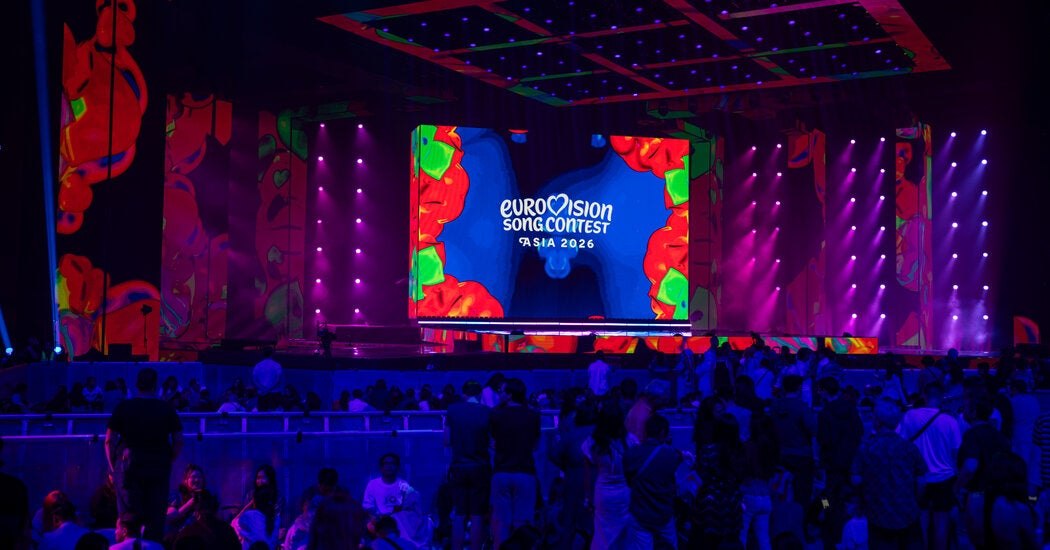
The Eurovision Song Contest Asia crowns its first champion in Bangkok on Saturday night, with singers from 11 countries competing in a new market for the European-born competition. The show goes live on YouTube at 8:30 p.m. local time, which is 8:30 a.m. Eastern, and will also air on television stations across the region.
The participants are Bangladesh, Bhutan, Cambodia, Laos, Malaysia, Mongolia, Nepal, the Philippines, South Korea, Thailand and Vietnam. Vietnam’s Toc Tien opens the show. She performed “Em Tien,” or “Little Fairy,” a folk-inflected electronic pop track written for the contest that sets traditional Vietnamese melodies against contemporary dance music.
The stakes are bigger than a single trophy. Eurovision has run since 1956, and it is one of the most recognizable events on the European cultural calendar. Past winners include ABBA for Sweden and Celine Dion, who represented Switzerland in 1988. Its organizers have tried to take the format elsewhere before, and it has not stuck. A Eurovision spinoff in the United States, the American Song Contest, ran for one season in 2022. An Australian public broadcaster called off its yearslong attempt to bring Eurovision to Asia in 2021.
This is the third attempt by the European Broadcasting Union to build an Asian spinoff. Assaf Blecher, the contest’s executive producer, says the timing is better this time. Pop music from South Korea, Japan and Thailand now has global appeal, and he believes Eurovision fans are curious about what is happening beyond Europe.
The European Broadcasting Union’s director of the Eurovision Song Contest, Martin Green, was careful about expectations. He said the organizers know they cannot simply carry the brand over.
“It would be profoundly arrogant to think that just because we have a heritage brand and a huge global audience for the European show, that we would walk in and demand it to be the same here. Like any new thing, it needs to find its roots.”
The scale difference is hard to miss. The European final in Vienna this year was staged in a 16,000-capacity arena with 35 participants and a four-hour broadcast to tens of millions of viewers. The host broadcaster spent about 16 million euros, or $17.7 million, on it. The Asian debut has 11 competitors and takes place at the One Bangkok Forum, a newly opened auditorium that seats around 5,000 people.
Money is also visible in the betting. Polymarket and Kalshi, two of the largest prediction markets, have the Philippines as the favorite. Malaysia led the markets for most of the week, but odds in Eurovision contests typically shift once fans watch rehearsals and judge who can perform live. More than $100,000 has been staked on the Asian contest across those two platforms. That is a fraction of the millions wagered on this year’s European edition, which also drew bets from traditional bookmakers. Finland’s act was the runaway favorite in Europe this year and finished sixth.
Voting is where the format looks most unfamiliar. Each performer gets half their score from a professional jury in each country and half from public voting on the Eurovision Asia website. Juries rank the songs, and those rankings are converted into points from zero to 12. Viewers get eight free votes, can buy up to 10 more, and must spread their votes across at least three countries. They cannot vote for their own nation’s act. The rule is meant to stop organized campaigns from backing a single act, a problem that surfaced in recent European editions.
Politics is largely absent from the Asian lineup, at least for now. Europe’s contest has a long record of geopolitical fights. Georgia withdrew in 2009 after organizers ordered a song’s apparent dig at Vladimir Putin changed, and Russia was barred altogether after its full-scale invasion of Ukraine. Organizers insist the event is “not a contest between governments,” yet they still police lyrics, symbols and broadcasts.
The Asian field has its own friction. Cambodia is performing in Thailand less than a year after a border war between the two neighbors killed dozens and displaced hundreds of thousands. Still, none of that has turned into a controversy on the Eurovision stage. Mr. Vuletic, a historian of the show at the University of Luxembourg, expects politics to become more visible if the Asian event grows and draws a bigger audience.
The biggest absences are China, Japan and India. Broadcasters from all three discussed taking part but did not sign up before the entry deadline. Pakistan and Indonesia are also missing. Organizers say they are in talks with more countries for future seasons, and the winning country will be invited to perform at next year’s European final, though not as a competitor.
Whether Eurovision Asia becomes a lasting franchise or a one-off remains unclear. Some viewers are already watching the stream. Around half an hour before showtime, roughly 7,000 people were waiting on YouTube, a small number next to the 11 million views the European final’s stream drew in May. Organizers expect most people to watch on their phones and personal devices rather than on television.
TL;DR
- Eurovision Song Contest Asia crowns its first champion in Bangkok on Saturday night, with 11 countries competing.
- The show goes live on YouTube at 8:30 p.m. local time, which is 8:30 a.m. Eastern.
- Viewers cannot vote for their own country and must split at least eight votes across three or more acts.
- Jury scores and public votes will be combined to decide the winner.
- Prediction markets favor the Philippines, though Malaysia led earlier in the week.
- The Asian contest has 11 competitors, compared with more than 30 countries in the European edition.