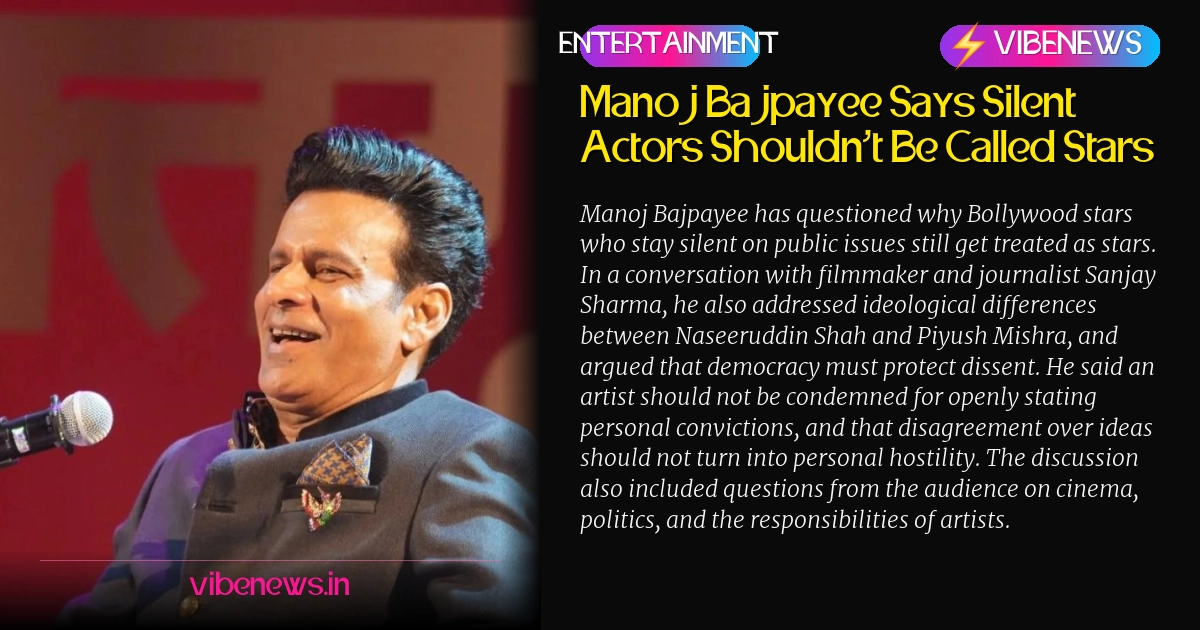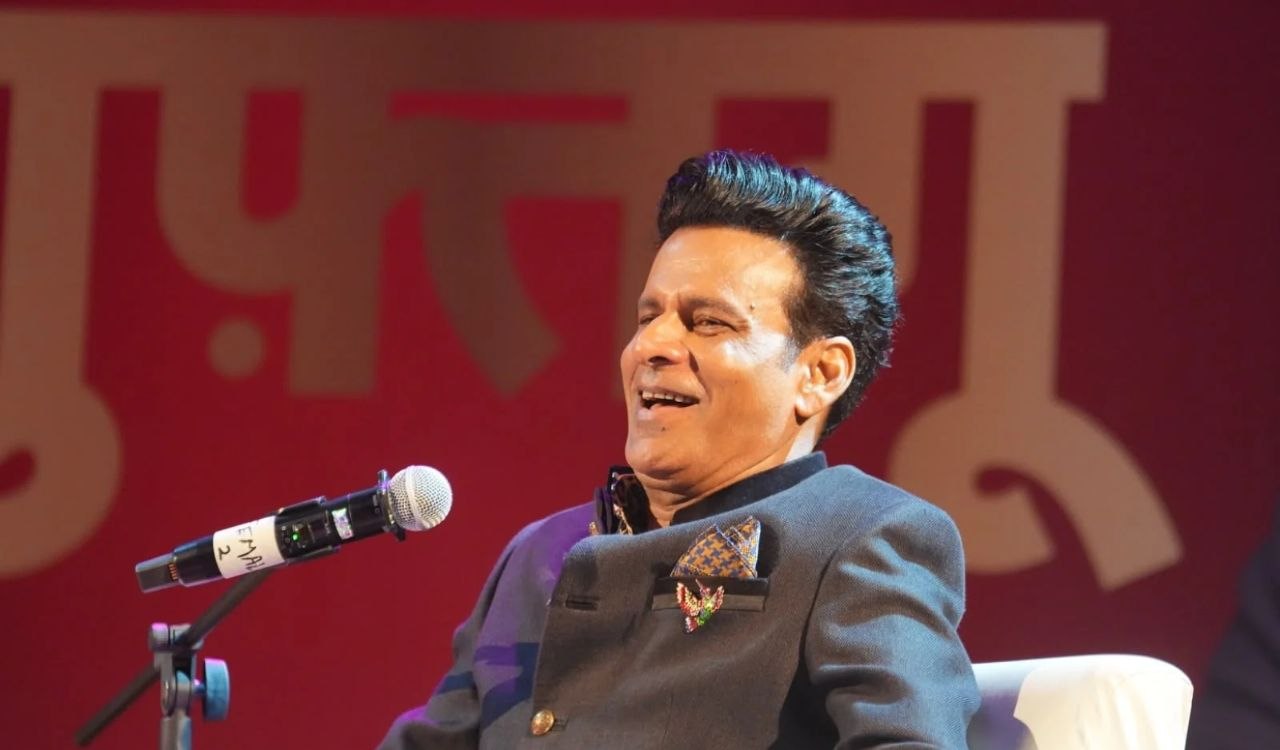
Manoj Bajpayee has challenged one of Bollywood’s most comfortable assumptions: that fame automatically earns an actor respect as a voice of conscience. In a conversation with filmmaker and journalist Sanjay Sharma, the actor asked a question that is likely to linger well beyond the conversation itself. “Why do you even consider those who remain silent on people’s issues to be stars?”
The exchange centred on a familiar contradiction in Indian cinema. Actors are often cast as revolutionaries and champions of justice on screen, yet many step back from the same causes once the cameras stop rolling. Sharma put that gap to Bajpayee directly, and the actor turned the question around rather than defending the industry’s silence.
The Satya actor did not stop at criticising silence. He also made a larger argument about who gets to speak in a democracy. Bajpayee said democracy must allow every individual, actors and non-actors alike, the freedom to express opinions and register dissent. That principle, in his telling, does not come with an exemption for people who happen to be famous.
A debate between two vocal voices
Much of the conversation turned on Naseeruddin Shah and Piyush Mishra, two prominent figures who have never shied away from stating their views. Both are vocal on a range of matters, and their public positions often differ. Sharma asked Bajpayee how he viewed their contrasting opinions and statements.
Bajpayee’s answer was notable for its warmth. He expressed deep admiration for Shah and said his respect for the veteran actor ran so deep that even if Shah were to slap him, he would accept it. The line was delivered as a personal confession, but it also served as a template for how he believes public disagreement should work.
When asked whether disagreeing with someone’s political or social opinions justified dismissing their entire personality, artistic achievements and contribution to cinema, Bajpayee came back to one idea: respect has to survive disagreement. He emphasised that maintaining that respect is what keeps a conversation alive instead of turning it into a fight.
Why he says artists should not be punished for speaking
Bajpayee was clear that an artist should not be condemned merely for speaking openly about personal convictions. In his view, a healthy society has to make room for different perspectives. Disagreements over ideas, he argued, should not automatically become personal hostility.
That position carries weight in an industry where public statements can quickly turn into online pile-ons, boycotts and bruising personal attacks. By separating the idea from the person, Bajpayee is drawing a line that many public figures struggle to hold, especially when opinions are polarising.
The argument also cuts in more than one direction. If silence is criticised, and outspokenness is also criticised, then the real question becomes whether the public is willing to accept dissent at all. Bajpayee’s remarks suggest that the answer should be yes, whether the dissenter is an actor, a writer, a politician or an ordinary citizen.
Audience questions opened up the conversation
The discussion was not limited to the stage script. Members of the audience were given the chance to interact directly with Bajpayee, and the questions covered a wide range of topics. People asked about cinema, the functioning of Bollywood, politics, social conditions, the responsibilities of artists and his personal experiences. Few of those themes are easy to answer in a sound bite, which is why the open format mattered.
Bajpayee, known to a generation of viewers as the lead of The Family Man, engaged across that range. The breadth of the questions reflected how much audiences now expect from public figures. They are no longer seen only as performers. Many people want to know what they think about the country they live in.
What comes next for the actor
Professionally, Bajpayee will next be seen in Ram Gopal Varma’s upcoming horror comedy Police Station Mein Bhoot, co-starring Genelia Deshmukh. The timing gives the conversation an interesting backdrop. An actor who has just questioned whether silent stars deserve their status is about to appear in a film that blends horror and comedy, a genre built on playing with expectations.
Whether Bajpayee’s comments will shift how Bollywood thinks about public responsibility is an open question. What his remarks do is put a sharp spotlight on a long-running tension. Stardom brings visibility, and visibility brings the expectation that a person will use it. Bajpayee is arguing that the expectation should not be used as a weapon against people who speak, and that the people who stay quiet should not be automatically rewarded with the title of star.
For readers, the takeaway is less about any single name and more about the principle underneath. Bajpayee wants room for disagreement that does not erase respect. He wants artists to be free to hold and voice convictions. And he wants audiences to ask harder questions about why silence gets celebrated as neutrality when it may simply be the absence of courage.
That is the kind of argument that rarely fits neatly into a headline. It is also why it is likely to spark debate, both among fans who admire the actor and among critics who see his stance as a challenge to how the industry has long operated.
TL;DR
- Manoj Bajpayee asked why Bollywood stars who stay silent on public issues are still considered stars.
- In a conversation with Sanjay Sharma, he argued that democracy must allow every individual the freedom to express opinions and register dissent.
- Bajpayee said an artist should not be condemned merely for speaking openly about personal convictions.
- He expressed deep admiration for Naseeruddin Shah, saying he would accept a slap from him.
- He stressed that disagreements over ideas should not automatically lead to personal hostility.
- Bajpayee will next be seen in Ram Gopal Varma’s horror comedy Police Station Mein Bhoot, co-starring Genelia Deshmukh.