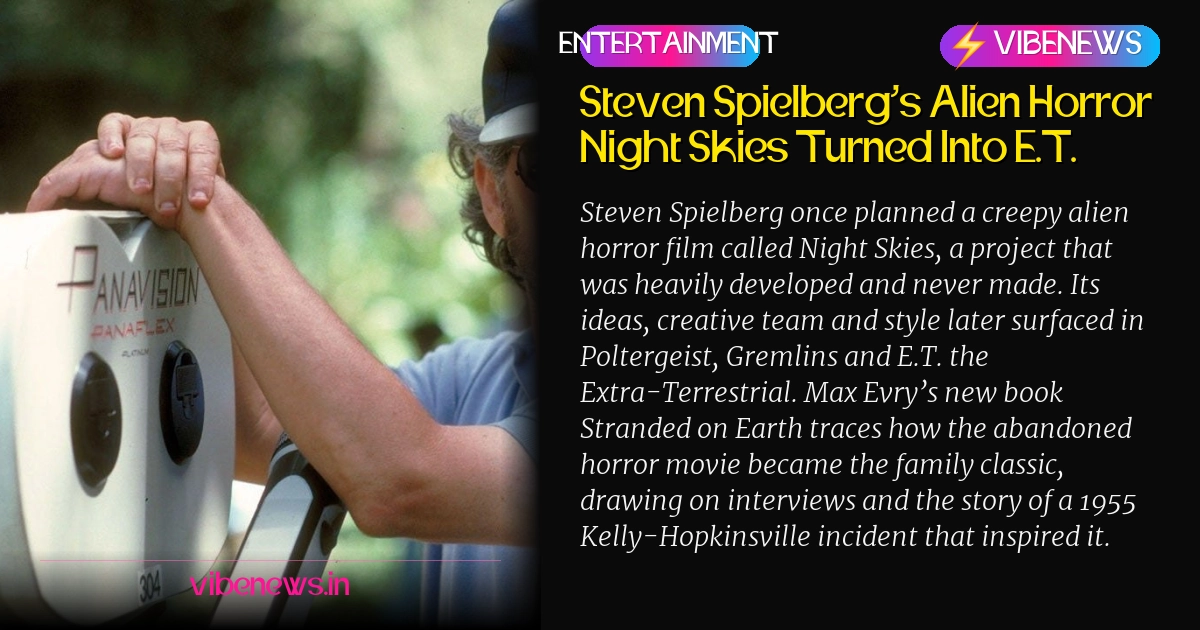
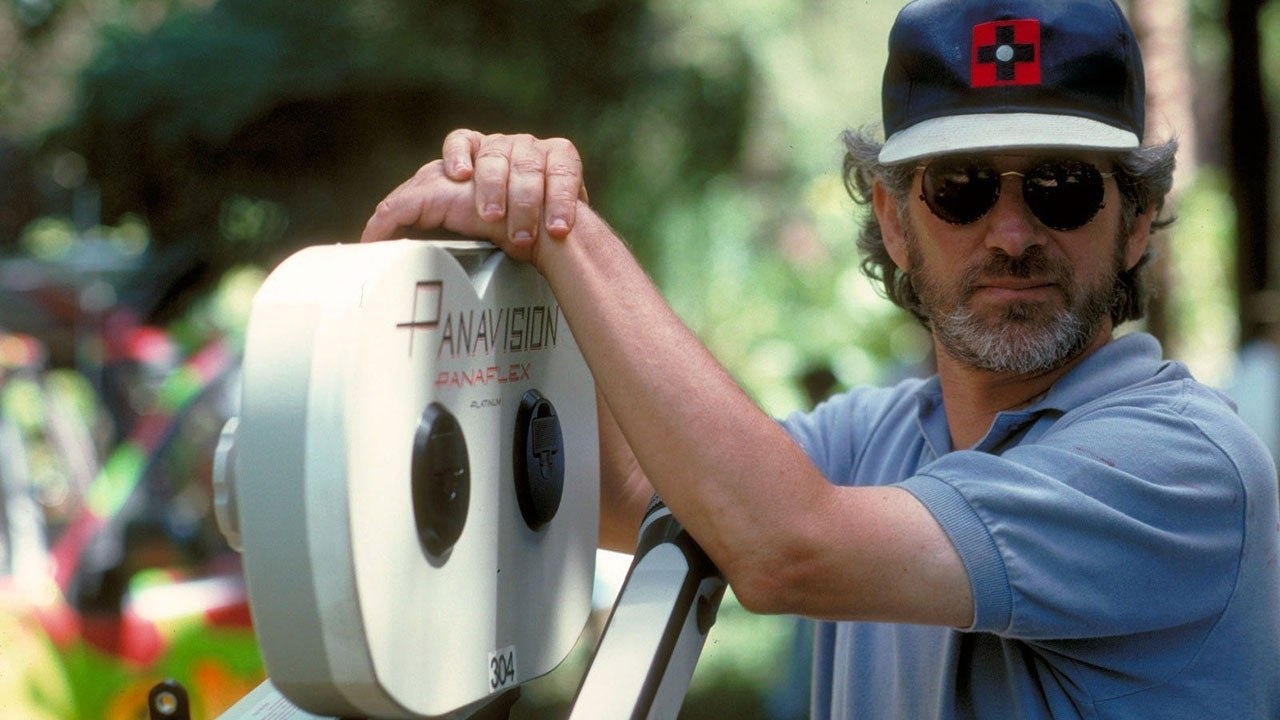
Steven Spielberg was developing an alien horror movie in the late 1970s and early 1980s, and it never got made. Its ideas, its team and even some of its lines ended up in other famous films, including Gremlins, Poltergeist and E.T. the Extra-Terrestrial.
Movie journalist and author Max Evry has written a new book about the project called Stranded on Earth: How Night Skies Became E.T. the Extra-Terrestrial. He describes the original concept in blunt terms. “It was going to be a horror movie about these evil aliens, or mischievous aliens, that come to this rural farmstead and really mess with this family.” The plan had Spielberg producing, John Sayles writing the script and production illustrator Ron Cobb making his directorial debut. Rick Baker was designing the aliens, and Kathleen Kennedy was also on board. Kennedy was working for Spielberg at the time and would soon earn her first full producer credit on E.T.
From Firelight to Close Encounters
Evry’s book starts well before Night Skies. It looks back at Spielberg’s teenage filmmaking, including Firelight, a feature he made for $500 when he was 15 or 16. The film got a theatrical release in his hometown for one night. The Fabelmans recreates that moment. Evry says Firelight already showed Spielberg’s interest in UFOs and the creatures behind them.
“We’re dealing with Spielberg, we’re dealing with aliens, so we got to go all the way back to when he was 15, 16, making his first sort of feature film,” Evry says. He compares Spielberg’s approach to Martin Scorsese’s relationship with gangsters. In his view, Spielberg uses aliens as a tool. “I don’t believe – and there are many people who corroborate this in the book – he has a firm belief one way or the other about alien visitations and things like that. I think it’s just a great tool that he uses to explore different subjects.”
Spielberg followed Close Encounters of the Third Kind in 1977 with a string of plans, and a direct sequel to that film did not interest him much. That is where Night Skies entered the picture. According to Evry, the team spent close to a million dollars developing the project. Some people in the book called it a kind of weird science experiment. Evry thinks it could have been a great movie.
A Bad Year for the Director
The timing made things harder. Spielberg also had 1941, a World War II-era comedy with an ensemble cast that included John Belushi. It opened in theaters in 1979 and became a costly misfire. Evry calls the production “a famous clusterfuck … a nightmare production where he was essentially going crazy with this thing, and it just kept getting bigger and bigger and bigger.” He adds, “It hurt his reputation a lot, and it sort of showed he wasn’t bulletproof.”
That reputation problem followed the project from studio to studio. Night Skies eventually passed from Columbia to Universal, and Universal set conditions. Evry says the studio was willing to proceed, but it wanted the money raised through a bond company. The studio did not want to be responsible if the film went over budget again. “There were a lot of people who thought he might be done,” Evry says. “It was this interesting period where it was like the last time people didn’t trust Steven Spielberg.”
Ideas That Moved Around
Spielberg never planned to direct Night Skies himself. Instead, he started producing films for other directors during this period. The earliest examples were Robert Zemeckis’ I Wanna Hold Your Hand (1978) and Used Cars (1980). Zemeckis and his partner Bob Gale also worked on a script for Spielberg called After School. Evry says that script “had a lot of elements that carried forward into E.T. also.” In his telling, Spielberg blended After School with Night Skies, and that mix produced E.T.
Before that shift, Ron Cobb was the one set to direct. Evry says Cobb developed the project from the ground up. He also pushes back on a claim that the film was ever a choice between Cobb and Tobe Hooper. “There’s some false information out there that it was between Cobb and Tobe Hooper. That is not true.” According to Evry, Cobb was working in Spain on the production design for Conan the Barbarian when Hooper came in much later. Rick Baker was making storyboards without him. Spielberg then reportedly called Hooper about the alien project. Hooper declined but said he would like to make a movie about ghosts.
That ghost movie became Poltergeist. Evry says many fans assume Night Skies fed into Poltergeist, but the two projects were developing at the same time. Both centered on families with the same makeup: a mom, a dad and three kids. The youngest child is the focus in each story, and a supernatural force invades the house. “In one case, it’s ghosts. In one case, it’s aliens.” Some lines from the Night Skies scripts also made their way into Poltergeist, including “They’re here…”
Evry sees even more Night Skies in Gremlins. Chris Columbus wrote the original spec script for Gremlins, but John Sayles took over as a ghost writer after Columbus. Sayles was also the main writer behind Night Skies. Evry points to a real event as a shared source. Night Skies drew inspiration from the Kelly-Hopkinsville Incident of 1955, in which aliens reportedly attacked a farm. It is a famous case in UFO lore, and Evry devotes a chapter to it. He even visited Hopkinsville while researching the book.
That incident is also where the phrase “little green men” comes from, and Evry notes that Gremlins refers to its creatures that way at the end. “If you look at the actual eyewitness drawings of the aliens from Kelly-Hopkinsville, they look a hell of a lot like the Gremlins.”
The Makeup Artist Who Got Hurt
For Evry, Rick Baker was the key creative force behind Night Skies, and he was the one Evry most wanted to interview. For Baker, though, the project brought painful memories. Evry says Baker is the central figure in the book’s most dramatic material. Sayles and Cobb came through the experience fine. Baker did not. “For whatever reason, he and Spielberg just had this tremendous falling out, very dramatic. And it was a trauma for him.”
Evry is careful about how he frames Baker’s story. Baker has seven Oscars now, but at the time he was a newcomer. “I never wanted to portray seven-time Oscar winner Rick Baker as some kind of victim, but the thing you have to remember is at that time he was zero-Oscar winner Rick Baker. He was still kind of new to the business.” Spielberg has his own account of the split, and Evry says it does not match Baker’s version. Evry notes that Spielberg’s comment in another E.T. book reads differently against Baker’s account. He also says other people in Baker’s studio back up what Baker described.
Baker was working on An American Werewolf in London at the same time he was on Night Skies. That film later became a major breakthrough, largely because of Baker’s effects work. Evry argues the Night Skies work was just as strong. He found the original VHS test of the alien that Baker sent to Spielberg. “If you did it today, it would still stand up. And this is far and away ahead of anything being done in makeup effects in 1980.” Evry describes the creature as expressive, versatile and eerie.
Whose Version Holds Up
Evry says the book deliberately asks whose memory is right. Film history often depends on who tells the story, and some accounts are embellished, knowingly or not. Evry compares the structure to Rashomon, with separate chapters on Sayles, Cobb and Baker. Readers see the same events from several angles.
One thing is not in dispute. At some point, Spielberg chose to make E.T. instead. Evry describes the switch as a moment of instinct. “Spielberg has this intuitive creativity where he just said, ‘You know what? I think I can do something else with this.’” Evry hopes horror fans, science fiction fans and Spielberg fans will read the book and see E.T. differently. For Evry, the question is not only what E.T. became, but what it could have been.
TL;DR
- Steven Spielberg developed an alien horror movie called Night Skies in the late 1970s and early 1980s, but it was never made.
- Its ideas, creative team and some lines later surfaced in Poltergeist, Gremlins and E.T. the Extra-Terrestrial.
- The project reportedly cost close to a million dollars in development before it changed direction.
- Max Evry’s new book Stranded on Earth traces how Night Skies became E.T.
- Rick Baker’s alien designs and his falling out with Spielberg are central to the book’s account.