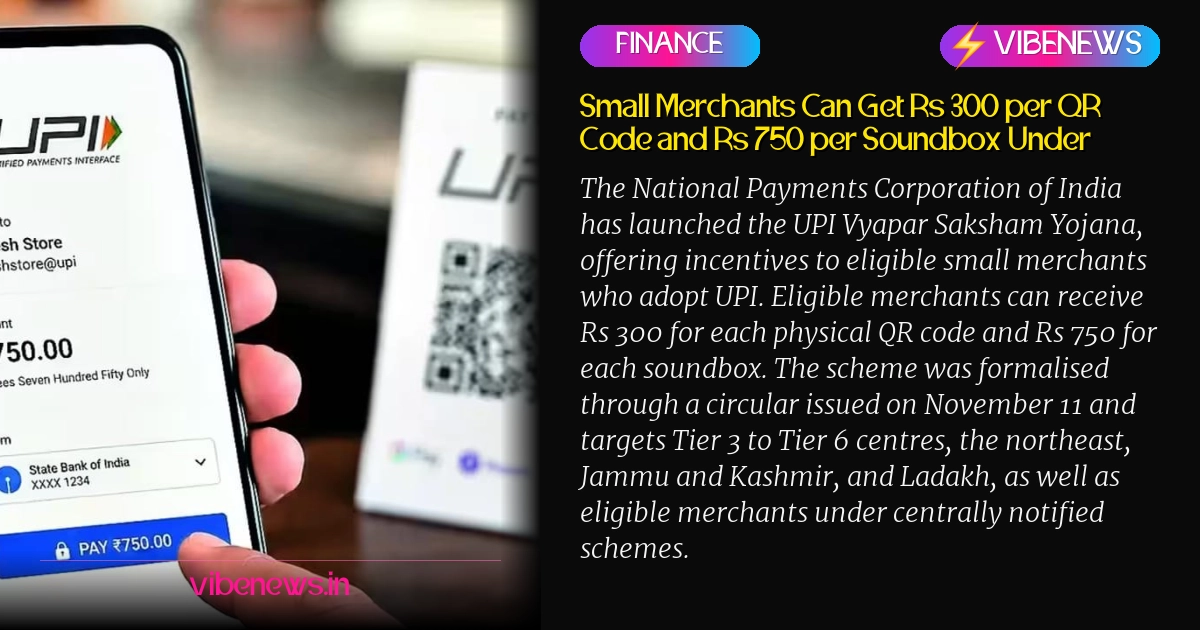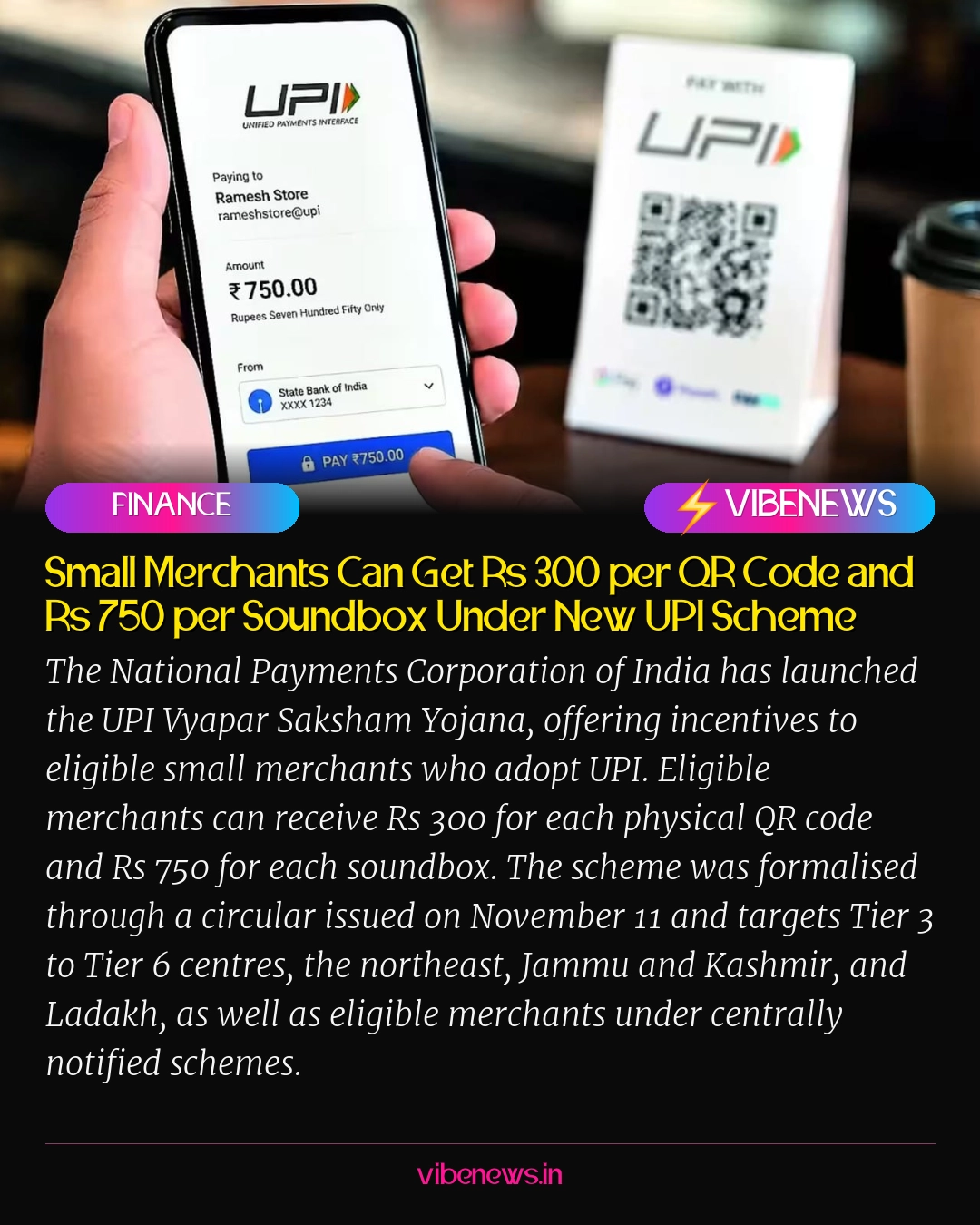
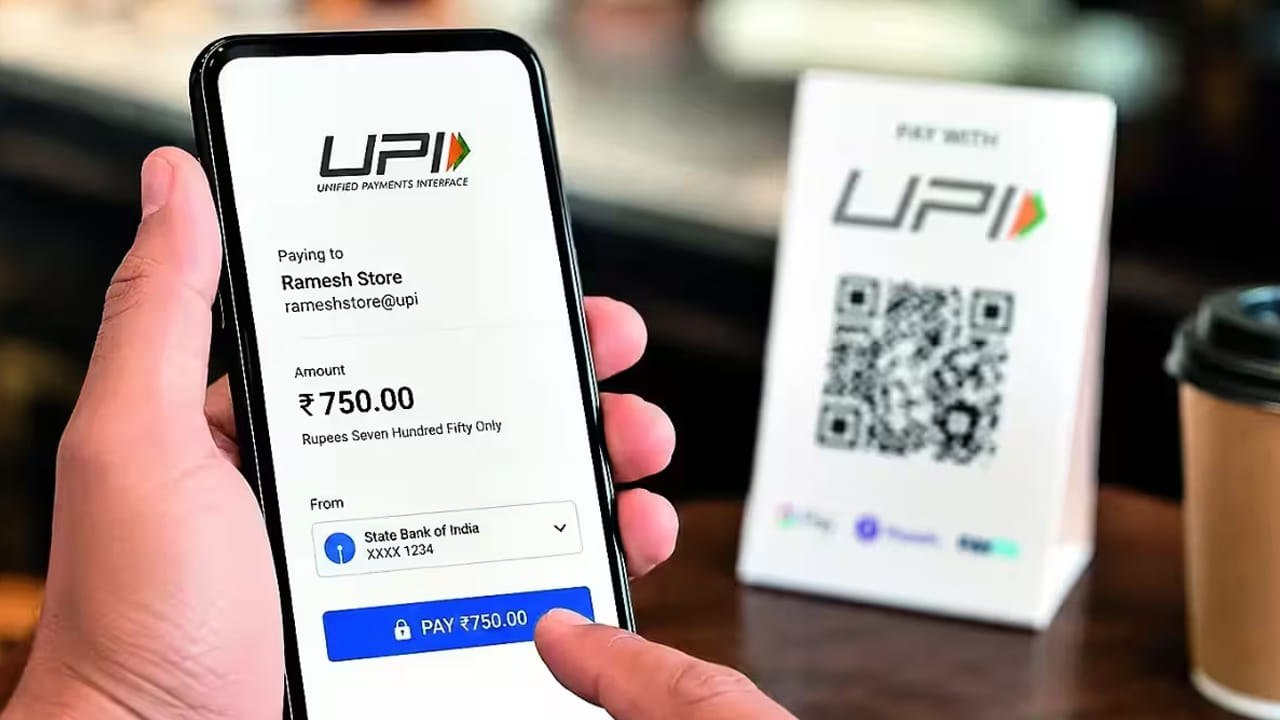
The National Payments Corporation of India (NPCI) has launched the UPI Vyapar Saksham Yojana, a scheme that offers cash incentives to small merchants who accept UPI payments. Eligible merchants will get Rs 300 for every physical QR code and Rs 750 for every soundbox they set up, according to a circular the agency issued on November 11.
The move targets a gap that is easy to see on the ground. UPI transactions are heavy in big cities and large towns, but smaller towns and villages still see far fewer of them. NPCI wants shopkeepers in those places to take digital payments, and the incentive is designed to push that change.
The scheme covers eligible small merchants in Tier 3 to Tier 6 centres, along with the northeast states, the union territories of Jammu and Kashmir and Ladakh, and merchants who qualify under centrally notified schemes. Those tiers cover smaller cities, towns and villages, which is exactly where the reporting says UPI usage lags behind.
The scheme aims to expand UPI infrastructure, bring in new small merchants and encourage continued growth in UPI transactions.
That line describes the scheme’s stated goals as reported, rather than a direct quote from an official. Still, it sums up the logic of the programme. The government is not only paying merchants to sign up. It is trying to build the physical setup, including QR codes and soundboxes, that keeps payments flowing after the sign-up.
The incentive structure has three components, but the details reported so far cover only the first. Component A focuses on onboarding new merchants, and it is the part with a clear payout structure. Reports do not describe what the other two components involve, so readers should not assume how they work.
What merchants need to show to qualify
Under Component A, a merchant must complete at least 25 eligible transactions in at least two of three months. On top of that, the total monthly transaction value must reach at least Rs 5,000 each month. These thresholds are modest, but they tie the payout to real usage. Simply signing up for a QR code or soundbox does not appear to be enough on its own.
For readers who do not use these terms daily, a physical QR code is the printed code a customer scans at a shop counter to pay. A soundbox is a small device that announces incoming payments out loud, so the shopkeeper knows a payment has come through without checking a phone. Both tools are common at small shops, which is why the scheme ties its payouts to them.
The Rs 300 and Rs 750 amounts are paid to merchants, not to the customers who scan the codes or make payments. The reporting says nothing about cash rewards for people who pay through UPI. Anyone hoping for a personal payout from this scheme should not read it that way.
The circular was issued on November 11, and news reports on the scheme followed on November 13. The reporting does not mention an application window or a deadline. It also does not explain how merchants should apply, when the money will reach their accounts, or which institutions handle the process. Those details will matter to any shopkeeper deciding whether the scheme is worth the effort.
The incentive is also limited to merchants who meet the eligibility criteria, which depend on location and on the scheme’s transaction rules. A shop in a big city may not qualify under the tier-based rules, even if it wants the same benefits. A shop in a smaller town will need to check whether its location and transaction history meet the conditions before counting on the payout.
For a shopkeeper in a small town, the first question is practical. Does the business already meet the transaction thresholds, or will it need to build up its UPI activity first? The answer decides whether the Rs 300 per QR code and Rs 750 per soundbox are worth chasing, and the official rules will settle the details that the current reporting leaves open.
TL;DR
- NPCI has launched the UPI Vyapar Saksham Yojana to reward small merchants who adopt UPI payments.
- Eligible merchants get Rs 300 per physical QR code and Rs 750 per soundbox under the scheme.
- The circular was issued on November 11 and targets Tier 3 to Tier 6 centres and the northeast.
- Jammu and Kashmir and Ladakh are also covered, along with merchants under centrally notified schemes.
- Component A requires 25 eligible transactions in two of three months and Rs 5,000 monthly value.
- The incentives go to merchants, and the reporting does not mention rewards for customers.