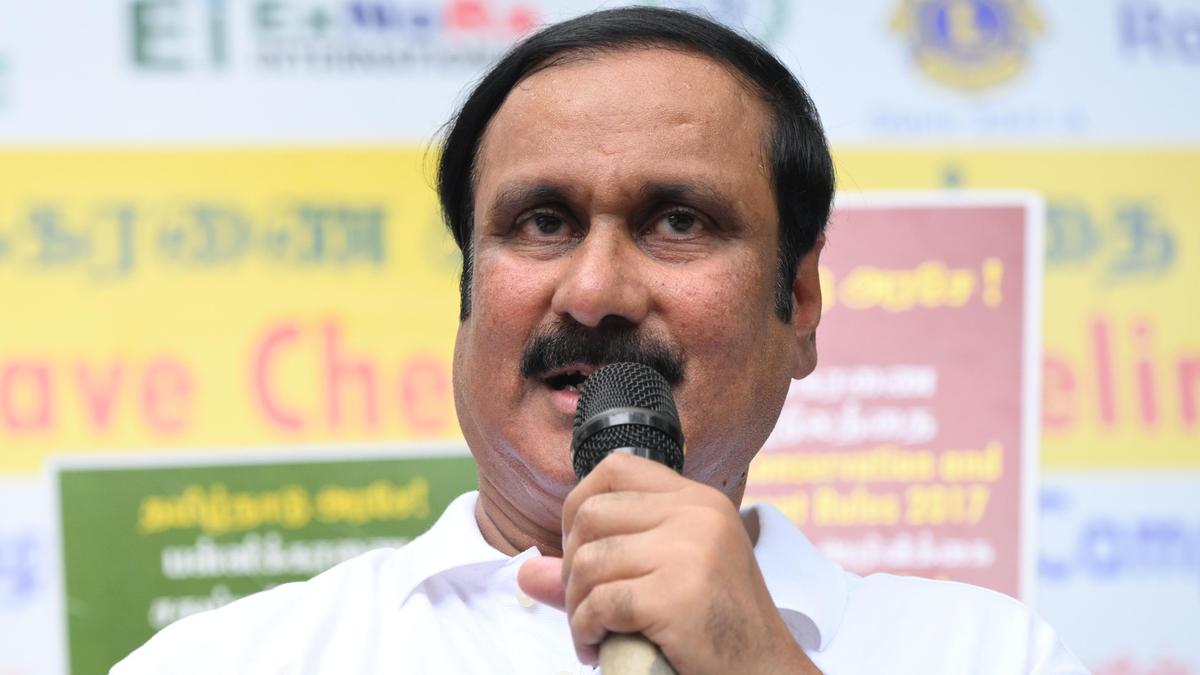
PMK president Anbumani Ramadoss on Friday accused the Tamil Nadu government of recording the highest inflation of 7.29% in October among all states in India, going by figures released by the Union government.
In a statement, Ramadoss said poor and middle-class families are already struggling under rising prices of essential food items, including rice, pulses and edible oils. He placed the blame squarely on the state administration, and he did not soften the charge.
The numbers he cited are hard to ignore. Nationally, inflation has risen to 6.09%, which is above the Reserve Bank of India’s tolerance limit of 6%. Tamil Nadu’s rate, according to his reading of the data, is 1.20 percentage points higher than that national figure.
For ordinary households, inflation is not an abstract number. It measures how fast the prices of everyday goods and services are climbing, and when it runs past the central bank’s comfort zone, families feel it first at the grocery counter and in the monthly budget. Ramadoss’s statement focuses on exactly that pressure.
Rice at the centre of the complaint
Ramadoss singled out rice. He said prices of essential commodities, particularly rice, have climbed to unaffordable levels in Tamil Nadu compared with other states. In his view, the sharp rise in rice prices has directly pushed up the overall inflation rate in the state.
Rice is a staple that rarely has a substitute in the household kitchen. When its price jumps, families cut back elsewhere, and the strain spreads to pulses, edible oils and vegetables. That is the chain of hardship Ramadoss described when he said the poor and middle class are bearing the brunt.
Schemes that did not deliver
Ramadoss also took aim at two specific measures. The first was a scheme to supply onions at subsidised rates through ration shops. He said that scheme has failed.
The second was an announcement that fine-quality rice would be supplied at Rs 30 per kg. According to Ramadoss, that plan did not win public support, because the rice being distributed was merely polished ration-shop rice. In other words, he argued, the promise of better grain did not match what reached the shelves and the households waiting for it.
Those two failures, he said, are part of the reason Tamil Nadu’s inflation has reached such a high level. He did not provide a separate breakdown of how much each scheme contributed to the figure, and the statement does not attempt one.
“The government has failed to take any meaningful action.”
That line sums up the core of the attack. Ramadoss is not only pointing to a high number. He is arguing that the state has had time to respond and has not done so in a way that matters to people buying food every week.
Rural families hit harder
Ramadoss also pointed to the uneven impact of price rises. He said the statistics show that rural populations have been more severely affected by inflation than their urban counterparts.
That detail matters because rural households often spend a larger share of their income on food, and they have fewer cushions when prices rise. Ramadoss did not go into the specific data behind the rural and urban comparison in his statement, but he presented it as a clear finding from the same government figures he used for the state rate.
Income is not keeping pace
The most pointed part of the statement concerns income. Ramadoss said people cannot be expected to withstand further increases in the prices of essential commodities when per capita income in Tamil Nadu has been declining.
That argument shifts the debate from prices alone to what families can afford. If incomes are falling while the cost of rice, pulses and oil rises, the gap between a household’s earnings and its basic needs grows wider. Ramadoss framed that squeeze as the reason the state cannot absorb another round of increases.
What is known and what is not
The core figures in the statement come from Union government statistics, as Ramadoss described them. The 7.29% October inflation rate for Tamil Nadu, the 6.09% national rate and the 6% RBI tolerance limit are the anchors of his case. The statement also references declining per capita income in the state, though the report does not supply the income figures themselves.
The article does not include a response from the Tamil Nadu government to Ramadoss’s allegations, including his claims about the onion scheme, the rice distribution and the state’s role in pushing up prices. Until such a response is on record, the criticism stands as the PMK leader’s account of the data and the policies.
What the statement does make clear is the political stakes. Inflation on essential food is among the most sensitive issues for voters, and Ramadoss has put the blame for the state’s position on the state government itself, using the national data as his yardstick.
TL;DR
- Tamil Nadu recorded the highest October inflation of 7.29% among all Indian states, per Union government data cited by Anbumani Ramadoss.
- Ramadoss says the national inflation rate is 6.09%, above the RBI’s 6% tolerance limit, with Tamil Nadu 1.20 points higher.
- He blames rising rice prices and failed ration-shop schemes for onions and fine-quality rice at Rs 30 per kg.
- Ramadoss says rural populations have been hit harder by inflation than urban ones, according to the same statistics.
- He argues per capita income in Tamil Nadu is declining, leaving families unable to absorb further price rises.
- The statement does not include a response from the Tamil Nadu government.