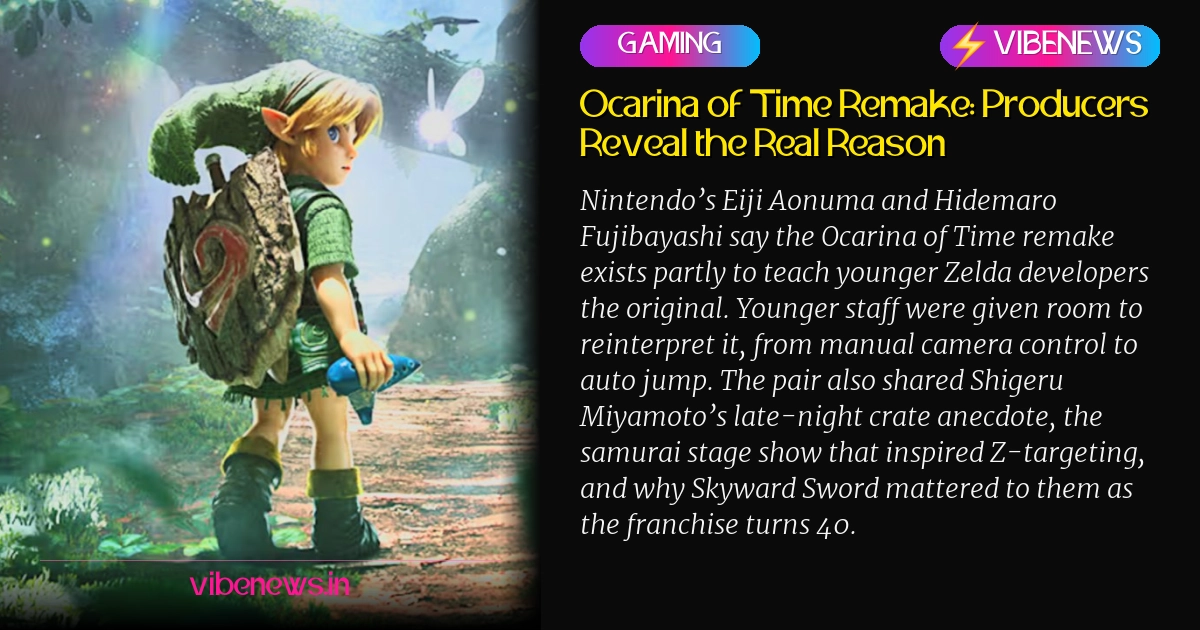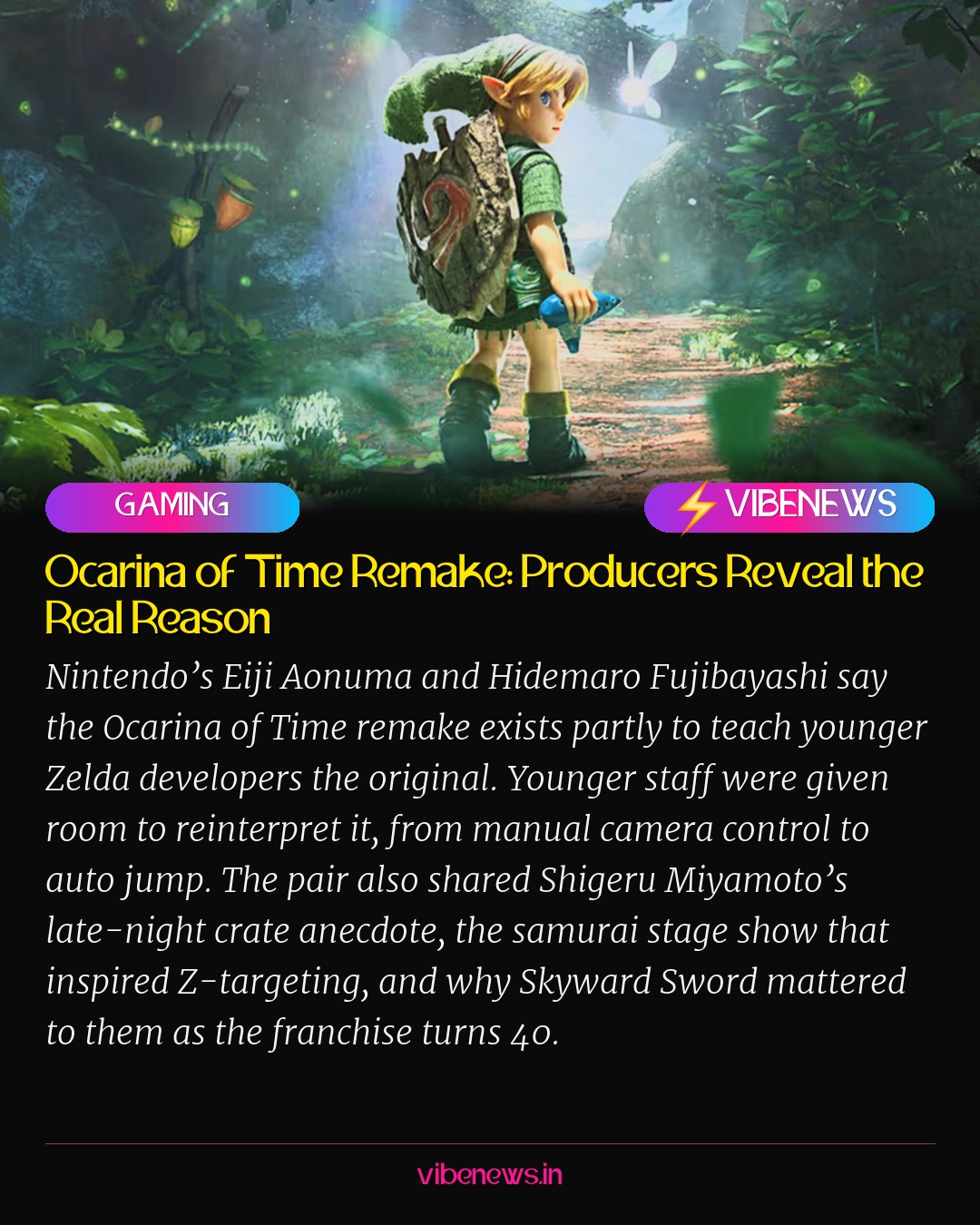
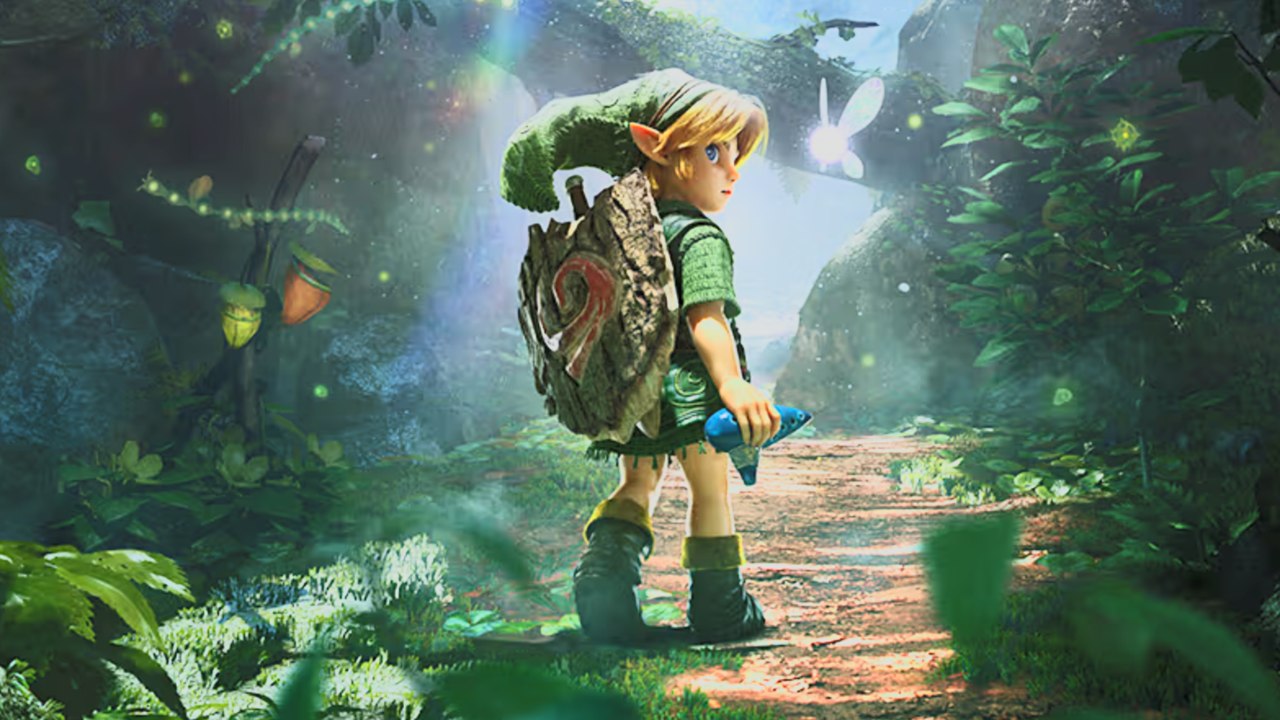
Nintendo’s Eiji Aonuma and Hidemaro Fujibayashi say a big reason the Ocarina of Time remake exists is to hand the original game down to a younger generation of Zelda developers. The pair spoke with IGN for nearly an hour ahead of the launch, as the franchise celebrates its 40th anniversary.
Aonuma says the team working on the remake is made up of much younger developers, and he sees the project as a learning opportunity for them. The idea is for them to play the original first, then build their own reinterpretation of it.
“There are much younger developers who are working on this game, and I do think this is a really valuable experience for them to familiarize themselves first with the original Ocarina of Time and then have their own reinterpretation of it.”
Aonuma also said he hopes these development conversations will help those developers on future projects. The opening tapestry cutscene, which frames Link’s journey as a story worth passing down, was not something he personally built with that legacy idea in mind. Developers working more directly on the game contributed it.
Back to basics, with new tools
Fujibayashi says the return to a more focused, linear 3D Zelda gave the team a chance to bring modern comforts into an older design. He pointed to a second control stick for camera control as one example that eases the experience and lets players focus on what he sees as the core of Zelda.
For Fujibayashi, that core is exploration and discovery. He argues it runs through the entire series, from the very first Zelda game to Tears of the Kingdom. Open-air games make that formula more complex, he said, and the simpler structure of Ocarina of Time lets players dig deeper into it.
How the team decided what to change
Aonuma says he left many decisions to the team. Rather than telling developers what to change, he encouraged them to come to the original and feel for themselves where a change was needed. Two examples he gave were the shift to manual camera control and an auto jump system.
Aonuma acknowledged that the freedom to jump almost anywhere adds extra work, because the team has to control player access. He still believes it gives players more freedom than the original jump system. Fujibayashi said the team defined early on what would change and what would stay the same. The changes leaned into the Nintendo Switch 2 hardware, which covers the camera controls, the jump, fully renewed graphics and improved sound. Every piece of background music is in 5.1 surround sound.
What stayed the same was the experience the original team wanted to convey. Fujibayashi said that was the guiding principle from the start.
Lectures, not rules
Aonuma said his sessions with the team were less like lectures and more like discussions. He asked developers how they felt playing the original and how they interpreted it. If they felt something needed changing, he told them to suggest it. Often, he said, the directors came back to say they did not want to change a thing.
He described a recurring moment in these talks. Younger developers would point to an aspect of the original they saw as important, one that had not been part of the original intent. Aonuma said he listened, because the feeling mattered to them and the direction it pointed them toward was worth supporting.
Both producers said the number of these moments was too high to pick a single example. Aonuma did describe one recurring theme, which is how much imagination to ask of players. That, he said, depends on the information gap a designer leaves. Too much detail, and players lose the satisfaction of making the leap themselves.
A first producer role, and a new kind of communication
This was Fujibayashi’s first time as producer on a Zelda game after directing the last few. He said his role has still been close to the front lines of development. The biggest challenge was communication. The team spans a wide range of ages, and Fujibayashi said he had to adjust how he gave advice depending on whether a colleague had been with the series for a long time or was new to it.
Real-world inspiration, down to the ocarina
Fujibayashi said he grew up in the countryside, and that time playing in mountains and rivers likely shaped the survival elements and food systems in Breath of the Wild and Tears of the Kingdom. For the remake, he said some designers went into the real world to study fabric they wanted to recreate in the game. Others checked out rocks outside to make the world feel like it actually exists.
Aonuma pointed to the animation team’s work on playing the ocarina. Staff studied real players, and some were ocarina players themselves, to get the hand movements right.
He also brought up one of Nintendo’s most famous stories from the original’s development. While the team was figuring out camera control during sword fights, members went to see an actual sword fight at a movie village theme park. That visit led to the idea of fixing the point that orbits around the target, which eventually became Z-targeting. Aonuma said the larger lesson was to look at the real world for motifs that add realism, immersion or ease of play.
Miyamoto’s crate, and the core of Zelda
Aonuma shared a moment from his years working with Shigeru Miyamoto. Late one night, Miyamoto came to him with a simple point: you cannot really cut a wooden crate with a sword. Aonuma said he wondered why Miyamoto was bringing that to him while so busy, but the point stuck. Zelda works best when the world follows rules players already know from real life, so they can predict what might happen.
Aonuma linked that predictability to the physics systems in Breath of the Wild and Tears of the Kingdom. He said the cycle of looking for something, working out how to deal with it, making a discovery, and deciding where to go next is what ties the franchise together.
Favorites, and what came next
Aonuma picked A Link to the Past as his most special Zelda game. Before it, he said, games were things you either won or lost. That game showed him they could feel like a fully realized world, and it sparked the ideas he later brought to Ocarina of Time.
Fujibayashi chose Skyward Sword. He said the hardware limits of that era pushed him toward ideas like diving from the sky and climbing anywhere, and removing a set course. Those ideas, he said, eventually shaped the open-air style of Breath of the Wild and Tears of the Kingdom.
The producers also talked about the remake’s Hall of Fallen Foes, which lets players see models and descriptions of defeated enemies and recreate some boss battles. Aonuma said the team would not announce anything about additional content at this time, though he said developers are always supported when they want to consider what comes next. The interviewers were not permitted to ask about projects outside Ocarina of Time, and parts of the conversation were edited for length and clarity.
TL;DR
- Nintendo’s Ocarina of Time remake is partly a teaching tool for a younger generation of Zelda developers, producers say.
- Eiji Aonuma and Hidemaro Fujibayashi said younger staff were encouraged to reinterpret the original rather than copy it.
- The team used Switch 2 hardware to add manual camera control, auto jump and fully renewed graphics.
- All background music in the remake is in 5.1 channel surround sound.
- Fujibayashi said Zelda’s core is exploration and discovery, from the first game to Tears of the Kingdom.
- Aonuma shared Shigeru Miyamoto’s late-night reminder about cutting a wooden crate with a sword.