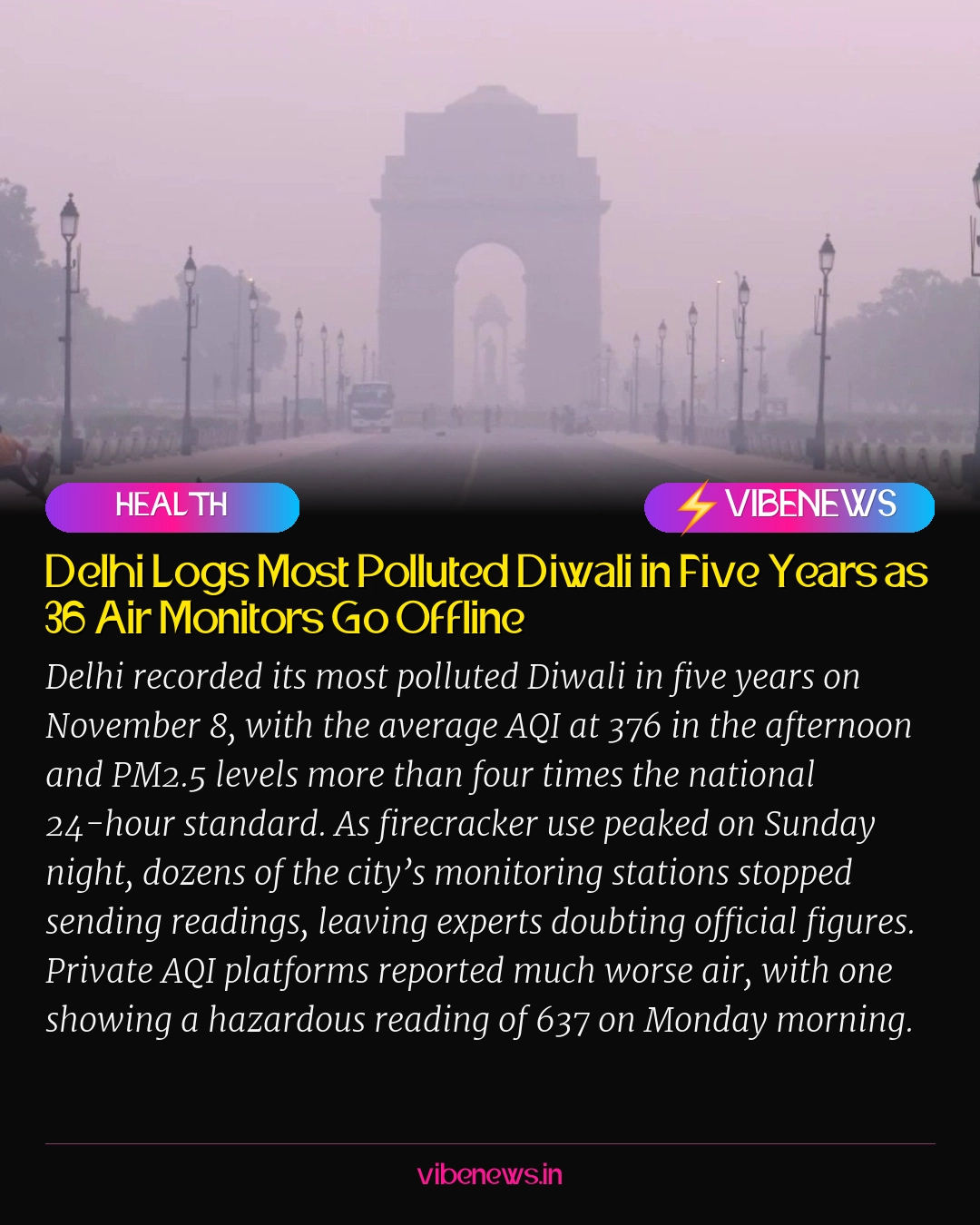
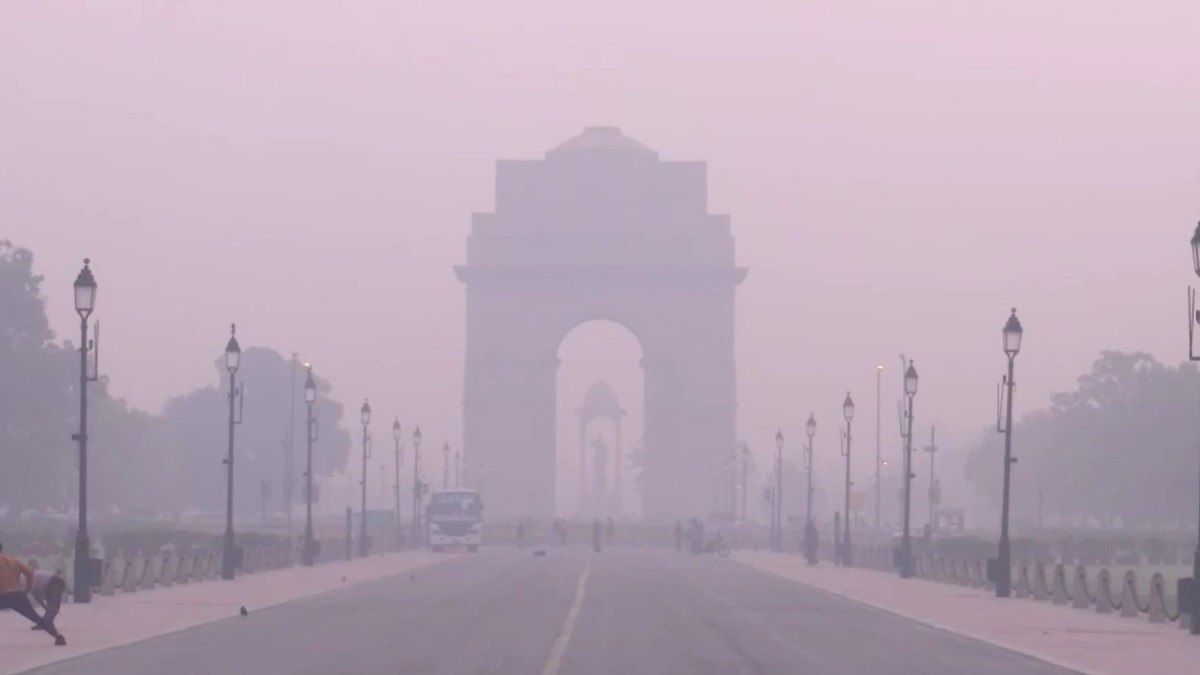
Delhi recorded its most polluted Diwali in five years on November 8, and the city’s air monitoring network went dark just when residents needed it most. The average AQI at 4 pm on Sunday stood at 376, the highest reading on a Diwali day since 2021.
The air did not clear once the firecracker window closed. At 10 pm, when the permitted time for bursting crackers had already ended, the AQI was still 371, and the city remained wrapped in a thick layer of smog. Every year, Delhi’s Diwali night follows the same pattern: pollution climbs, bans on firecrackers are openly flouted, and questions get asked about how reliable the AQI tracking really is. This year those questions became hard to ignore.
The numbers behind the smog
Average PM2.5 concentration in Delhi on Diwali was 257 micrograms per cubic metre. That is more than four times the national 24-hour standard of 60 micrograms, and more than 17 times the 24-hour guideline of 15 micrograms set by the World Health Organization. PM2.5 refers to fine particles small enough to travel deep into the lungs and bloodstream, which is why health experts pay close attention to them during spikes like this one.
Monitors went silent at the worst possible hour
The data gap is what has alarmed analysts most. Around 7 pm on Sunday, only one of Delhi’s 59 monitoring stations was not giving readings. By 1 am on Monday, that number had climbed to 36, meaning only 23 stations were still reporting hourly PM2.5 data. The drop happened during the firecracker peak, when pollution levels were at their highest and the information was most needed.
Anumita Roychowdhury, Executive Director of the Centre for Science and Environment, questioned the failure directly. She said public money had been spent building the Delhi-NCR air quality monitoring network, and active operation and maintenance contracts exist for it. In her view, data disappearing at the peak of Diwali pollution is hard to understand.
When public money has gone into building the Delhi-NCR air quality monitoring network, and there are active operation and maintenance contracts for it, it is incomprehensible that data goes missing at the peak of pollution during Diwali.
Private readings paint a bleaker picture
While official stations struggled to report, private air quality platforms showed a much grimmer picture across most of Delhi-NCR. AQI.in reported an AQI of 637 on Monday morning, which placed the air in the hazardous category. Experts had already begun to doubt government data before that reading came out.
The gap between the two sets of numbers needs some care. Private platforms cannot be compared directly with CPCB readings, because agencies can use different measurement scales, averaging periods and methods. That does not make the private figures wrong, but it does mean neither source can settle the question alone. What is clear is that residents got conflicting pictures of the same air, on the night it was at its most dangerous.
What it means for the city’s residents
For people living in Delhi, the practical problem is simple. Public air quality data is supposed to guide decisions about going outdoors, keeping children inside and deciding whether elderly or sick family members need extra protection. When the official feed goes quiet during the worst hours, families are left guessing. The data gap also raises a harder question about accountability, since the monitoring network is paid for with public funds and maintained under active contracts.
The Diwali numbers also show how far the city is from the standards that govern its air. Even the 10 pm reading, taken long after firecracker time had ended, stayed far above the levels considered safe. Residents woke up on Monday to air that the numbers described as hazardous, and the official record for the most critical hours is incomplete.
TL;DR
- Delhi’s Diwali PM2.5 average was 257 micrograms per cubic metre, over four times the national 24-hour standard.
- Average AQI at 4 pm on November 8 was 376, the highest Diwali-day reading since 2021.
- By 1 am Monday, 36 of Delhi’s 59 monitoring stations had stopped giving PM2.5 readings.
- CSE Executive Director Anumita Roychowdhury questioned why data went missing during peak pollution.
- Private platform AQI.in showed 637 on Monday morning, a hazardous reading, though methods differ from official data.