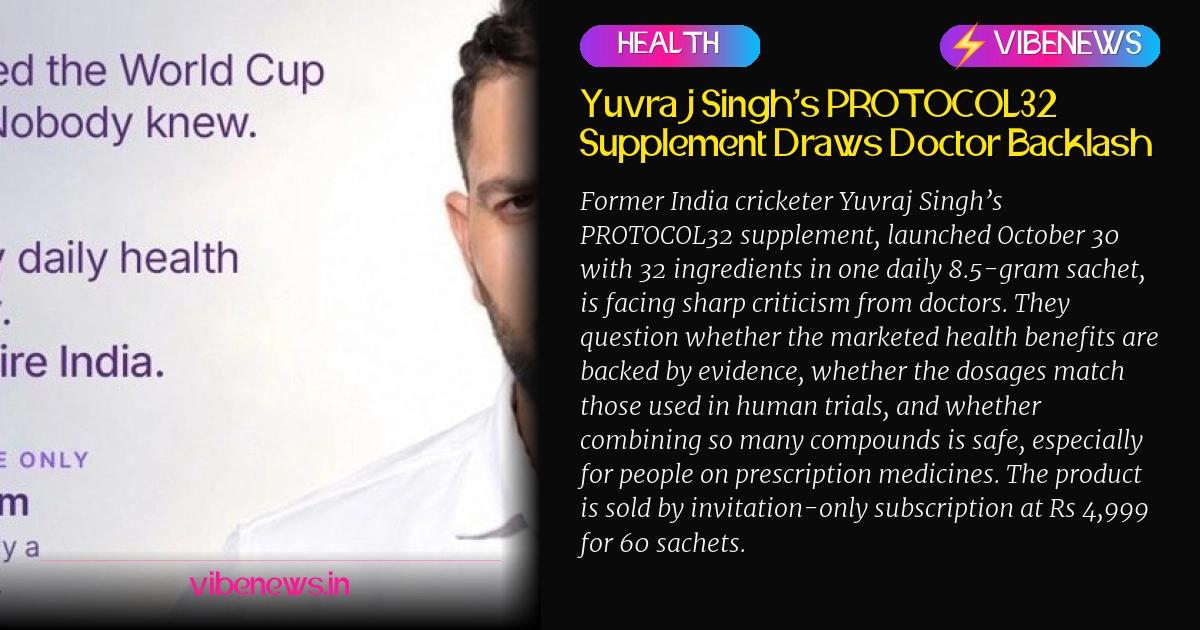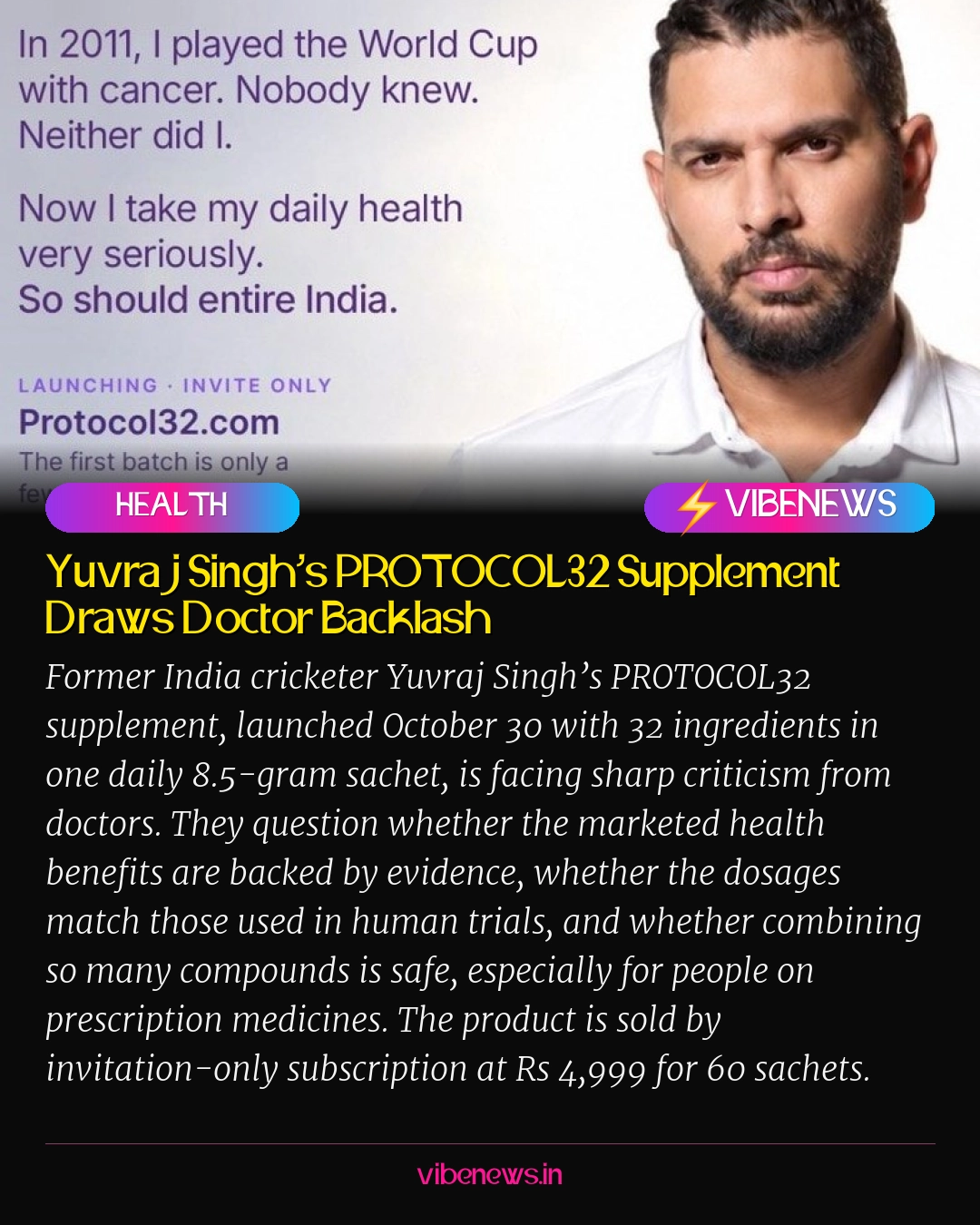
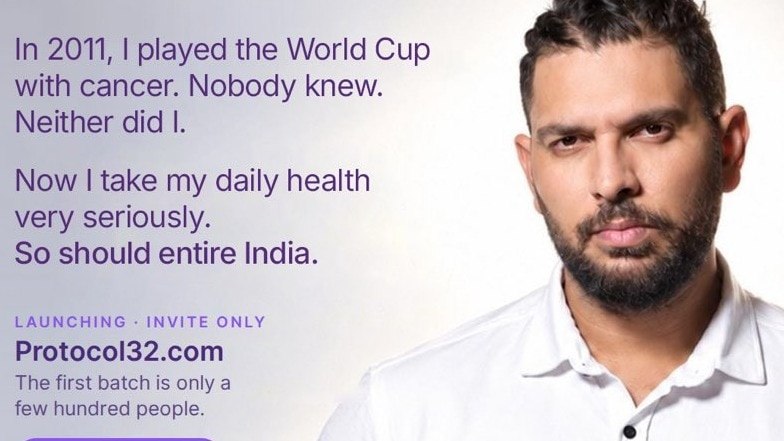
Former India cricketer Yuvraj Singh’s new health supplement, PROTOCOL32, has drawn sharp criticism from doctors who question both the science behind its claims and the safety of packing 32 ingredients into one daily sachet. The product launched on October 30, and Singh says it is licensed by the Food Safety and Standards Authority of India (FSSAI).
The 8.5-gram sachet is built around what the company describes as 10 pillars of health, supported through 13 interconnected processes it calls ‘chains’. Singh, who was diagnosed with a rare germ-cell cancer affecting the mediastinum after India’s 2011 World Cup victory and recovered after chemotherapy in the US, has made health and wellbeing a central part of his public advocacy. That personal story is exactly why the launch has landed so hard.
What the product promises
According to the company, PROTOCOL32 supports energy, brain function, stress and sleep, skin, digestion, immunity, joints, eyes, heart and blood vessels, and liver health. Singh wrote on X that the idea is a once-a-day nutritional supplement covering energy, brain function, immunity, digestion and liver health. He said the formulation was vetted by two senior doctors, Dr Anurag Agrawal, a biologist and professor at Ashoka University, and Prayagraj-based surgical oncologist Dr Arpit Bansal.
The ingredient list is long. It includes creatine monohydrate, glycine, N-acetyl cysteine (NAC), trimethylglycine (TMG), choline bitartrate, algal DHA, magnesium carbonate, CoQ10, vitamins C, E, D3, B6, B2 and B12, zinc citrate, copper gluconate and folic acid. Herbal extracts include ashwagandha, curcumin, Boswellia, milk thistle, American ginseng, bacopa, ginger and saffron. The rest of the blend includes acacia fibre, sunflower lecithin, L-theanine, lutein, zeaxanthin, digestive enzymes, Bacillus coagulans and astaxanthin.
The company says the ingredients were chosen to fill nutritional gaps common in Indian diets and are meant for healthy adults. It also says it publishes ingredient quantities and supporting research, and that batches undergo independent testing.
For now, the product is not sold through regular retail. It is available through an invitation-only subscription model, with the first rollout limited to a few hundred people, including athletes, doctors, dietitians, fitness creators and entrepreneurs. The website lists Rs 4,999 for 60 sachets, a two-month supply.
The doctors push back
The criticism started within hours of the announcement. Dr C S Pramesh, director of Tata Memorial Hospital in Mumbai, one of India’s leading cancer hospitals, questioned the claims on X. He reminded Singh of the responsibility that comes with a large following, called the claims not evidence-based, and asked him to share supporting evidence. He also warned him against letting commercial interests erode the trust of his followers.
Obstetrician and gynaecologist Dr Rajesh Parikh was blunter.
“You will be dragged to court sooner (rather) than later. Drop the ad.”
Doctors have not disputed that individual nutrients matter. Their argument is that the benefit of a single nutrient does not automatically carry over when dozens of them are mixed into one product.
Where the science gets shaky
The sharpest critique came from hepatologist Dr Cyriac Abby Philips, popularly known as LiverDoc, who spoke to India Today. He questioned the assumption that nutrients able to correct clinical deficiencies will also improve the health of people who are already well nourished.
He also pointed out that none of the ingredients has been shown to extend human longevity or prevent cancer. The product makes claims across 10 bodily systems, and Philips said there is no evidence that this specific combination delivers those benefits in healthy adults.
A key gap is between evidence for individual ingredients and evidence for the finished product. Research showing creatine can improve certain measures of cognitive performance does not prove that a sachet with creatine and 31 other ingredients will do the same. Philips said eight of the 32 ingredients lack randomised controlled trial support. Two of those are carriers, acacia fibre and sunflower lecithin. He said six more are backed only by weaker human studies, mechanistic explanations or safety considerations.
Copper gluconate is a case in point. The company says it is included partly to balance zinc supplementation and prevent copper deficiency. Yet the ingredient is also tied to several health claims in the formulation.
The dosage question
Philips argued that several ingredients appear in amounts well below those used in human trials. He cited creatine at 1,500 mg, glycine at 700 mg, NAC at 400 mg, American ginseng at 200 mg, ginger at 100 mg, digestive enzymes at 25 mg and saffron at 15 mg.
A smaller dose is not automatically useless or unsafe. The real question is whether these specific amounts, inside this specific formula, have shown the benefits being advertised. On that point, the company has not yet produced convincing answers in public.
Safety and drug interactions
The safety concerns may matter more to readers than the marketing debate. Doctors are worried about stacking many active compounds in one daily dose, particularly botanical extracts such as ashwagandha and curcumin. Both have been linked to cases of herb-induced liver injury.
Philips flagged possible risks from combining minerals, antioxidants and other compounds without clear data on how they interact in the finished product. His list of concerns included zinc and copper quantities, and the conversion of choline and TMG by gut bacteria into trimethylamine-N-oxide (TMAO). He also raised possible interactions with prescription medicines.
According to him, some ingredients could affect blood-thinning medication, liver drug metabolism and the absorption of certain antibiotics and thyroid drugs. He further questioned the use of antioxidants and folic acid in a product marketed around long-term health. He cited research suggesting some nutrients may have unintended effects in people who already have cancer.
For readers who take prescription drugs or have existing conditions, that is the part to pay attention to. A supplement with 32 ingredients is harder to vet than one with three or four, and the interactions are not something a marketing page can settle.
Singh’s side and the cancer confusion
India Today reached out to Singh’s team for comment, and the report says the copy will be updated if a reply comes in. When contacted, a doctor identified in the report as Dr Agarwal suggested the criticism could be coming from people who misunderstood the product as being meant for cancer. The line was only partly reported, so the full context of that remark is unclear.
That explanation does little to address the core complaints. The product’s own messaging, with its broad promises across 10 health areas, is what doctors are challenging. Nobody in the criticism has said the product is for cancer treatment. They are asking for proof that a daily sachet can do what the marketing says.
The story now turns on whether the company releases independent trial data for the finished formulation, or whether the doctors’ questions get answered with more ads.
TL;DR
- PROTOCOL32, launched October 30 by Yuvraj Singh, packs 32 ingredients into one daily 8.5-gram sachet.
- Critics say the company has not shown that the finished formula delivers the benefits it advertises.
- Hepatologist Dr Cyriac Abby Philips says eight of the 32 ingredients lack randomised controlled trial support.
- Several ingredients appear in doses well below those used in human trials, he argues.
- Doctors warn that ashwagandha and curcumin carry known liver injury risks when combined with many other compounds.
- The product sells by invitation-only subscription at Rs 4,999 for a two-month supply of 60 sachets.