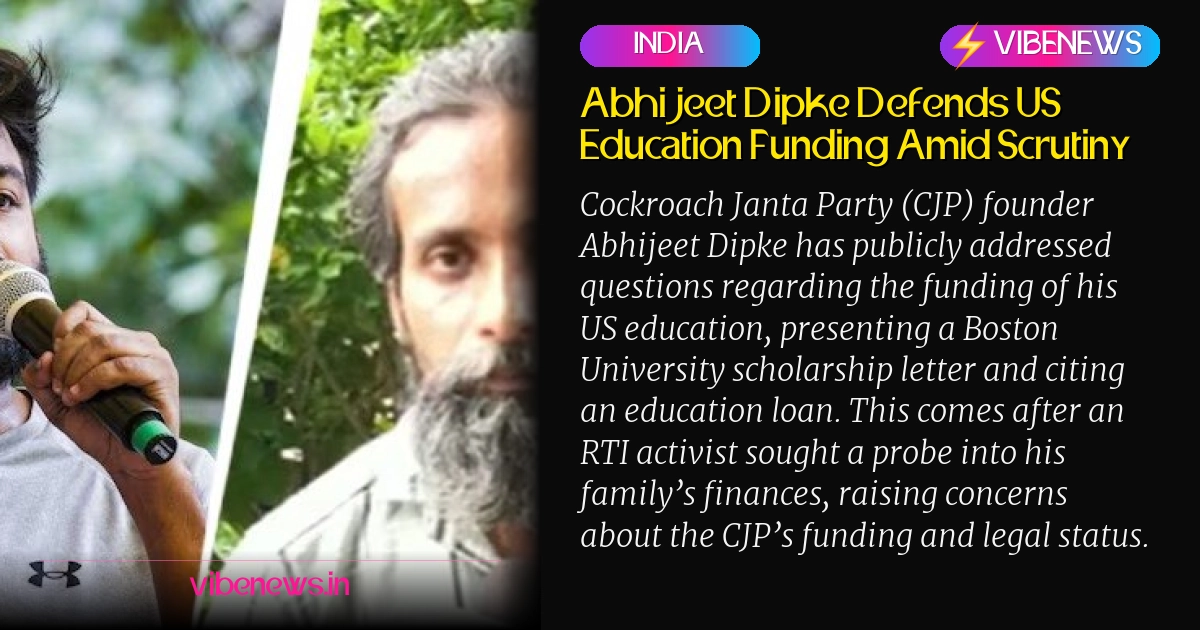

Abhijeet Dipke, the founder of the nascent Cockroach Janta Party (CJP), has publicly addressed the swirling controversy surrounding the funding of his higher education in the United States. Responding to an RTI activist’s demand for a probe into his family’s finances, Dipke asserted that his studies at Boston University were primarily financed through a scholarship and a substantial education loan.
This clarification comes amidst heightened scrutiny of the CJP’s financial mechanisms and legal standing, particularly following its prominent role in recent nationwide agitations. The allegations have cast a spotlight on the financial transparency expected from emerging political voices in India.
The Genesis of Scrutiny
The controversy ignited on August 1st when Surat-based RTI activist Amit Tiwari lodged complaints with various authorities, including the Maharashtra government. Tiwari specifically sought an investigation into the financial affairs of Dipke’s father, Bhagwanrao Dipke, a retired junior engineer from the Maharashtra Industrial Development Corporation (MIDC).
Tiwari’s core contention revolved around the perceived disparity between a government employee’s alleged monthly income of Rs 60,000-65,000 and the substantial costs associated with sending children for higher education abroad. This line of questioning often arises in India when public servants or their families display wealth seemingly disproportionate to their declared income.
Dipke’s Financial Disclosure
In an interview with senior journalist Barkha Dutt, Dipke directly refuted suggestions that his overseas education was bankrolled by undisclosed family wealth. He presented his scholarship letter from Boston University as evidence, emphasizing the significant financial aid received.
Furthermore, Dipke openly acknowledged taking an education loan, which he stated he is now obligated to repay. This dual approach of scholarship and loan is a common pathway for many Indian students pursuing international education, often requiring substantial financial planning and commitment.
CJP’s Future Funding Model
Beyond his personal finances, Dipke also elaborated on the Cockroach Janta Party’s strategy for future operations and funding. He announced that the CJP intends to rely on crowdfunding, soliciting contributions directly from the public with a commitment to complete transparency.
This model, while increasingly popular globally for grassroots movements, faces unique challenges and regulatory oversight in the Indian political landscape. It signals a departure from traditional party funding mechanisms, aiming to foster a sense of public ownership and accountability.
The Anti-NEET Agitation and Public Support
Dipke referenced the recent nationwide protests against the NEET paper leak as an example of the CJP’s ability to mobilize and sustain support through public participation. He highlighted that much of the assistance during these agitations came spontaneously from ordinary citizens.
He recounted instances where protesters received donations of food and water from the public, underscoring a groundswell of organic support. Dipke even alleged that some Delhi Police personnel, sympathetic to the cause due to their own children preparing for NEET, privately offered water bottles, requesting anonymity.
Intensifying Scrutiny and Political Undercurrents
The financial scrutiny of the CJP intensified significantly after veteran lawyer and politician Kapil Sibal announced a Rs 1 crore legal aid fund. This fund was specifically designated to assist protesters arrested during the anti-NEET paper leak agitation, drawing further attention to the CJP’s operational ecosystem.
The RTI activist, Amit Tiwari, has also escalated his concerns to the Election Commission of India (ECI). His complaints to the ECI seek clarity on the legal status of the Cockroach Janta Party and a thorough examination of Sibal’s legal aid initiative, raising questions about political funding regulations.
CJP’s Counter-Narrative
In response to the mounting allegations, CJP spokesperson Vaishnavi Gaur vehemently defended the party and its founder. Gaur accused the RTI activist of selectively targeting a private individual, suggesting a politically motivated agenda behind the complaints.
In a pointed remark on social media, Gaur challenged the activist to also scrutinize funds like the PM CARES Fund, implying a double standard in the application of transparency demands. The CJP collectively dismissed the complaints as politically driven attempts to undermine their burgeoning influence.
Editorial Context
The ongoing controversy surrounding Abhijeet Dipke and the Cockroach Janta Party transcends a mere financial audit; it represents a critical juncture for India’s evolving political landscape. The emergence of youth-led, issue-specific movements like the CJP, often leveraging social media and direct public engagement, challenges established political norms.
This episode highlights the delicate balance between public scrutiny, essential for democratic accountability, and the potential for politically motivated attacks designed to stifle dissent or emerging opposition. The questions raised about personal finances, party funding, and legal status will likely set precedents for how future grassroots movements are perceived and regulated in India.
Over the long term, the resolution of this probe will influence public trust in new political entities and the efficacy of regulatory bodies like the ECI in ensuring fair play. It underscores the increasing demand for transparency from all public figures, irrespective of their political tenure or organizational size, shaping the future discourse on political ethics and accountability in the nation.
TL;DR
- Abhijeet Dipke presented a Boston University scholarship letter and cited an education loan as the primary funding sources for his US studies.
- RTI activist Amit Tiwari initiated a probe into Dipke’s family finances, questioning how his retired father’s income could support US education costs.
- Dipke announced that the Cockroach Janta Party (CJP) plans to adopt a transparent crowdfunding model for its future financial activities.
- The CJP’s finances came under increased scrutiny following Kapil Sibal’s announcement of a Rs 1 crore legal aid fund for anti-NEET protesters.
- An RTI complaint has been filed with the Election Commission of India, seeking clarity on CJP’s legal status and an examination of Sibal’s aid.
- CJP spokesperson Vaishnavi Gaur dismissed the complaints as politically motivated, accusing the activist of selective targeting.