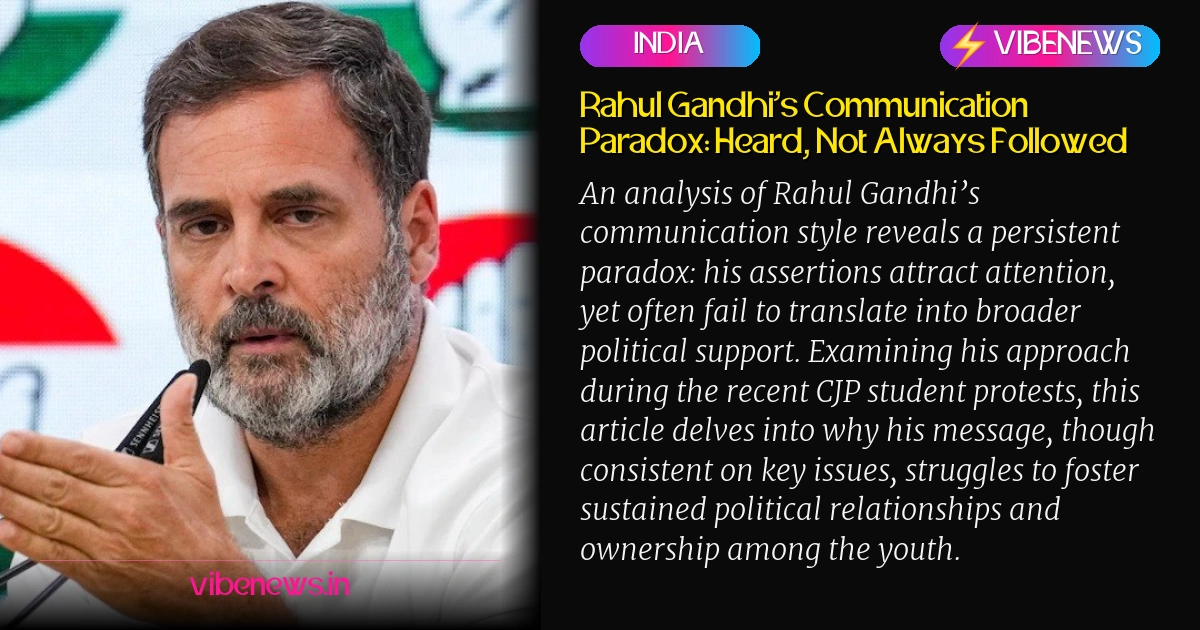
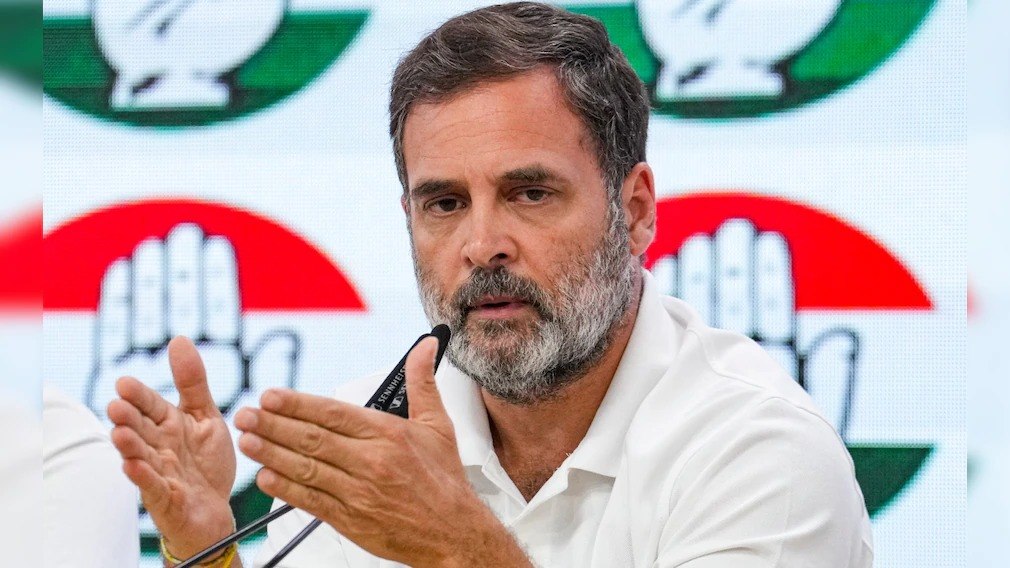
Rahul Gandhi’s recent press conference on July 29, addressing the alleged excessive force used against Cockroach Janta Party (CJP) student protesters, showcased many of his familiar communication traits. It featured a large screen, photographic evidence, a clear opponent, and an emphatic conclusion, delivered with the intensity of a closing argument in a courtroom.
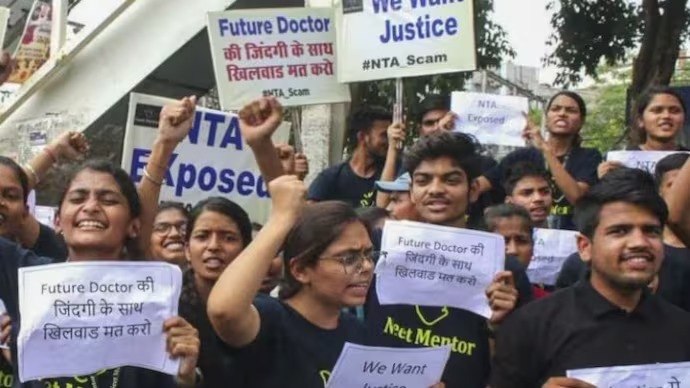
The immediate backdrop was serious. Young CJP activists claimed that pellet guns, lathis, shock batons, and tear gas were deployed during their July 20 protests in Delhi. Gandhi stated he was prevented from fully raising the issue in Parliament, subsequently presenting a stark choice: either Home Minister Amit Shah was aware of the Delhi Police’s actions, making him responsible, or he was not, rendering him incompetent. In either scenario, Gandhi declared, Shah ‘has to go’.
The Student Protests and Congress’s Engagement
This episode was vintage Rahul Gandhi: assertive, accusatory, fluent in both Hindi and English, and unscripted. Yet, it also highlighted a recurring challenge in his political communication: his press conferences often attract significant attention without consistently expanding his political base. He tends to be most persuasive when posing questions, but less so when he appears to have already concluded the investigation and pronounced judgment.
Gandhi has consistently articulated concerns about unemployment, examination paper leaks, the commercialisation of education, and the widespread anxiety among young Indians. He engaged with students in Kota and Dehradun before the Delhi protests. However, when the CJP agitation erupted, the Congress party found itself reacting to events rather than initiating them.
Despite this, the party’s subsequent response was robust. Rahul and Priyanka Gandhi visited injured protesters at Ram Manohar Lohia Hospital, while Congress volunteers provided food, water, and legal assistance. Gandhi then led a sit-in near the Prime Minister’s residence, a powerful visual that positioned him directly in opposition to the state. This direct engagement earned him considerable credit.
An undeniable fact remained, however: the protests fundamentally belonged to the students themselves. When the government eventually entered negotiations, it engaged directly with the CJP. The agitation concluded following the resignation of Education Minister Dharmendra Pradhan and assurances on other demands, with the Congress largely outside the negotiating room.
Gandhi rightly framed the outcome as ‘a victory of the youth,’ emphasizing the Congress’s intention to support the agitation wholeheartedly. Any attempt to appropriate the protest would have alienated the very demographic he sought to connect with. This incident, however, exposed a deeper vulnerability: Gandhi’s ability to identify a political current and lend it moral weight, but his struggle to transform that current into a sustained political relationship.
The Nuances of Political Communication
The CJP did not require Rahul Gandhi to articulate its anger; rather, Gandhi needed to understand how the students had effectively communicated that anger themselves. His press conference style possesses several virtues: he is prepared to take questions, often accepts follow-ups, moves seamlessly between languages, and his body language is animated and authentic. He is not afraid to deviate from a script and can be witty, combative, and occasionally self-deprecating – qualities increasingly rare in India’s controlled political communication landscape.
However, Gandhi’s communication often suffers from an ‘inflation of stakes.’ Every allegation can become a final revelation, every institutional dispute a battle between absolute truth and falsehood. Adversaries are frequently portrayed not merely as mistaken, but as compromised, culpable, or morally bankrupt. Sugata Srinivasaraju has observed that Gandhi frequently constructs binaries of courage and fear, love and hate, truth and falsehood, consistently positioning himself at the virtuous end. This approach risks moral conviction hardening into self-righteousness, hindering the patient and precise pursuit of political issues.
Ramachandra Guha, while acknowledging the Bharat Jodo Yatra’s success in enhancing Gandhi’s credibility and connecting him with ordinary Indians, has criticized his perceived lack of discipline and sustained application. Guha argues that Gandhi often raises critical issues at occasional press conferences only for them to fade from public attention shortly thereafter. His challenge is not in identifying the significant questions of the era, but in converting that awareness into tangible political momentum and sustained engagement.
Lessons from Global Leaders and a Path Forward
The CJP agitation underscored that young people do not necessarily want to be spoken for; they seek the means to speak, organize, create symbols, and exercise political ownership. Great communicators throughout history have understood this distinction.
John F. Kennedy transformed the presidential press conference into live political theatre, yet his apparent spontaneity was built on intensive preparation. Bill Clinton engaged youth culture through MTV forums, structuring conversations around participants’ concerns. Barack Obama consistently sought to understand young people’s hopes and fears, making questioners feel like active participants in the political narrative.
Among women leaders, Jacinda Ardern’s conversational broadcasts and empathetic approach conveyed seriousness without remoteness. Margaret Thatcher, though combative and meticulously prepared, always anchored her sharpness in a clearly defined argument. Indira Gandhi, too, mastered economy and control, rarely appearing to seek approval.
The overarching lesson is not for Rahul Gandhi to imitate any specific leader, but to master modulation: knowing when to argue, explain, empathize, or allow silence to convey meaning. The solution is not fewer press conferences, but more of them, conducted differently and in varied locations.
Gandhi should consider taking his press conferences to educational hubs like Kota, Patna, Prayagraj, Ranchi, Guwahati, and Hyderabad. There, he could engage with district reporters, education correspondents, vernacular journalists, and young independent creators who rarely access the AICC media room. His opening statements should be brief, allowing questions to dominate the session. Reporters should be encouraged to inquire about Congress-governed states, local corruption, examination failures, and the performance of party leaders.
The Congress could then publish answers to unanswered questions, track cases raised by students, and revisit cities to assess changes. This approach would imbue Gandhi’s national arguments with local memory and relevance. Crucially, the human stories often missing from his political communication are readily available. During the CJP protests, there were injured students, anxious parents, aspirants who lost years of preparation, and dedicated volunteers. While Gandhi visited some injured protesters, the national narrative often focused more on his confrontation with Amit Shah than on the students whose injuries prompted it – a significant failure in storytelling.
The CJP succeeded by empowering its supporters with a language they could reshape. Rahul Gandhi’s communication, conversely, often presents an argument that people are expected to accept. This is the critical lesson from one of India’s most consequential recent youth agitations. Gandhi was right to stand with the students, but he must learn to lower the temperature without abandoning the issue. He needs to differentiate a difficult question from a hostile conspiracy, allowing room for uncertainty, humour, testimony, and human detail. Above all, he must resist making himself the central protagonist of every struggle he joins.
Narendra Modi understands presentation, and the CJP understands participation. Rahul Gandhi’s opportunity lies in combining democratic openness with the emotional intelligence to discern when to argue, when to listen, and when to step aside, allowing the voices of those he seeks to represent to take centre stage.
Editorial Context
This ongoing challenge in Rahul Gandhi’s communication strategy holds significant long-term implications for the Indian political landscape and the future of the opposition. In a democracy as diverse and dynamic as India, effective communication is not merely about conveying a message, but about building trust, fostering participation, and creating a shared narrative. For the Congress party, and indeed for any opposition seeking to challenge the dominant political force, the ability to connect authentically with various demographics, particularly the youth, is paramount.
Gandhi’s struggle to convert consistent messaging on critical issues into sustained political relationships highlights a broader issue within Indian opposition politics: the difficulty in translating public discontent into organized, electorally viable movements. Over the long term, if the opposition cannot master the art of empathetic, inclusive, and participatory communication, it risks remaining on the periphery, despite identifying genuine public grievances. This analysis underscores that political leadership in the 21st century demands not just conviction, but also a sophisticated understanding of how to empower citizens to become active stakeholders in their own political story, rather than passive recipients of a leader’s pronouncements.
TL;DR
- Rahul Gandhi’s communication style often attracts attention but struggles to expand his political constituency, particularly among youth.
- During the CJP student protests, Congress responded energetically, but the agitation’s ownership and negotiation remained with the students.
- Gandhi consistently identifies key issues like unemployment but faces a ‘conversion problem’ in turning political currents into sustained relationships.
- His communication style is criticized for ‘inflation of stakes,’ often framing issues as absolute binaries and making himself the protagonist.
- Effective political communication, as seen in global leaders, relies on modulation, empathy, and making the audience feel like participants.
- A path forward involves more localized, open press conferences, focusing on human stories, and empowering constituents rather than merely presenting arguments.