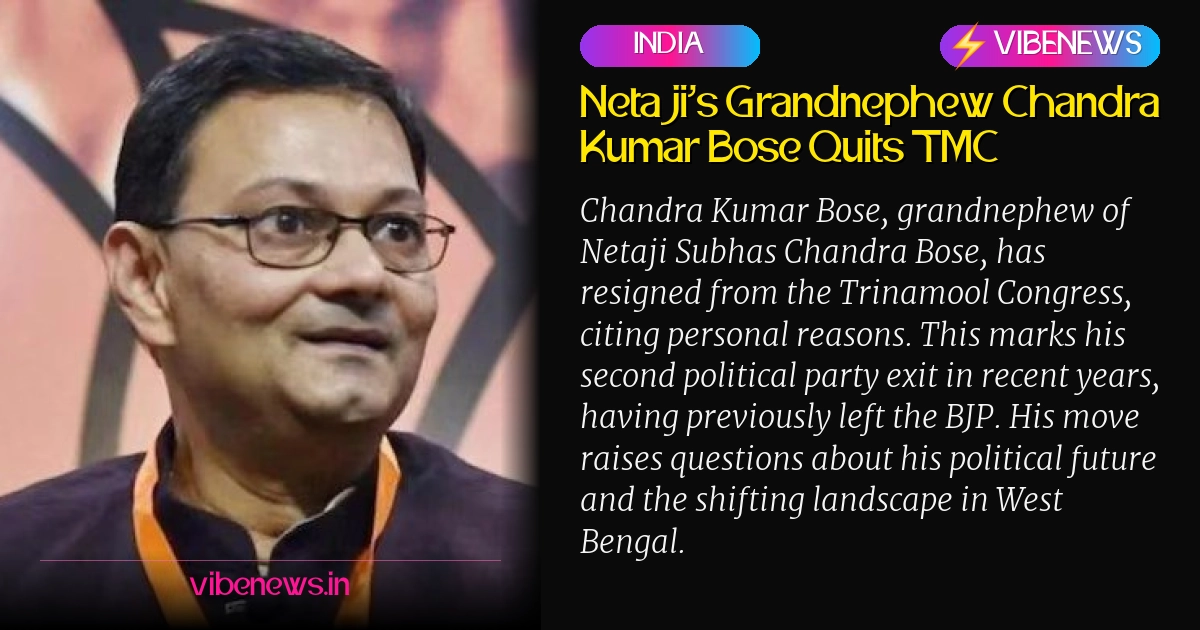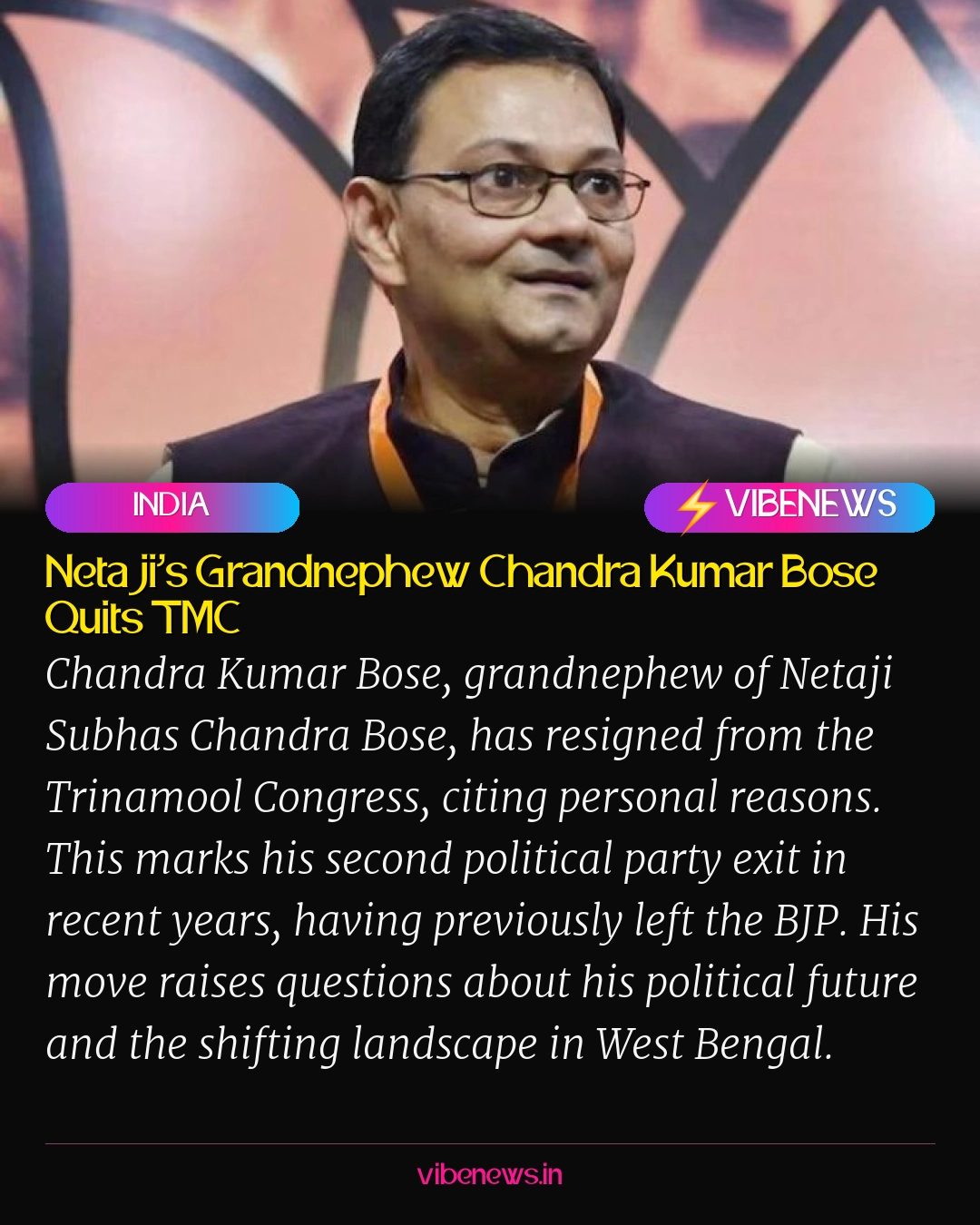
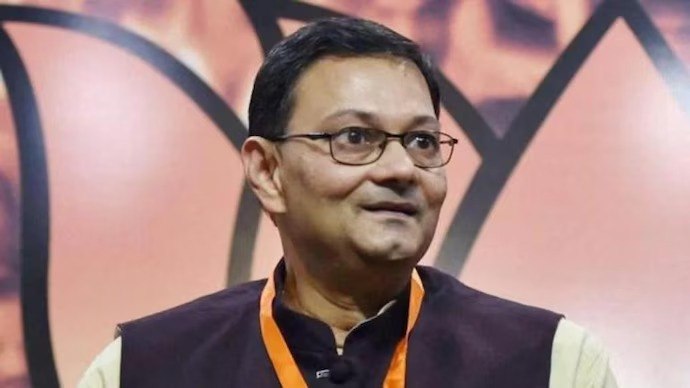
Chandra Kumar Bose, a prominent figure and grandnephew of the revered freedom fighter Netaji Subhas Chandra Bose, has announced his resignation from the Trinamool Congress (TMC). Citing ‘personal reasons’ for his departure, Bose’s exit marks another significant shift in his political career, which has seen him move between major parties in recent years.
His resignation comes nearly four months after he joined the Mamata Banerjee-led party. This latest move reignites discussions about the political allegiances of individuals from historically significant families and the broader dynamics within West Bengal’s political arena.
A Shifting Political Trajectory
Chandra Kumar Bose’s political journey has been characterized by notable transitions. He initially entered the political fray by joining the Bharatiya Janata Party (BJP) in 2016. During his tenure with the BJP, he contested both the 2016 West Bengal Assembly elections and the 2019 Lok Sabha elections, though without securing a victory.
He was appointed as the West Bengal BJP vice-president in 2016, a position he held until a party organizational reshuffle in 2020. Bose eventually resigned from the BJP in 2023, expressing disillusionment. He publicly stated that the party had failed to uphold its promise of promoting Netaji’s inclusive nationalist ideology, which he believed was crucial for national unity.
Following his departure from the BJP, Bose made the decision to join the Trinamool Congress. At the time, he described his earlier choice to align with the BJP as a ‘mistake’ and advocated for a more inclusive political approach. His brief stint with the TMC, however, has now concluded, once again leaving his political future uncertain.
The Weight of a Storied Legacy
Chandra Kumar Bose hails from one of India’s most distinguished political families, a lineage that carries immense historical and emotional weight, particularly in West Bengal. He is the son of Amiya Nath Bose, a former Member of Parliament and a respected lawyer. His grandfather was Sarat Chandra Bose, a senior Congress leader, barrister, and the elder brother of Netaji Subhas Chandra Bose.
The Bose family name evokes a powerful sense of patriotism and sacrifice, making any political affiliation by its members a subject of keen public interest. Political parties in West Bengal often seek to associate themselves with Netaji’s legacy, recognizing its profound resonance with the electorate. Chandra Kumar Bose’s presence in any party, therefore, lends a certain historical gravitas, even if his electoral successes have been limited.
Beyond the Political Arena
Before his foray into active politics, Chandra Kumar Bose built a successful career in the corporate world and as an entrepreneur. An alumnus of the prestigious Indian Institute of Management (IIM) Calcutta and a graduate in Economics from Hendon College, London, he spent 18 years with Tata Steel, rising to the position of Area Sales Manager.
In 2004, he ventured into entrepreneurship, founding Bose Information Technology Pvt Ltd, a company specializing in HR consultancy and skill development. Beyond his professional and political pursuits, Bose has been a vocal advocate for preserving Netaji’s legacy. As a spokesperson for the Open Platform for Netaji, he has actively campaigned for the declassification of files related to the freedom fighter and pushed for greater public access to historical records, aiming to bring more clarity to Netaji’s life and disappearance.
Editorial Context
Chandra Kumar Bose’s repeated shifts between major political parties underscore a broader trend in Indian politics, where ideological alignment can often be secondary to personal or strategic considerations. His journey highlights the challenges faced by individuals from historically significant families who enter the political arena, often burdened by the expectations associated with their lineage.
While his stated reasons for leaving the TMC are ‘personal,’ the timing and nature of his previous exits suggest a deeper struggle to find a political home that genuinely aligns with his vision, particularly concerning the interpretation and promotion of Netaji’s inclusive nationalism. This development also reflects on the political parties themselves, and their ability to integrate and retain figures who bring a unique historical perspective and public recognition.
Over the long term, such movements contribute to the fluidity of political landscapes, particularly in states like West Bengal, where historical narratives and iconic figures play a crucial role in public discourse. It prompts a re-evaluation of how political parties engage with historical legacies and whether they can offer a consistent platform for those who seek to champion specific ideological tenets.
TL;DR
- Chandra Kumar Bose, Netaji Subhas Chandra Bose’s grandnephew, has resigned from the Trinamool Congress (TMC).
- He cited ‘personal reasons’ for his departure, just months after joining the party.
- Bose had previously left the BJP in 2023, alleging the party failed to promote Netaji’s inclusive ideology.
- He contested elections for the BJP in 2016 and 2019 and served as West Bengal BJP vice-president.
- Beyond politics, Bose has a corporate background and actively advocates for the declassification of Netaji’s files.
- His political shifts highlight the challenges of ideological alignment and the weight of his family’s legacy in West Bengal politics.