
India’s Job Challenge: Demographic Dividend Unfulfilled
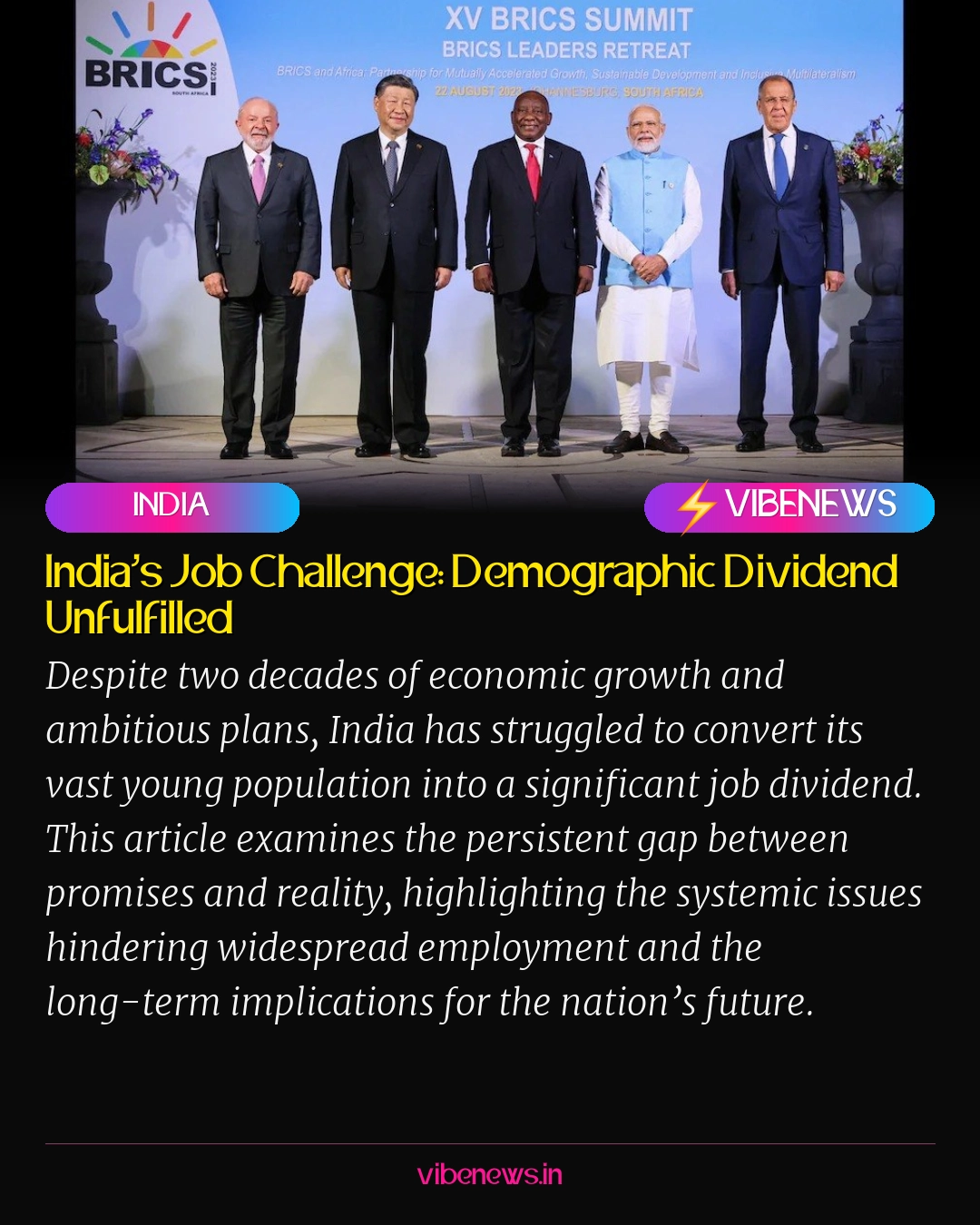
Twenty-five years ago, the ‘BRIC’ acronym emerged, identifying Brazil, Russia, India, and China as rising economic powers. For India, the core argument for its inclusion rested on its vast, young population, promising a significant demographic dividend. This vision, articulated in research notes and echoed in national plans, projected India as a future economic powerhouse fueled by its human capital. However, a quarter-century later, the nation grapples with a profound challenge: the demographic dividend remains largely unharvested, marked by a persistent struggle to create adequate employment opportunities.
The Promise of a Young Workforce
Early 21st-century forecasts painted an optimistic picture. Reports from McKinsey, the Planning Commission’s Task Force on Employment Opportunities, and the AIMA all projected the creation of 72 to 100 million jobs. India’s Tenth Five-Year Plan aimed to double per capita income and generate 100 million employment opportunities, while subsequent plans, the Eleventh and Twelfth, targeted 58 million and 50 million non-farm jobs respectively. These ambitious goals were underpinned by the expectation that a rapidly growing economy, expanding at 8% or more, would naturally absorb the 10 million new entrants joining the workforce annually.
The Reality of Job Scarcity
The actual outcomes have fallen significantly short of these projections. The 12th Five-Year Plan estimated that only 56 million non-farm jobs were created across the entire decade from 2000-01 to 2009-10, with manufacturing contributing a mere 6.6 million. This stark disparity is vividly illustrated by the overwhelming number of applicants for government positions. In 2003, 74 lakh individuals competed for 20,000 railway posts. By 2024, 15.35 lakh candidates vied for just 452 RPF Sub-Inspector vacancies, and 25 lakh applicants, many holding advanced degrees, sought 53,000 peon posts in Rajasthan. This intense competition underscores a deep-seated crisis of job availability.
Policy Responses and Unanswered Questions
Over the years, the narrative around job creation has shifted, moving from Five-Year Plans to tracking metrics like the number of taxpayers or EPF members. State governments frequently host grand investment summits, announcing Memoranda of Understanding (MoUs) worth trillions of rupees, such as Madhya Pradesh’s ₹30 lakh crore or Maharashtra’s ₹15.7 lakh crore. Yet, concrete data on the conversion of these MoUs into actual investments and, crucially, jobs remains elusive. The dissolution of the Planning Commission in 2015 further fragmented data collection and long-term strategic planning for employment.
Sectoral Challenges and Persistent Dependence
Despite decades of reforms and initiatives like ‘Make in India,’ agriculture continues to be the largest employer, supporting 43% of India’s workforce in 2025. This is a significant figure 35 years after the 1991 reforms and a decade after promises to shift labor from farms to factories. The Mahatma Gandhi National Rural Employment Guarantee Scheme (MGNREGS), now known as G-Ram G, with over 10 crore active workers and a substantial allocation, highlights the ongoing need for guaranteed rural employment. While production-linked incentive (PLI) schemes have attracted investments and created 14 lakh jobs, this is a modest figure compared to the scale of the challenge. The services sector, once a beacon of hope, generates over half of the national output but less than a third of the jobs, with NITI Aayog’s own reports offering conflicting figures and uncertain projections for the AI economy.
Systemic Hurdles to Economic Transformation
Several systemic factors contribute to India’s struggle. Unlike other major economies that built global brands through significant R&D investment, India has reached the top five global economies without a comparable focus on innovation. Furthermore, while the 1991 reforms dismantled the ‘licence raj,’ a ‘permission raj’ persists, characterized by a labyrinthine regulatory environment. Enterprises face thousands of laws, compliances, and filings, with a pharmaceutical MSME, for instance, requiring 87 licenses and carrying 992 continuing obligations. This regulatory burden, coupled with a strong political consensus for weak reforms across parties, stifles entrepreneurship and job creation. The implicit assumption that development would proceed successfully, as envisioned in the original BRIC papers, has been undermined by systemic apathy to outcomes, leaving demography waiting for politics to deliver on its promise.
Editorial Context: The Long-Term Stakes
The failure to adequately harness India’s demographic dividend carries profound long-term implications. A large, underemployed youth population can lead to social unrest, economic stagnation, and a significant waste of human potential. The consistent ranking of unemployment and price rise as top voter concerns in Lok Sabha and Assembly elections underscores the political urgency of this issue. Addressing this challenge requires more than just investment summits or new schemes; it demands fundamental reforms in regulatory frameworks, a renewed focus on R&D and innovation, and a robust, data-driven approach to policy-making that genuinely connects investment to job creation. Without these systemic changes, India risks squandering its unique demographic advantage, trapping a generation in a cycle of unfulfilled aspirations and hindering its ascent to true global economic leadership.
TL;DR
- India’s demographic dividend, once a key reason for its BRIC inclusion, has largely gone unharvested over 25 years.
- Early forecasts projected 72-100 million jobs, but actual creation fell significantly short, with only 56 million non-farm jobs created in the 2000s decade.
- Overwhelming competition for government jobs (e.g., 3,400 applicants per RPF Sub-Inspector post) highlights the severe job scarcity.
- Despite numerous investment summits and PLI schemes, concrete data on job creation from these initiatives remains scarce.
- Agriculture continues to employ 43% of the workforce, and the services sector, while contributing over half of GDP, creates less than a third of jobs.
- Systemic issues like low R&D spending, persistent ‘permission raj,’ and complex regulatory compliance hinder entrepreneurship and job growth.