Supreme Court Reserves Order on EC Appointment Law Challenge
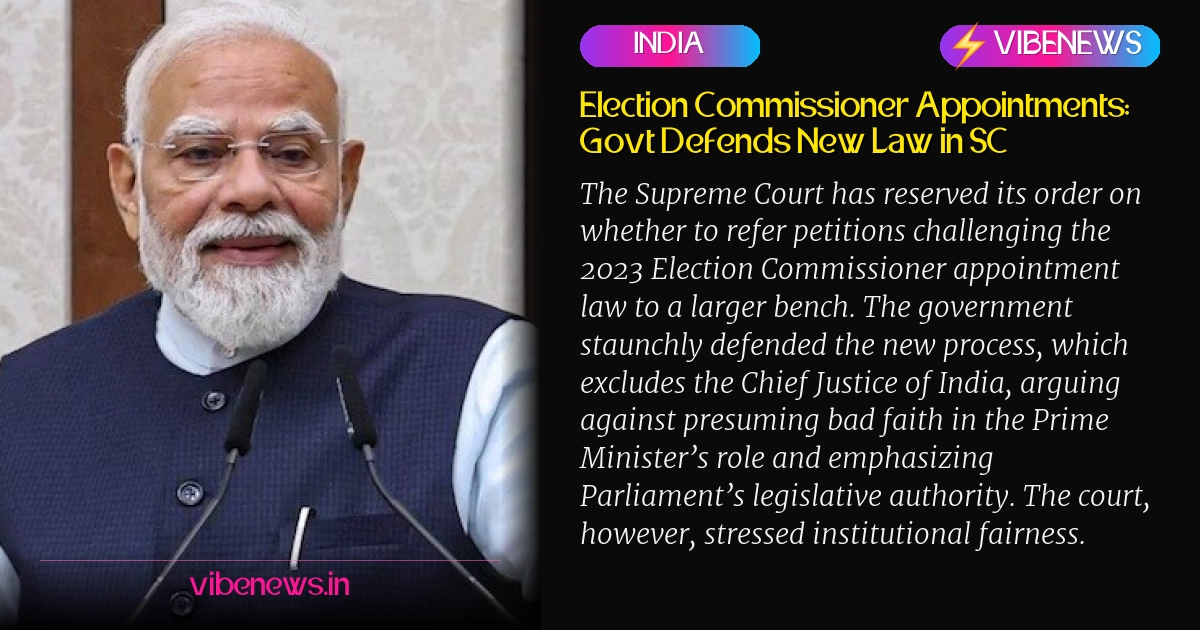
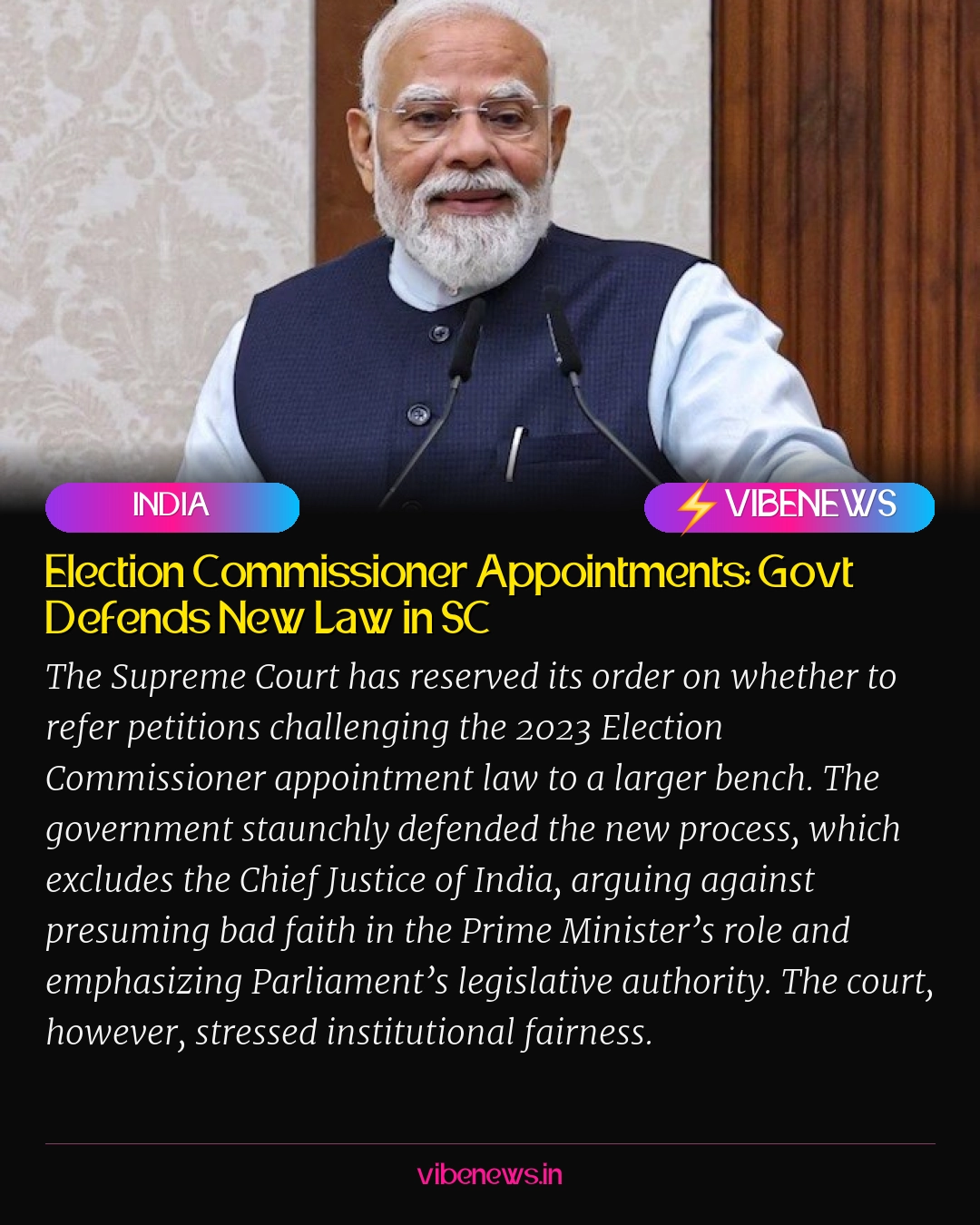
The Supreme Court of India has reserved its order on a crucial preliminary issue: whether to refer a batch of petitions challenging the constitutional validity of the Chief Election Commissioner and Other Election Commissioners (Appointment, Conditions of Service and Term of Office) Act, 2023, to a larger constitution bench. This development follows a robust defense by the government of the new law, which alters the composition of the selection committee for Election Commissioners.
During the proceedings, the government, represented by Solicitor General Tushar Mehta and Attorney General R Venkataramani, strongly argued against the assumption that the executive would act against democratic values. They contended that questioning the selection committee, as defined by the 2023 Act, amounts to doubting Parliament’s legislative wisdom and the constitutional trust reposed in elected institutions.
The Legislative Shift and Its Precedent
The contentious 2023 Act replaced a previous Supreme Court directive that mandated a three-member selection committee comprising the Prime Minister, the Leader of the Opposition, and the Chief Justice of India. The new law substitutes the Chief Justice with a Union Cabinet Minister nominated by the Prime Minister, effectively giving the ruling government a two-thirds majority in the appointment process.
This legislative change came just months after a constitution bench of the Supreme Court, in March 2023, had issued its interim arrangement. That ruling aimed to ensure the independence of the Election Commission until Parliament enacted a specific law on the matter. The government’s current argument posits that the 2023 Supreme Court verdict was merely an interim measure and did not establish a binding constitutional requirement for the Chief Justice’s inclusion.
Government’s Stance on Executive Authority
Solicitor General Tushar Mehta emphasized the sanctity attached to the office of the Prime Minister. He questioned the premise that the Prime Minister’s decision-making in such appointments could not be trusted, drawing a parallel to the selection of Cabinet ministers. Mehta argued that courts cannot begin with the assumption of bad faith on the part of constitutional authorities.
The government further urged the Supreme Court to refer the matter to a larger constitution bench, asserting that the petitions involve substantial questions relating to the interpretation of Article 324 of the Constitution. This article deals with the appointment of Election Commissioners and Parliament’s legislative powers in this domain. Attorney General R Venkataramani supported this, arguing that the earlier constitution bench judgment itself raised constitutional issues requiring authoritative determination by a larger bench.
Judicial Scrutiny and Institutional Fairness
A bench of Justice Dipankar Datta and Justice Satish Chandra Sharma heard the submissions. Justice Datta, while acknowledging trust in the Prime Minister, clarified that the court’s concern was not about distrust but about ensuring institutional fairness and public confidence in the independence of Election Commissioners. He observed that the issue revolved around whether the appointment process visibly reflected principles of fairness and impartiality.
The bench also repeatedly questioned whether an immediate reference to a constitution bench was necessarily required before the petitions could be heard on their merits. This indicates the court’s careful consideration of procedural aspects alongside the substantive constitutional questions at hand.
Historical Context of Election Commission Independence
The debate surrounding the appointment of Election Commissioners is not new. Historically, the independence of the Election Commission of India has been a cornerstone of the nation’s democratic framework, ensuring free and fair elections across states like Telangana and Andhra Pradesh, and indeed, the entire country. Various committees and legal experts have, over the decades, deliberated on mechanisms to insulate the appointment process from executive influence, often suggesting multi-member bodies that include judicial or opposition representation.
The current legal challenge reignites these long-standing discussions about the balance of power between the executive, legislature, and judiciary in safeguarding the autonomy of vital constitutional bodies. The Election Commission’s role in overseeing electoral processes, from voter registration to results declaration, demands an unimpeachable perception of neutrality.
Editorial Context
This development holds profound long-term implications for India’s democratic institutions. The outcome of this legal challenge will significantly shape the future independence and public perception of the Election Commission, a body critical for maintaining the integrity of the electoral process. A selection mechanism perceived as overly influenced by the executive could erode public trust in election outcomes, a fundamental pillar of any democracy.
The Supreme Court’s eventual decision, whether on the reference to a larger bench or on the merits of the law itself, will set a crucial precedent for the appointment of heads of other independent constitutional bodies. It will define the boundaries of parliamentary legislative power concerning constitutional appointments and the judiciary’s role in upholding the spirit of constitutional checks and balances. The ongoing dialogue between the government and the judiciary underscores the dynamic nature of India’s constitutional governance and its continuous evolution to meet the demands of a robust democracy.
TL;DR
- The Supreme Court has reserved its order on whether to refer petitions challenging the 2023 Election Commissioner appointment law to a larger constitution bench.
- The government strongly defended the new law, which replaced the Chief Justice of India with a Union Minister in the selection committee for Election Commissioners.
- Arguments from the government centered on the sanctity of the Prime Minister’s office, Parliament’s legislative wisdom, and the interim nature of the previous Supreme Court ruling.
- The Supreme Court bench, led by Justice Dipankar Datta, clarified that its concern was about institutional fairness and public confidence in the Election Commission’s independence, not distrust of the Prime Minister.
- The 2023 Act was enacted months after a Supreme Court judgment had mandated a committee including the Chief Justice of India for appointments until Parliament legislated.
- The core legal and constitutional debate revolves around the balance between executive power and the perceived autonomy of a crucial constitutional body responsible for free and fair elections.