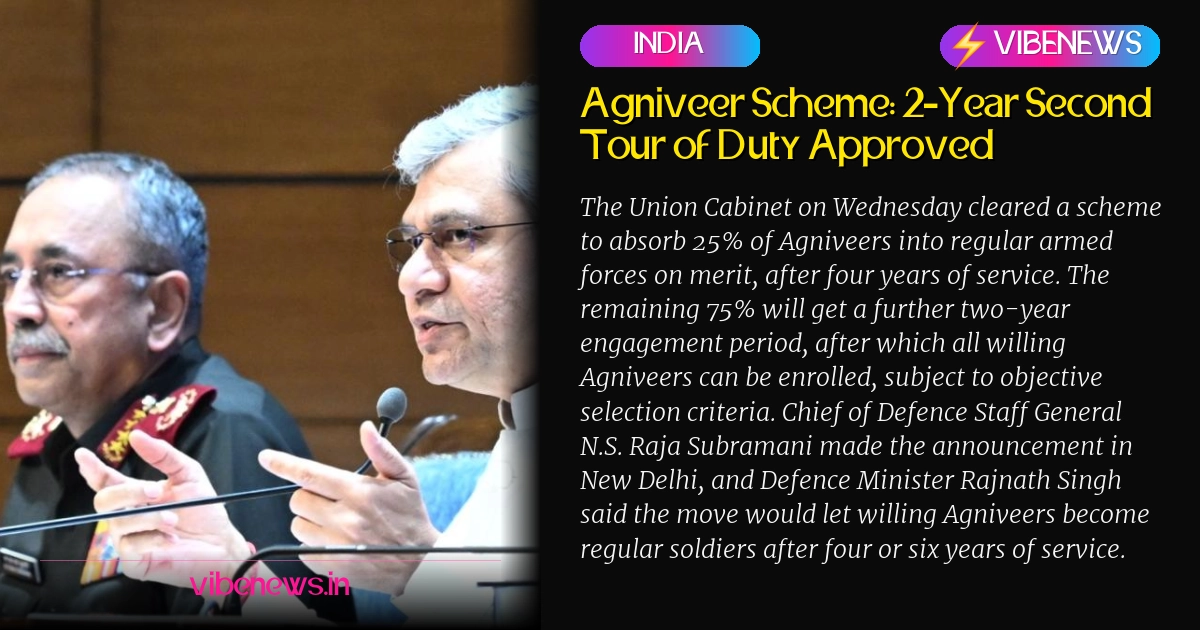
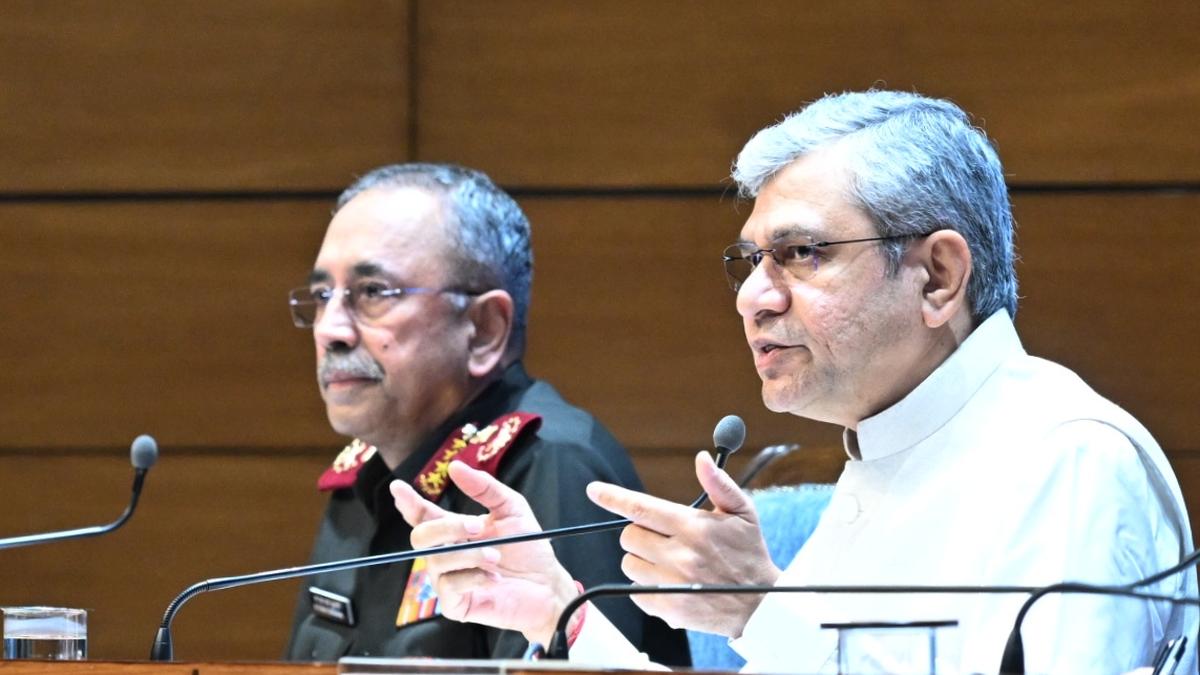
The Union Cabinet on Wednesday, November 4, 2026, cleared a scheme to absorb 25% of Agniveers into the regular armed forces based on merit, Chief of Defence Staff General N.S. Raja Subramani announced at the National Media Centre in New Delhi. The remaining 75% will not leave the forces at the end of their first term. They will be offered an additional two-year engagement period.
That is the core of what is being called the ‘Second Tour of Duty’ under the Agnipath scheme, and it changes the career math for thousands of young soldiers who were recruited on a short-term basis.
What the Cabinet approved
Under the current structure, 25% of Agniveers will be enrolled into the armed forces upon completing four years of service under Agnipath. The other three-quarters will now be offered two more years. Once that two-year period ends, everyone who is willing will be enrolled into the forces, provided they clear objective selection criteria.
General Subramani put the sequence plainly. Two more years of engagement will be offered to the remaining Agniveers. When that period is over, all Agniveers are to be inducted into the armed forces, subject to those selection criteria.
There is a hard edge to the policy as well. If an Agniveer is not retained even after the six years, there will be no reservation for them in any government jobs. That single line will matter to every family weighing whether the scheme offers a secure future.
Why the timing and the tenure matter to soldiers
For the Agniveer serving his or her first four years, the decision alters the end point of the contract. Instead of a single exit after four years, there is now a defined path to a second tour and, for those who qualify, permanent enrolment as a regular soldier after either four or six years.
The distinction between the two outcomes is important. An Agniveer who is selected after four years joins the regular forces earlier. An Agniveer who completes the additional two-year engagement and then meets the criteria is enrolled after six years. The policy does not promise regular status to everyone at the same point, and it does not promise it to everyone at all. Selection is the gate.
Defence Minister Rajnath Singh framed the decision as a chance for every ‘willing’ Agniveer to enrol as a regular soldier after their tenure of four or six years, conditional on meeting the selection criteria. The word ‘willing’ does real work in that sentence. Participation in the second tour is tied to the individual’s choice, and final induction is tied to performance against objective standards.
The recruitment question
The Agnipath scheme was announced in 2022 to recruit youth between 17.5 and 23 years into the three branches of the armed forces on a short-term basis. Around 3,00,000 Agniveers are currently serving in the defence forces, according to the figures presented with the announcement.
That number is the scale of the decision. Roughly three lakh personnel now have a clearer, though still conditional, route beyond their first engagement. For future recruits, the message is that a short-term entry no longer has to be a dead end. It can lead to a second tour and, for those who meet the criteria, to a regular career.
For prospective applicants, the policy also sharpens the trade-off. The engagement period is longer for most people, and the outcome depends on selection. The government has tied the scheme to what it describes as the requirements of a modern force, but the employment consequences outside the forces are limited for those who are not retained. Anyone deciding whether to join will need to weigh that risk directly.
How the government framed it
Rajnath Singh’s statement on X called the Cabinet’s decision a continuation of long-term structural reforms in the defence forces. He said the aim is a younger, fitter, technologically equipped and future-ready military. He also tied the policy to the changing nature of conflict.
“It is not merely a recruitment policy; it is a way forward to prepare India’s military for the changing character of warfare,” Singh said.
That framing positions the scheme as more than a staffing mechanism. The government is presenting it as part of a broader reshaping of how the armed forces are built, with an emphasis on age profile, fitness and technology. The Cabinet’s approval gives that argument formal weight, while the selection criteria and the retention numbers will determine how it works in practice.
The Cabinet meeting was chaired by Prime Minister Narendra Modi, and Union Railway Minister Ashwini Vaishnaw appeared alongside General Subramani at the media briefing. The announcement landed the same day as the Cabinet decision, leaving families, serving Agniveers and recruits with a specific set of rules to digest rather than a vague promise.
What to watch next
The key details are now clear. Twenty-five per cent of Agniveers move into the regular forces after four years, based on merit. The remaining 75% get two more years. After that engagement period, willing personnel are enrolled subject to objective selection. Anyone not retained after six years will not get reservation in government jobs.
The open questions are the ones that will define the scheme’s reception. How the objective selection criteria are applied will decide who becomes a regular soldier. How many of the 75% choose the second tour will shape the size of the future force. And how the no-reservation rule plays out for those who leave will determine whether the policy is seen as a career pathway or a fixed-term commitment with a steep exit.
For now, the Cabinet has changed the Agnipath story. It is no longer only about a four-year contract. It is about whether a short-term soldier can become a permanent one, and the answer, according to the government, is yes for those who are willing and who qualify.
TL;DR
- The Union Cabinet cleared a scheme on November 4, 2026, to absorb 25% of Agniveers into regular forces based on merit.
- The remaining 75% of Agniveers will get an additional two-year engagement period under the Agnipath scheme.
- After the two-year period, all willing Agniveers can be enrolled into the armed forces, subject to objective selection criteria.
- Agniveers not retained after six years will get no reservation in any government jobs.
- Around 3,00,000 Agniveers are currently serving in the defence forces.
- The Agnipath scheme was announced in 2022 to recruit youth aged 17.5 to 23 on a short-term basis.