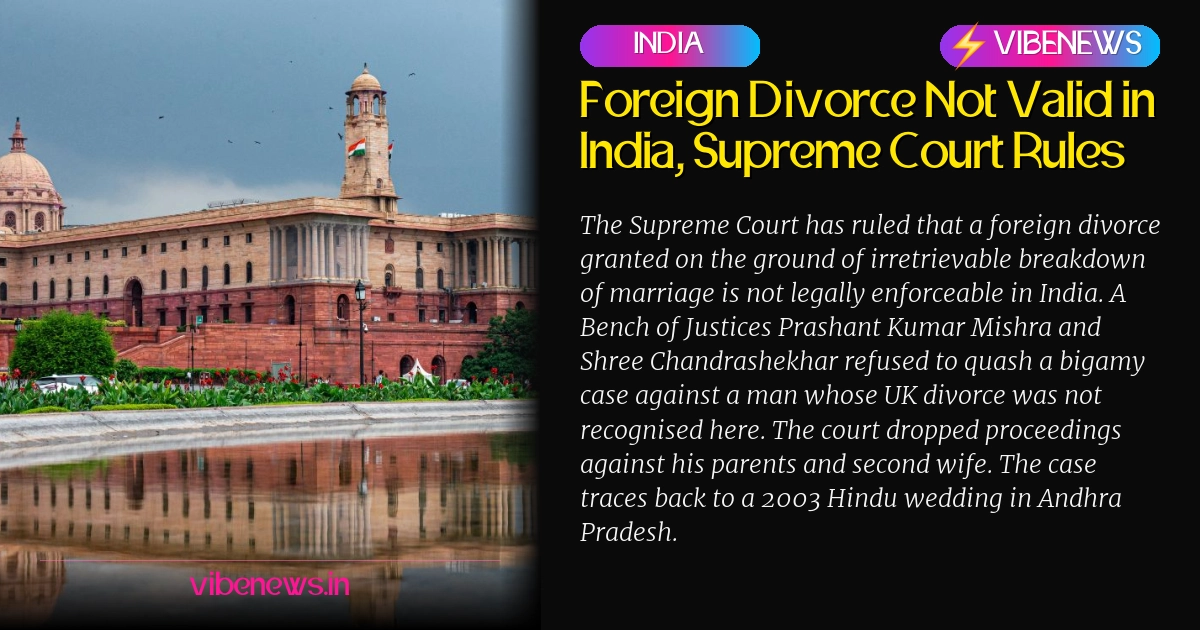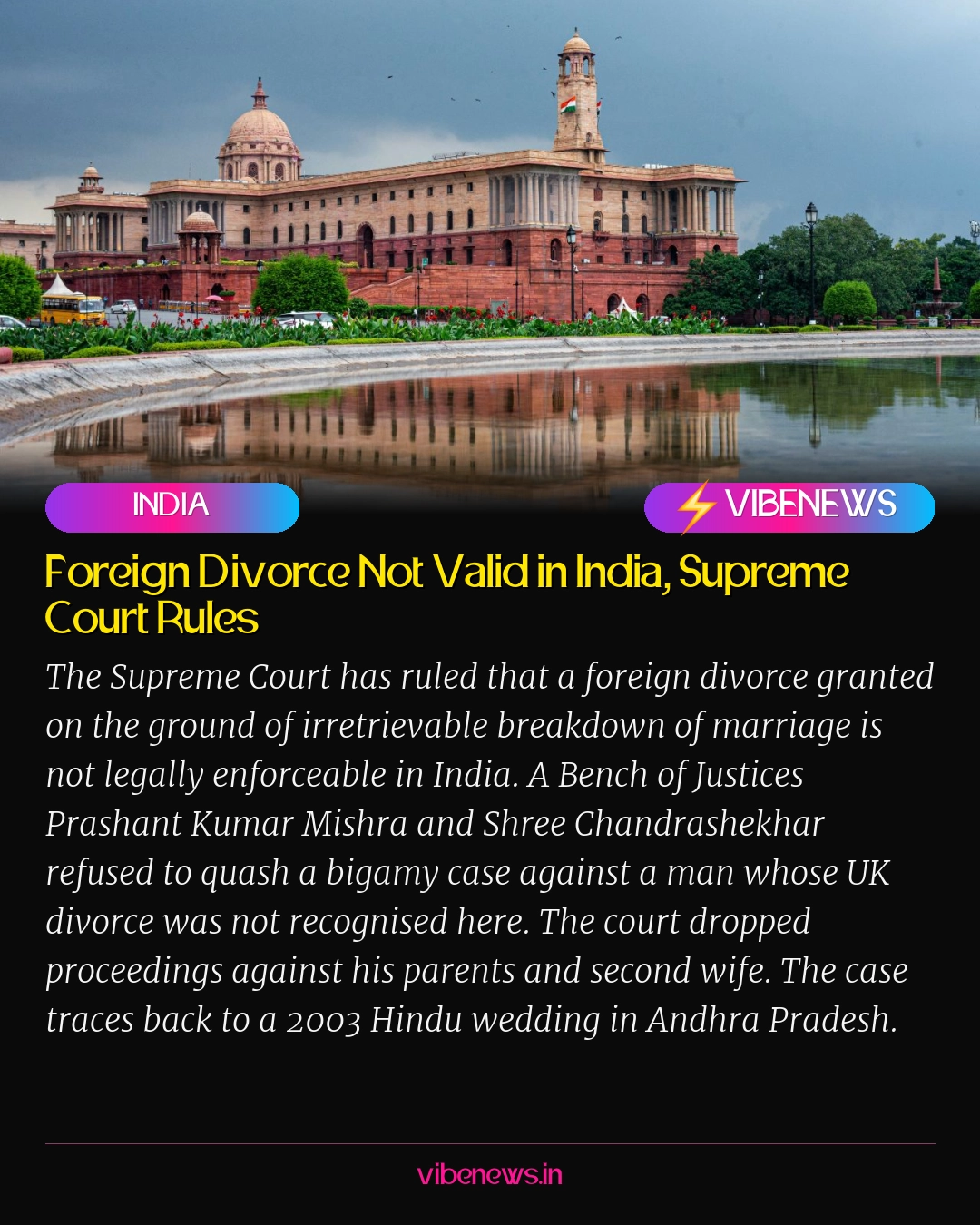
The Supreme Court of India has held that a divorce decree granted by a foreign court on the ground of irretrievable breakdown of marriage is not legally enforceable in India. The ruling came on Tuesday, and it lands squarely on couples who believed a foreign divorce had closed their marriage for good.
A Bench of Justices Prashant Kumar Mishra and Shree Chandrashekhar made the observation while dismissing a plea from a man who wanted a criminal case against him for bigamy and criminal conspiracy quashed. The court refused. It did not stop there.
“In our view, the foreign divorce decree was passed in contravention of the existing matrimonial law in India and on a ground that is not even recognised statutorily.”
What the court said about the UK decree
The bench found that the UK divorce violated the legal threshold of Section 13 of the Code of Civil Procedure, which every foreign decree must clear before it can be enforced in India. The judges also pointed to earlier observations by the Supreme Court on the conditions a foreign decree must meet to be enforceable here.
The court made clear that the sanctity of matrimonial status could not be allowed to give way to the principle of forum non conveniens, the doctrine that a court may decline a case because another forum is more appropriate. The bench rejected that argument in the form it was presented.
The reasoning turned on one fact. The husband had married his first wife in India under Hindu rites, rituals and customs. That mattered, the bench said, even though the second marriage took place outside the country.
Why the location of the second wedding did not help
The bench said the allegations under Section 494 of the Indian Penal Code, which deals with bigamy, were not diluted by the fact that the second marriage happened abroad. An inquiry into bigamy, the court said, cannot be confined to the place of the second marriage. It must take into account the subsisting matrimonial relationship.
In plain terms, a marriage registered and solemnised in India continued to carry legal weight in India, regardless of what a court in England decided later.
The Andhra Pradesh roots of the case
The story has deep roots in Andhra Pradesh. The man married his first wife on April 18, 2003, in Sattenapalli, according to Hindu rites and customs. The couple then moved to Hyderabad, where the husband was pursuing postgraduate studies at Osmania Medical College.
On February 4, 2005, the man left for the UK to pursue a career as a doctor. His wife joined him later. In August 2007, she returned to her parental home in Sattenapalli for a delivery. The husband said she did not go back to the UK despite his repeated requests.
As the marriage deteriorated, the husband filed divorce and custody proceedings before the competent court at Narasaraopet, in Guntur district of Andhra Pradesh. Those proceedings were dismissed. He then filed an appeal in the High Court but later withdrew it. For families in Guntur and beyond, the sequence is a reminder that a dispute started in one state can travel across oceans and still return to local courts.
The UK divorce and the second marriage
The husband was granted British citizenship on February 1, 2013. He then started divorce proceedings against his first wife before the Cambridge County Court in England. The court granted him a divorce in 2014 on the ground of irretrievable breakdown of marriage.
The man married again in Norfolk, in the UK. Nearly two years later, his first wife lodged a complaint at the Sattenapalli Town Police Station in Guntur district. The complaint was filed under Sections 494 and 120B, read with Section 34, of the Indian Penal Code.
That complaint set off the chain of cases that eventually reached the Supreme Court. The UK decree, which the husband had treated as the end of the marriage, did not shield him from the criminal process in India.
Who was spared and who was not
The ruling was not a clean sweep for either side. While the court refused to quash the case against the husband, it quashed the criminal proceedings against his parents and his second wife.
That split is the detail many readers will focus on. The husband remains exposed to the bigamy allegation. His parents and the second wife are no longer part of the criminal case, according to the court’s order as reported.
Why this ruling matters beyond one courtroom
For anyone who has finalised a divorce abroad and assumed the matter was settled in India, the judgment is a warning. A foreign decree granted on irretrievable breakdown is not automatically accepted in India. Couples who married in India and later sought divorce overseas may find that the Indian marriage still carries legal consequences.
The case also shows how a criminal complaint can continue even after a foreign court has granted a divorce. The bigamy provision was applied because the first marriage was solemnised in India, and the bench said the subsisting relationship had to be considered.
The court’s remarks on Section 13 of the Code of Civil Procedure and on the conditions for enforcing foreign decrees are likely to be read closely by lawyers and families alike. The bench did not leave room for the view that a foreign court’s decision alone can erase an Indian marriage from the record.
The bottom line
The Supreme Court has drawn a hard line. A divorce decree from abroad, granted on irretrievable breakdown, does not carry automatic force in India. A marriage performed here under Hindu rites can still support a bigamy charge, even if the second marriage took place in England. The husband must still face the case, while his parents and second wife have been freed from it.
TL;DR
- The Supreme Court has ruled that a UK divorce granted on irretrievable breakdown of marriage is not enforceable in India.
- The bench refused to quash a bigamy case against the husband, whose first marriage was performed under Hindu rites in Andhra Pradesh.
- The court quashed criminal proceedings against his parents and second wife.
- The husband married his first wife in Sattenapalli on April 18, 2003.
- The Cambridge County Court granted the UK divorce in 2014.
- The bench said the bigamy inquiry must account for the subsisting Indian marriage.