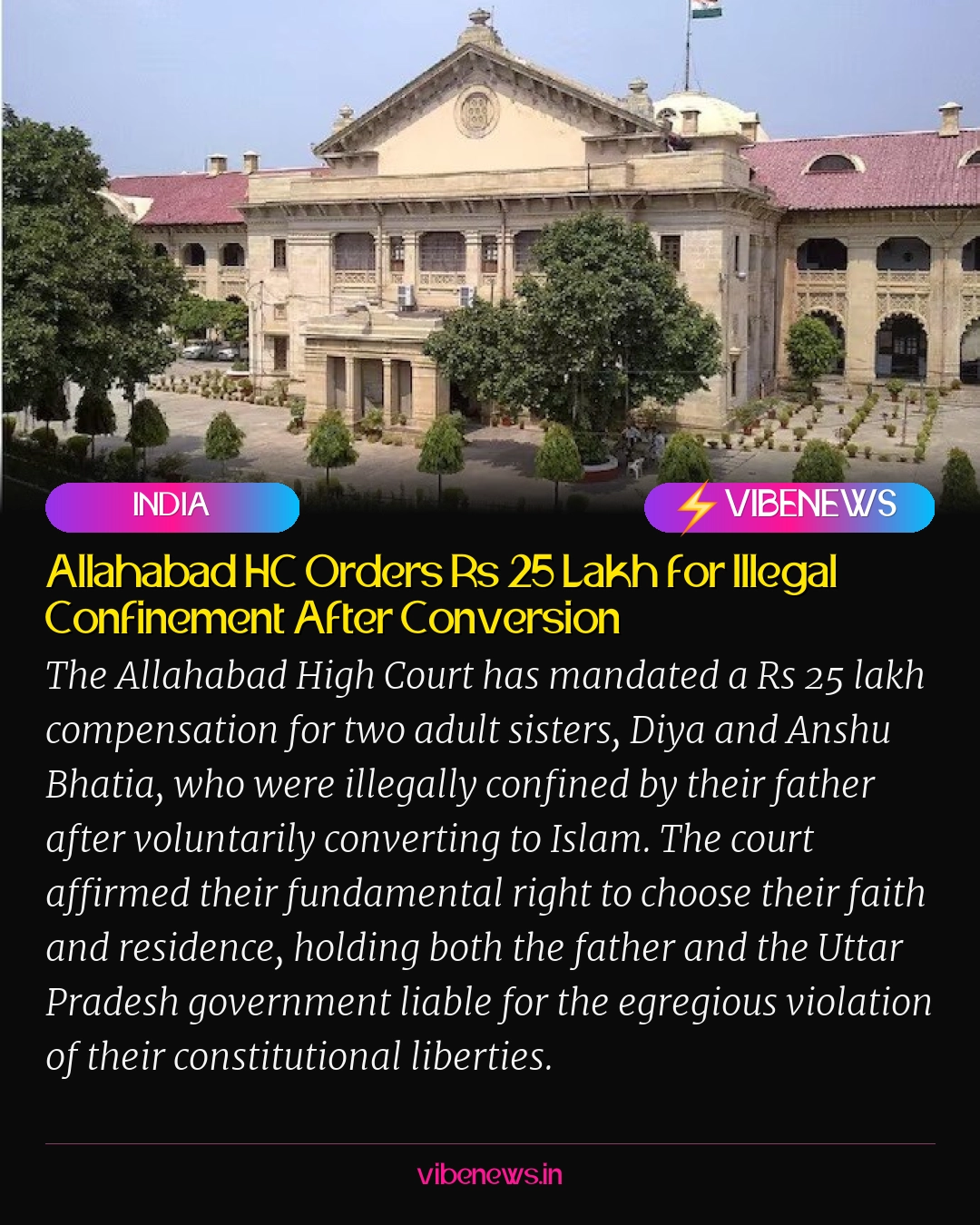

The Allahabad High Court has delivered a landmark judgment, ordering a compensation of Rs 25 lakh to two adult sisters who were illegally confined by their father after they voluntarily embraced Islam. The court held both the father and the Uttar Pradesh government jointly and severally liable for this egregious violation of fundamental rights, emphasizing the unassailable right of individuals to choose their faith and residence.
Justice Sandeep Jain, presiding over a habeas corpus petition, ruled that Diya Bhatia alias Zoya Diya Bhatia, 20, and Anshu Bhatia alias Amina Anshu Bhatia, 35, were free to live as they wished. The compensation amount is to be equally shared between the sisters and must be paid within eight weeks, underscoring the urgency and severity with which the court viewed the matter.
Upholding Individual Autonomy and Constitutional Liberty
The court’s decision hinged on the sisters’ unequivocal testimony that they converted to Islam out of their own free will. Anshu converted in 2020 and Diya in 2021, citing faith, conscience, and spiritual solace as their motivations. They explicitly stated that their decisions were free from any force, fraud, coercion, or undue influence, a claim the court found credible after direct interaction.
Justice Jain observed that once an individual attains majority, the Constitution recognizes their autonomy to make decisions concerning faith, belief, residence, and association. This personal liberty, protected under Articles 21 (Protection of Life and Personal Liberty) and 25 (Freedom of Conscience and Free Profession, Practice and Propagation of Religion) of the Constitution, cannot be dictated or interfered with by either the state or family, except within constitutionally permissible limits.
The judgment reiterated that parental authority must yield to constitutional liberty and individual autonomy once a person reaches adulthood. Any restraint on the movement or liberty of such a person, without lawful authority, constitutes illegal confinement and a direct infringement of fundamental rights.
State’s Role and the Conversion Law Context
The Uttar Pradesh government had opposed the habeas corpus petition, citing an FIR filed by the women’s father. The FIR alleged forcible and deceitful conversion from Hinduism to Islam, invoking provisions of the Bharatiya Nyaya Sanhita and sections 3/5(1) and 5(2) of the Uttar Pradesh Prohibition of Unlawful Conversion of Religion Act, 2021.
The state argued that the alleged conversion was part of a larger conspiracy impacting national sovereignty and unity, suggesting that releasing the women could hinder the ongoing investigation. However, the court clarified that its observations on the illegal confinement would not influence the criminal investigation, which would proceed strictly according to law.
The Uttar Pradesh Prohibition of Unlawful Conversion of Religion Act, 2021, often referred to as the "anti-love jihad" law, has been a subject of considerable debate since its enactment. It aims to prohibit conversion by misrepresentation, force, undue influence, coercion, allurement, or fraudulent means. Critics argue that such laws often infringe upon individual liberties and the right to choose one’s partner or faith, while proponents assert their necessity to prevent exploitation and maintain social harmony.
This law, along with similar legislations in states like Madhya Pradesh, Gujarat, and Himachal Pradesh, has faced legal challenges and scrutiny for potentially impinging on the fundamental right to religious freedom and personal autonomy. The Allahabad High Court’s current ruling, while not directly striking down the conversion law, strongly reaffirms the individual’s right to voluntary conversion and freedom from confinement.
Culpability of State Machinery
In a significant indictment, the court also faulted the state machinery for its failure to protect the women’s liberty. Instead of facilitating their release, the state allowed the illegal detention to persist under the guise of criminal proceedings. The court found that through acts of omission and commission, the state had "lent tacit support to the continued deprivation of the fundamental rights" of the sisters.
This aspect of the judgment highlights the state’s constitutional obligation to safeguard the liberties of its citizens, even when faced with allegations of unlawful conversion. The court deemed this a "grave and egregious violation of constitutional rights," warranting exemplary constitutional compensation to underscore the seriousness of the state’s dereliction of duty.
Editorial Context
This Allahabad High Court judgment carries profound implications for the ongoing discourse surrounding religious freedom, individual autonomy, and the role of the state in personal matters in India. By unequivocally upholding the right of adult individuals to choose their faith and residence, the court has reinforced the foundational principles enshrined in the Indian Constitution.
The ruling serves as a critical reminder to both families and state authorities that personal liberty, once attained through majority, cannot be curtailed under the pretext of parental authority or ongoing investigations, unless explicitly sanctioned by law and due process. It sets a significant precedent for state accountability, particularly in cases where governmental actions or inactions lead to the deprivation of fundamental rights.
Furthermore, this judgment will likely influence future interpretations and applications of anti-conversion laws across various states. It underscores the judiciary’s role as a guardian of constitutional rights, ensuring that legislative intent does not override the fundamental freedoms guaranteed to every citizen. The compensation awarded is not merely punitive but also restorative, acknowledging the severe emotional and psychological toll of illegal confinement and the violation of personal dignity.
TL;DR
- The Allahabad High Court ordered a compensation of Rs 25 lakh.
- The compensation is for two adult sisters, Diya and Anshu Bhatia, who were illegally confined.
- The sisters were confined by their father after they voluntarily converted to Islam.
- Both the father and the Uttar Pradesh government were held jointly and severally liable for the violation.
- The court affirmed the sisters’ fundamental rights to choose their faith, residence, and personal liberty under the Constitution.
- The state machinery was explicitly faulted for failing to protect the women’s constitutional liberties and for tacitly supporting their detention.