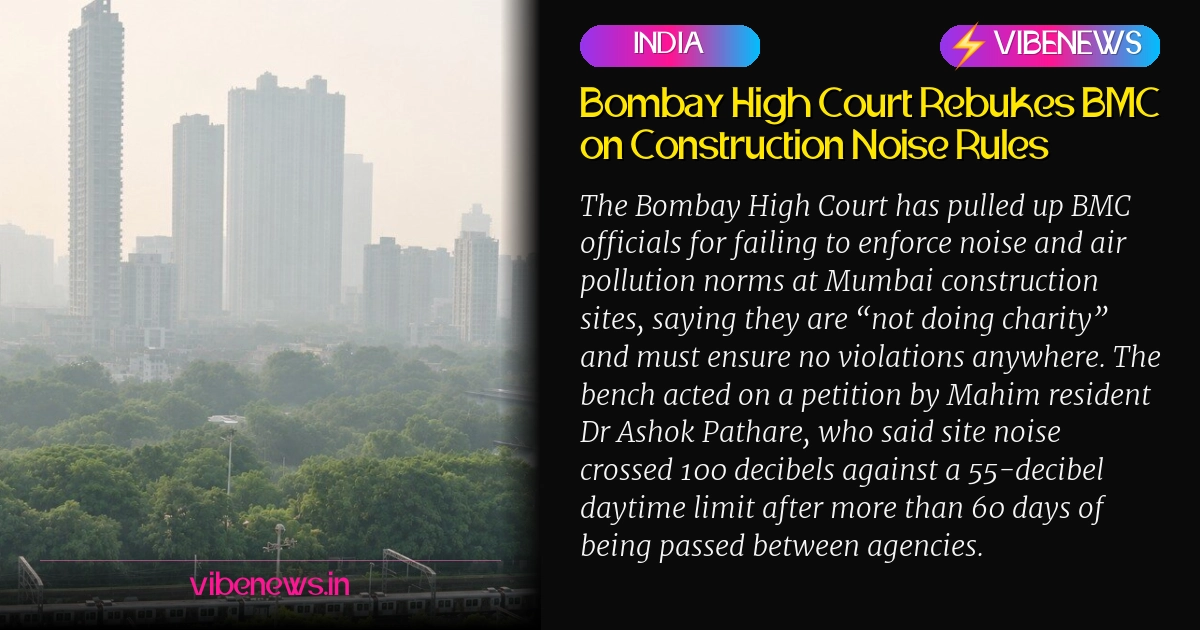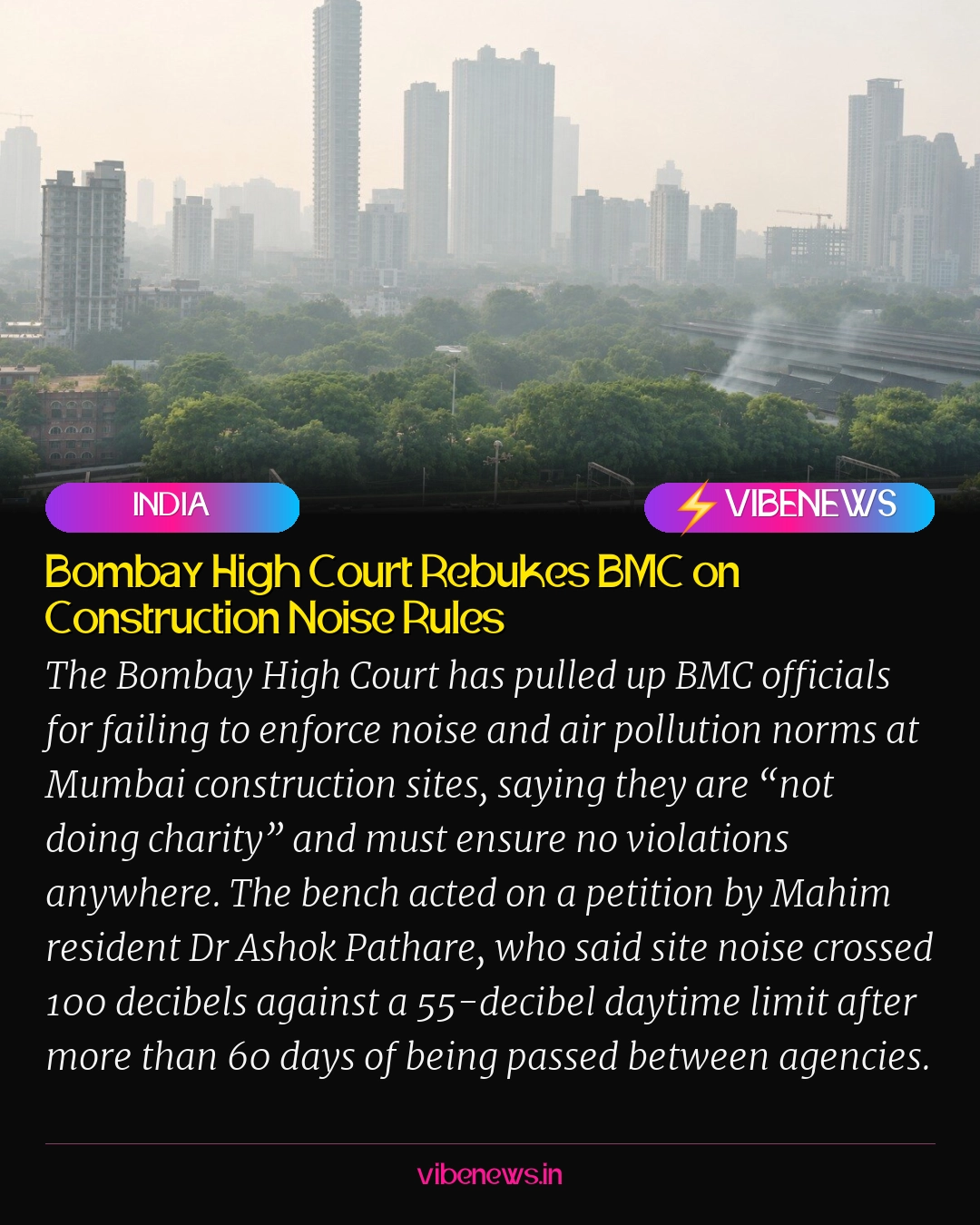
The Bombay High Court on Wednesday pulled up Brihanmumbai Municipal Corporation officials for failing to make sure construction sites comply with noise and air pollution norms. The bench said the civic body was “not doing charity” by enforcing the rules, and it ordered that there be no violations anywhere in the city.
The words came from a bench of Chief Justice MC Tripathi and Justice Advait M Sethna. The judges made clear that pollution monitoring cannot be a reactive exercise limited to punishing individual builders. It has to happen routinely across Mumbai.
“They are not doing charity. They have to ensure that the norms are followed in toto.”
A resident who says he was ignored for two months
The case began with a petition from Mahim resident Dr Ashok Pathare. He complained of persistent construction noise at a site next to his home. Pathare told the court that the noise was only part of the problem. He said he had spent more than 60 days approaching different departments and authorities, and each one kept passing the responsibility along without any reduction in noise levels.
That kind of runaround is exactly what the court seemed to find unacceptable. When a citizen can knock on the doors of multiple civic offices and still hear nothing useful, the system is not working, whatever its rulebook says.
Conditions on paper, violations on the ground
Pathare argued that the BMC had already imposed conditions on the site. Those conditions required construction work to prevent nuisance, take precautions during piling work, and comply with noise pollution regulations. According to him, the violations continued regardless.
To back up the claim, Pathare cited police panchnamas, which are formal records of inspections and proceedings. They showed that noise levels at the site had crossed 100 decibels. The permissible daytime limit in residential areas is 55 decibels. Pathare alleged that the implementation and enforcement of pollution rules had remained confined to paper.
The numbers are stark. A reading nearly double the daytime residential limit is not a borderline case. It is the kind of gap that should trigger immediate action, not a long chain of forwarded complaints.
A household paying the price
Pathare also described what the construction activity was doing to his family. He said he has permanent partial hearing loss. His son, who has autism spectrum disorder, suffers severe distress because of the noise. For a family already living with those conditions, a constant din from next door is not an inconvenience. It is a daily assault on health and wellbeing.
He further alleged that the developer and contractor kept working despite repeated complaints. He also claimed they invoked influential connections to discourage him from pursuing the matter. Those allegations are part of his petition and were put before the court. They have not been tested in the way a final verdict would test them.
The builder that did not respond
The High Court noted that the builder concerned had not filed an affidavit assuring the court there would be no further violations of noise and air pollution norms. In a case like this, that silence matters. A sworn assurance is a basic step, and its absence leaves the court with no commitment to hold the builder to.
The bench did not treat the matter as a dispute between one builder and one neighbour. It pushed the focus back onto the officials whose job is to prevent the problem in the first place.
A direct order to civic officers
The bench framed its remarks as a reminder of statutory duties. Officials were told that their responsibility is to protect the public from pollution. The judges said the directions were meant to make clear that the duty already exists and that the High Court has issued a mandate on it.
“There is a mandate of the High Court. In every area this is to be monitored, no inconvenience is to be caused to the public at large.”
The message was blunt. Permission to build does not come with a license to pollute. As the bench put it, when permission is given, there should not be noise or air pollution. The rules have to be followed, and the officers responsible have to ensure that they are.
The court also said it was not targeting one individual builder. Its concern was a system that allows violations to continue across the city. Monitoring, the bench said, should happen on a routine basis in every area.
Light pollution enters the frame
Beyond noise and air, the court called for substantial reductions in both pollution types. It also flagged light pollution as another concern. That is a notable addition. It signals that the judges see the problem as wider than the decibel reading at one site, and that night-time disturbance from urban development is also on their radar.
An open invitation to citizens
The bench asked residents to bring forward instances of violations. It told people not to hesitate if they had first-hand information. The judges said they would look into such cases.
That request matters because it places part of the enforcement burden on the public. Residents who have been stonewalled by departments now have a direct line to a court that has just said it will act on their evidence.
For Mumbai residents living beside active sites, the message is clear. Keep records, document violations, and report them. The court has said it is listening, and it has also made clear that the officials responsible will be held to account for the rules they are supposed to enforce.
TL;DR
- Bombay High Court pulled up BMC officials for failing to enforce noise and air pollution norms at construction sites.
- The bench said the civic body is “not doing charity” and must ensure no violations occur anywhere.
- A Mahim resident said site noise crossed 100 decibels against a 55-decibel daytime residential limit.
- He said he spent over 60 days being passed between departments without any reduction in noise.
- The court said monitoring must be routine across Mumbai, not limited to action against individual builders.
- The bench also flagged light pollution and asked citizens to report violations directly to the court.