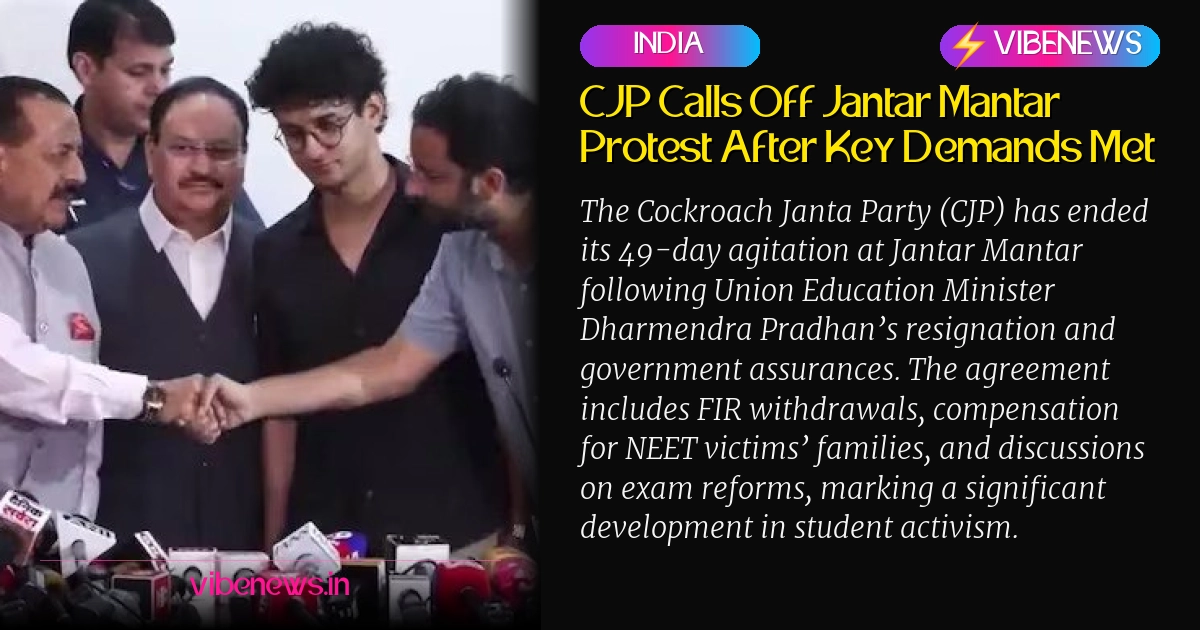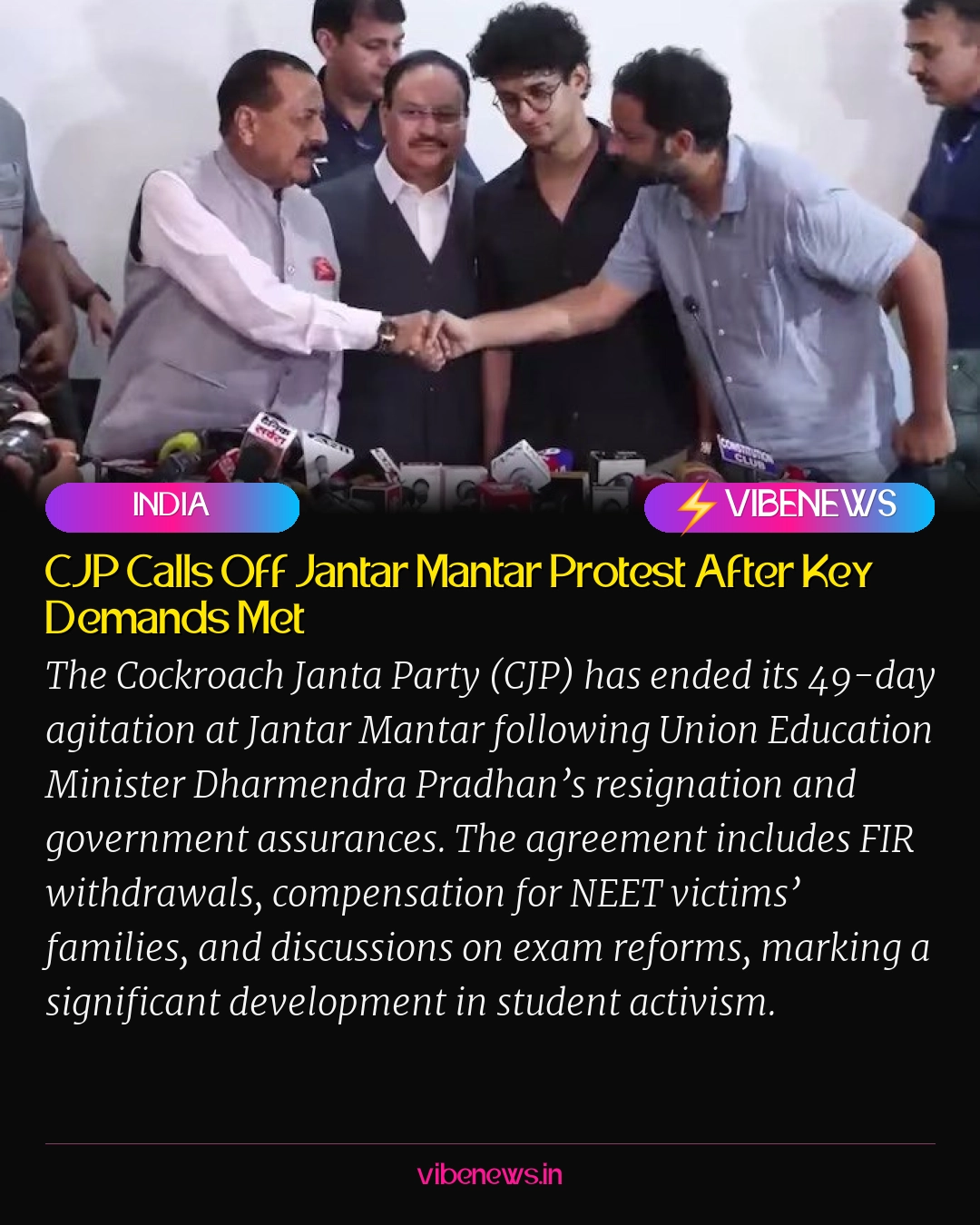
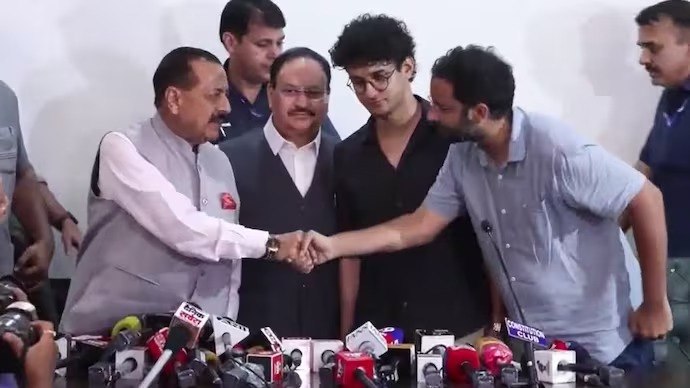
The Cockroach Janta Party (CJP) has officially concluded its extensive 49-day protest at Delhi’s iconic Jantar Mantar, a decision that follows the resignation of Union Education Minister Dharmendra Pradhan and significant assurances from the government. This marks a pivotal moment in the recent wave of student activism that gripped the nation, fueled by widespread discontent over alleged irregularities in national examinations.
The announcement came after a series of intensive negotiations between a CJP delegation and high-ranking government representatives, including Union Ministers JP Nadda and Jitendra Singh. CJP Chief Spokesperson Saurav Das confirmed the withdrawal, emphasizing that the move was made in good faith, with the expectation that all agreed-upon terms would be implemented within the stipulated timelines.
The Genesis of a Movement
The agitation, which commenced on June 6, quickly gained traction, drawing attention to critical issues plaguing India’s examination system. The CJP had articulated three primary demands: the immediate resignation of then-Education Minister Dharmendra Pradhan, the withdrawal of all First Information Reports (FIRs) and legal cases lodged against protesting students and organizers, and a substantial compensation of Rs 1 crore for the families of individuals who tragically lost their lives in the aftermath of the NEET paper leak controversy.
The resignation of Dharmendra Pradhan earlier on Saturday addressed the CJP’s foremost demand, signaling a significant concession from the government. This development was widely seen as a direct consequence of the sustained pressure exerted by the student body and the broader public outcry.
Addressing Legal Ramifications
A crucial aspect of the agreement involves the government’s commitment to withdraw all FIRs filed against protesters and organizers. Saurav Das clarified that this assurance extends beyond cases registered in Delhi, encompassing those initiated in various BJP-ruled and BJP-allied states across the country. This comprehensive approach aims to alleviate the legal burden on numerous students and activists who participated in the demonstrations.
The CJP has sought a written guarantee from the government regarding the withdrawal of these legal proceedings and an assurance against any future punitive actions. While the government has pledged to provide these guarantees by Tuesday, the CJP awaits the formal documentation to solidify this critical aspect of the agreement. Copies of the FIRs, estimated to be between 15 and 20 in Delhi alone, are also expected to be shared with the protest organizers within a few days.
Support for Affected Families
Another sensitive demand from the CJP concerned compensation for the families of those who died by suicide following the NEET paper leak. Ashutosh Ranka, a CJP representative, confirmed that the government has agreed to provide "honorary compensation" to these families, adhering to existing rules and regulations. While the initial demand was for a fixed sum of Rs 1 crore, the government’s commitment to provide compensation under applicable frameworks offers a measure of relief to the bereaved families.
Charting Future Reforms
Beyond the immediate demands, the CJP also presented a comprehensive five-point charter outlining broader reforms for India’s education and examination systems. Union Minister JP Nadda acknowledged the charter, assuring the CJP delegation that the government would thoroughly study the proposals and engage in further discussions. A follow-up meeting between the government and the CJP is anticipated in approximately four weeks to delve deeper into these systemic reform demands.
This commitment to ongoing dialogue suggests a recognition by the government of the deeper structural issues highlighted by the protests. The CJP’s willingness to engage in these discussions, even after achieving its immediate goals, underscores its long-term vision for educational integrity and accountability.
Editorial Context
The resolution of the CJP protest at Jantar Mantar carries profound implications for India’s political and social landscape. It serves as a powerful testament to the efficacy of sustained, organized student activism in compelling governmental accountability. The resignation of a Union Minister, directly linked to public pressure, sets a significant precedent for future governance and citizen engagement.
Furthermore, the government’s agreement to withdraw FIRs against protesters is a crucial step towards upholding democratic rights and preventing the chilling effect of legal action on legitimate dissent. The commitment to discuss broader education reforms, while still in its nascent stages, offers a glimmer of hope for addressing the systemic vulnerabilities exposed by recent examination controversies. This episode will likely be studied as a case in point for how public grievances, when articulated persistently and collectively, can influence policy and political outcomes, shaping the trajectory of youth movements and government responsiveness in the years to come.
TL;DR
- The Cockroach Janta Party (CJP) has ended its 49-day protest at Jantar Mantar following the resignation of Union Education Minister Dharmendra Pradhan.
- The government has agreed to withdraw all First Information Reports (FIRs) filed against protesters and organizers, including those in BJP-ruled and BJP-allied states.
- Assurances have been given for "honorary compensation" to the families of individuals who died by suicide following the NEET paper leak, under applicable rules and regulations.
- The CJP presented a five-point charter for broader education and examination reforms, which the government has committed to studying and discussing further.
- The decision to call off the agitation came after three rounds of talks between the CJP delegation and government representatives, including Union Ministers JP Nadda and Jitendra Singh.
- The CJP awaits written guarantees for FIR withdrawals and future actions, with a follow-up meeting on the reform charter planned in approximately four weeks.