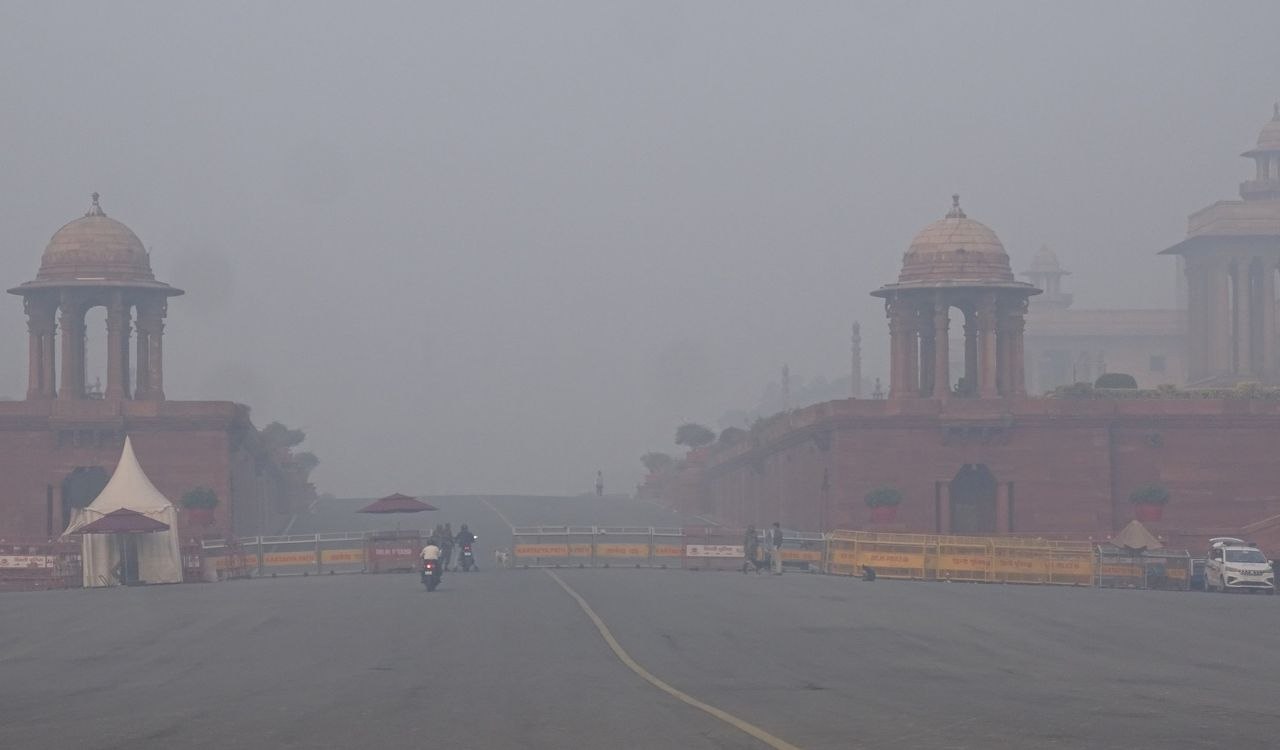
Delhi recorded its coldest morning of the month on Monday, as the minimum temperature fell to 14.8 degrees Celsius, according to the India Meteorological Department (IMD). It was the lowest minimum of the season so far. The same reading had been logged on November 11, so the city has matched its seasonal low but has not gone below it.
The cold came with a daytime high that still felt mild. The maximum temperature settled at 27.5 degrees Celsius at Safdarjung, the city’s base weather station. That leaves a gap of nearly 13 degrees between the afternoon peak and the overnight low, and it is the kind of swing that catches people off guard when they dress for one part of the day and spend the other part outside in a different temperature altogether.
The cold did not arrive alone. The city’s average Air Quality Index stood at 275, which falls in the ‘poor’ category. That number is only a small step better than the previous day, when the reading was 290. Residents who were hoping for a clear break in the haze did not get one on Monday.
What the AQI number actually tells you
The Central Pollution Control Board (CPCB) uses a six-tier scale to classify air quality. An AQI between 0 and 50 is considered ‘good’, 51 to 100 is ‘satisfactory’, and 101 to 200 is ‘moderate’. Readings between 201 and 300 fall into the ‘poor’ category, which is where Delhi sits right now. Anything from 301 to 400 is ‘very poor’, and readings between 401 and 500 are classed as ‘severe’.
Delhi is therefore one step below the ‘very poor’ band, but it is well above the ‘moderate’ range. The difference between a reading of 275 and a reading of 301 is small on paper, yet it moves the city into a different classification. The city has not reached that point on Monday, but the margin is not wide.
The main culprit is fine particulate matter. PM2.5 was the predominant pollutant in the national capital, according to the CPCB data cited in the report. These particles are small enough to travel deep into the lungs, which is why officials track them more closely than many other pollutants.
A forecast that promises little relief
The Air Quality Early Warning System (AQEWS) for Delhi has forecast a marginal decline in both PM2.5 and PM10 concentrations over the next two days. The word that matters in that forecast is ‘marginal’. Nothing in the projection points to a sharp drop in pollution, and the cold nights that have settled over the city are unlikely to disperse the haze on their own.
Slight improvement is expected over the next few days, according to the same reporting. That means the people who spend long hours outdoors, including commuters, street vendors and delivery workers, will likely face the same conditions for at least the near term.
Station by station, the picture is uneven
The IMD data shows that the cold was not spread evenly across the city. Safdarjung recorded the highest maximum temperature at 27.5 degrees Celsius. Lodhi Road followed at 27.2 degrees, Ayanagar at 27 degrees, the Ridge at 26.4 degrees and Palam at 25.6 degrees Celsius.
Overnight readings also varied. Palam recorded a minimum of 14.7 degrees Celsius, which was 0.5 degrees above normal. Lodhi Road registered 14.8 degrees, a full 2.8 degrees above normal. Safdarjung also recorded 14.8 degrees. The Ridge station logged 15.3 degrees, which was 0.1 degrees below normal, and Ayanagar recorded 15.1 degrees, 0.6 degrees above normal.
That mix matters. The city’s official seasonal low is a record of the lowest figure in the period, but most stations were actually running warmer than their usual benchmark. Only the Ridge fell below normal. The ‘coldest day’ label is therefore a comparison across the season, not a sign that every corner of the capital was unusually chilly.
The minimum temperature at Palam was 14.7 degrees Celsius, 0.5 degrees above normal, while Lodhi Road registered 14.8 degrees Celsius, 2.8 degrees above normal.
Why the cold and the smog matter together
On their own, a dip to 14.8 degrees and an AQI of 275 would each be a talking point. Together, they shape how the city feels to live in. Cool mornings tend to keep the air close to the ground, and the poor AQI reading means residents are breathing in more particulate matter during the same hours they are dressing for the cold.
The reports do not draw a direct medical link between the two conditions, and no health advisory is cited in the source material. What the data does show is that Delhi is facing both a seasonal temperature shift and a pollution problem that is not yet clearing. For families with young children, older residents or people with breathing problems, that combination is the practical concern.
The gap between the two numbers also tells a story about timing. The temperature dropped sharply enough to be the lowest of the season, while the air quality only moved by 15 points from the day before. Weather can change in a single night. Pollution, according to this forecast, will change slowly.
Monday’s figures do not show a crisis in the making, but they do show a city that has not caught a break. The next two days will reveal whether the marginal improvement forecast by the AQEWS holds, and whether the cold stays at its current level or slides further as winter sets in.
TL;DR
- Delhi recorded its coldest morning of the month on Monday, with the minimum temperature falling to 14.8 degrees Celsius.
- The same minimum was logged on November 11, matching the season’s lowest so far.
- The city’s average AQI stood at 275, classified as poor by the CPCB.
- AQI improved only marginally from 290 the previous day.
- PM2.5 remains the predominant pollutant in the national capital.
- AQEWS forecasts only a marginal decline in PM2.5 and PM10 over the next two days.