TL;DR
- External Affairs Minister S. Jaishankar strongly defended India's purchase of Russian oil at the Kultaranta Talks in Finland.
- He challenged Western critics, stating Europe lacked the moral authority to lecture India, citing European weapons used against India.
- Jaishankar emphasized India's decision was based on affordability and availability, especially after European nations shifted their oil sourcing.
- He revealed that the United States itself encouraged India to increase Russian oil imports in 2022 to stabilize global energy markets.
- India's imports of Russian crude peaked in August 2025, making Russia its largest crude supplier.
- Jaishankar highlighted India's long-standing security concerns regarding Western arms supplies to the region, which have ended up in adversarial hands.
- He contrasted this with India's record, noting no Indian-made weapon has ever been used against a European country.
- The EAM's remarks underscore India's commitment to an independent foreign policy driven by national interest and energy security.
IN SHORTExternal Affairs Minister S. Jaishankar recently defended India's Russian oil purchases, directly confronting Western criticism. Speaking in Finland, he questioned Europe's moral authority, highlighting that European-made weapons have historically been used against India. Jaishankar also revealed the US encouraged India's oil imports in 2022 to stabilize global markets.
TL;DR
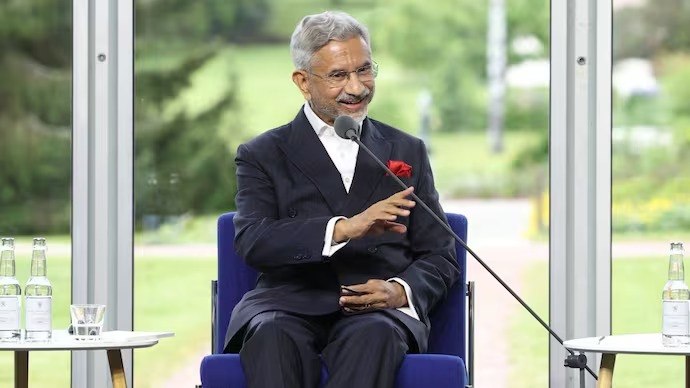
- External Affairs Minister S. Jaishankar has forcefully defended India's continued purchase of Russian oil, directly challenging Western nations on their criticism by pointing to European weapons that have historically been used against India. Speaking at the Kultaranta Talks in Finland, Jaishankar asserted that the West holds no moral authority to dictate India's energy choices.
- The seasoned diplomat made his remarks during a discussion on 'Emerging Powers and the New Geopolitical Competition,' where a journalist questioned India's stance on the Russia-Ukraine conflict and its oil imports. Jaishankar responded by highlighting that India's decision to buy Russian crude after the 2022 conflict was primarily driven by affordability and availability. He further revealed that the United States had, in fact, encouraged India to continue these purchases in 2022 to help stabilize volatile global markets.
- India's reliance on Russian energy significantly increased following the outbreak of the Russia-Ukraine war and subsequent Western sanctions. This shift occurred as European consumers began sourcing oil en masse from India's traditional Middle Eastern suppliers. "I buy oil based on cost and availability," Jaishankar stated, explaining the practical necessity that guided India's policy. By August 2025, Russian imports reached approximately 2 million barrels per day, establishing Moscow as India's largest crude supplier.
- Beyond the economic rationale, Jaishankar launched a pointed critique regarding Europe's moral standing. He explicitly stated that many weapons supplied by European nations over decades have found their way into the hands of countries that subsequently used them to attack India. "No European country has been attacked with Indian weapons. I wish I could say that for Europe weapons vis-a-vis India," he remarked, drawing a stark contrast.
- Expanding on this, Jaishankar reiterated India's long-standing security concerns about Western arms supplies to the region. He explained, "Europe sells weapons, which are used to attack India. Not just now but for many years." This historical context is crucial for understanding India's perspective. For instance, India's neighbor, Pakistan, has maintained a significant arsenal of European hardware, including French-made Mirage jets, Swedish-made Saab 2000 Erieye Early Warning Aircraft, and German rifles. French-made Daphne class submarines were also part of Pakistan's naval fleet, with one sinking the Indian Navy frigate INS Khukri during the 1971 India-Pakistan war.
- Jaishankar underscored that India has never contributed to threats against European security, nor has any Indian-made weapon been used against a European country. This argument frames India's foreign policy as one of strategic autonomy, prioritizing its national interests and energy security without compromising its non-aligned principles. The EAM's statements signal India's firm resolve to navigate complex geopolitical landscapes based on its own assessment of circumstances and historical grievances, rather than succumbing to external pressures or double standards.