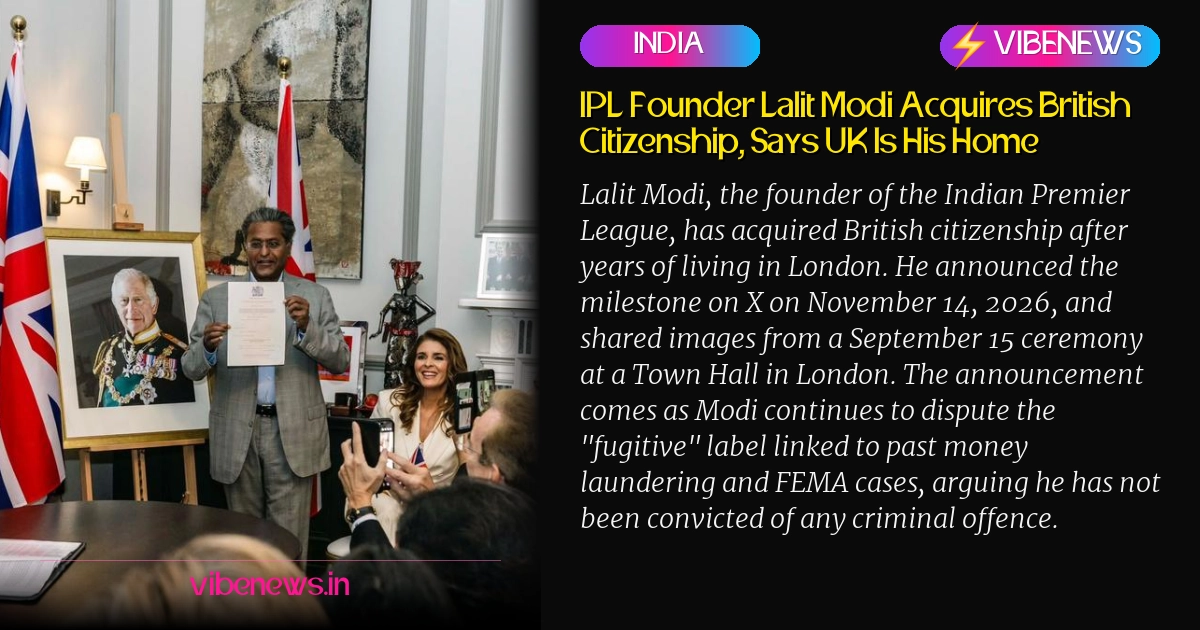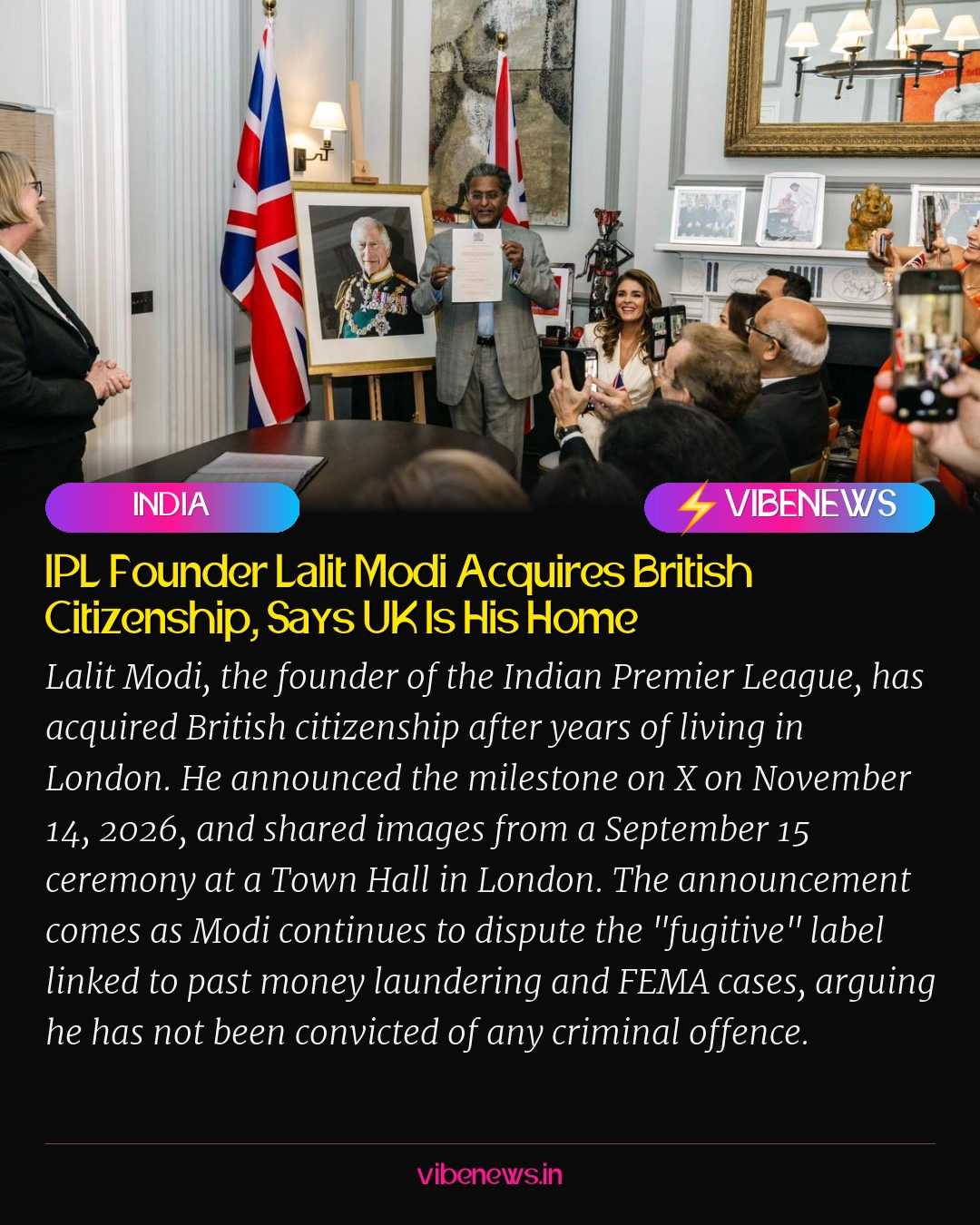
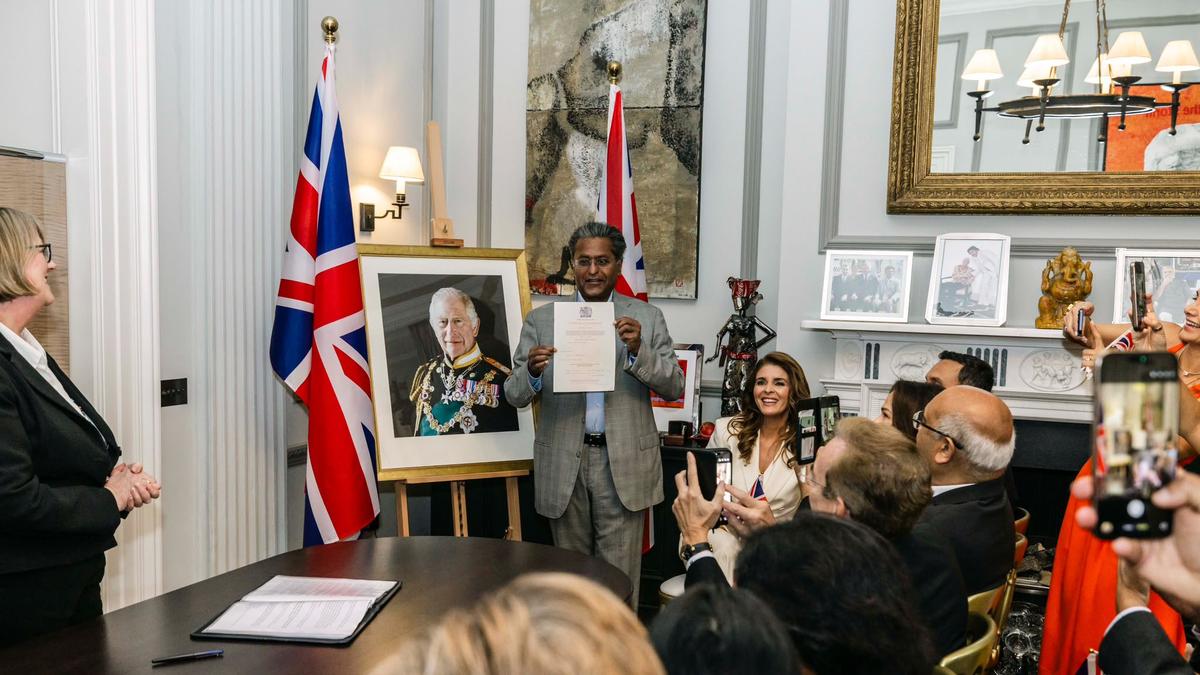
Lalit Modi, the founder of the Indian Premier League, has acquired British citizenship, announcing the milestone on X on Saturday, November 14, 2026. The former IPL chief, who has been based in London for several years, says the United Kingdom has been his home for many years.
Modi chose a public stage to make the announcement. He said he had shared the news at an address to the Oxford Union, calling it a “very special and personal milestone.” His post on X carried photographs from the citizenship ceremony itself, which took place at a Town Hall in London on September 15, 2026. He described the day as one spent “surrounded by family and friends.”
The timing of the announcement was not accidental. Modi noted that November 14 was King Charles III’s 78th birthday, and he closed his post with “God Save the King!” alongside a crown emoji. For a man whose name has long been tied to one of India’s most watched sporting leagues, the choice of a royal occasion to declare his loyalty to a new country carries a pointed symbolism that many readers will not miss.
The story of Modi’s departure from India began more than fifteen years ago. He left the country in May 2010, after the Board of Control for Cricket in India suspended him amid allegations of financial irregularities in the IPL. The suspension marked the start of a long series of legal and regulatory battles that have followed him abroad.
In 2015, a special court in India issued a non-bailable warrant against him. The court acted after Modi failed to respond to summonses from the Enforcement Directorate in a money laundering case. The reports do not say whether that warrant remains in force today, and that gap matters, because it is the reason many in India have treated his absence as a flight from the law.
Modi rejects that framing. He has strongly objected to being called a “fugitive,” arguing that he has not been convicted of any criminal offence. That position is the core of his public defence, and it sits uneasily beside the arrest warrant and the years he has spent outside India.
Earlier this year, the legal picture shifted in one respect. In July 2026, an appellate tribunal set aside a penalty imposed on Modi in a separate case under the Foreign Exchange Management Act. That case arose from the IPL’s 2009 edition, which was held in South Africa. The tribunal’s ruling removed one financial penalty, but the reports included in the source material do not describe the outcome of the other proceedings.
Modi’s post on X framed the citizenship in deeply personal terms. He said he was “proud to be a British citizen” and wrote that the United Kingdom had become a place he admired for its “people, institutions, traditions and values.” He also thanked family, friends and the Oxford Union for hosting the moment, and he described his life as having been shaped by “different cultures and experiences.”
The words that have drawn the most attention are the ones about home. In a post that is likely to be read as a direct answer to critics back in India, Modi wrote:
“The United Kingdom has been my home for many years. It is a country I have come to admire and appreciate deeply — its people, institutions, traditions and values.”
He went further, calling British citizenship “a privilege and a responsibility that I embrace with pride, gratitude and a genuine sense of belonging.” He added that he looked forward to “continuing to contribute positively to the country I proudly call home.”
Those lines do not address the legal questions that have followed him since 2010. Modi’s announcement is about identity and belonging, not about the warrant, the money laundering case or the financial allegations that led to his suspension from the BCCI. Those matters are on a separate track, and the source reports do not say whether acquiring British citizenship affects any of them.
What the announcement does establish is that Modi now holds British citizenship, and that he has chosen to make the news public at a moment of his own choosing. He has told the story in his own words, with photographs and a royal birthday attached. Whether that story will settle the questions about his past is a different matter, and one the public record has not yet answered.
TL;DR
- Lalit Modi, founder of the IPL, announced on X that he has acquired British citizenship.
- He celebrated the citizenship at a ceremony in London on September 15, 2026, and shared the news publicly on November 14.
- Modi left India in May 2010 after the BCCI suspended him over alleged financial irregularities in the IPL.
- A special court issued a non-bailable warrant against him in 2015 after he failed to respond to Enforcement Directorate summonses.
- In July 2026, an appellate tribunal set aside a penalty against him in a separate FEMA case linked to the 2009 IPL.
- Modi rejects the “fugitive” label, saying he has not been convicted of any criminal offence.