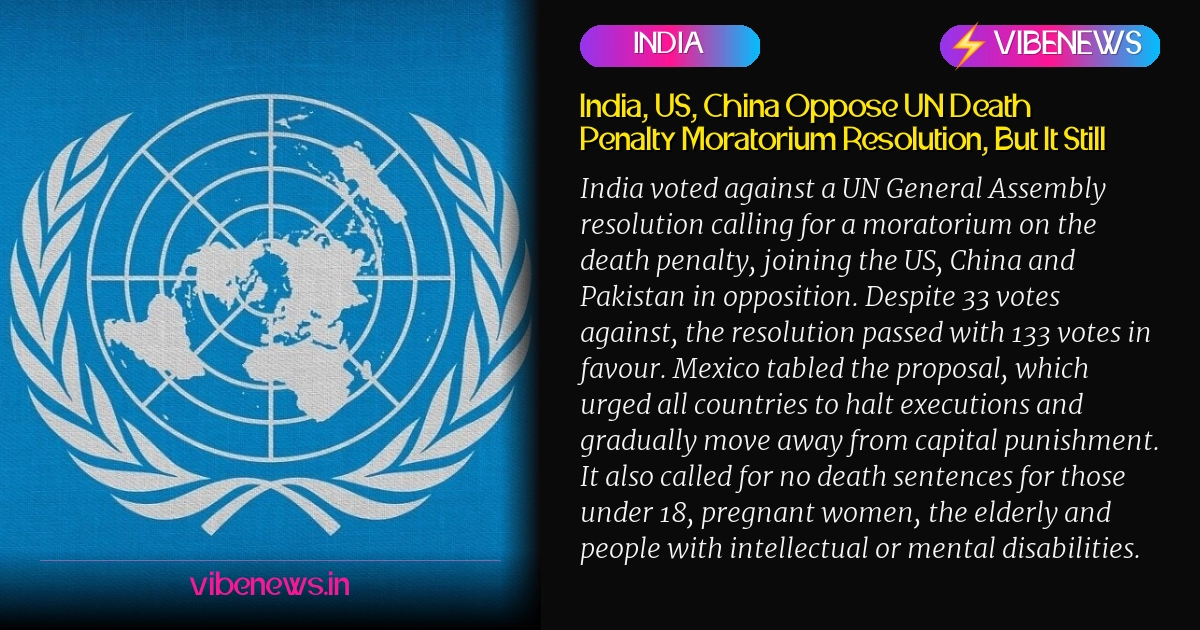
India voted against a United Nations General Assembly resolution that calls for a moratorium on the death penalty, and the measure passed anyway. The vote took place on Friday. Of the 193 UN member states, 133 voted in favour, 33 voted against and 16 abstained.
India was not alone. The United States, China and Pakistan also voted no, putting them in the same bloc as a long list of countries from the Middle East, Asia and beyond. The report names Japan, Iran, Iraq, Saudi Arabia, Egypt, Bahrain, Kuwait, the Maldives, Oman and Qatar among those opposing the resolution.
That is an unusual lineup. The United States, China and India rarely end up on the same side of a UN vote, and this one put all three together. The report, however, does not explain why these governments opposed the text. It records the votes and the names, but it stops short of giving reasons, so readers should treat the motives as unreported for now.
Mexico introduced the resolution. Its aim was to move the world step by step toward ending capital punishment. The text urged every country to stop carrying out executions, and it asked nations that had already abolished the death penalty not to bring it back.
What the resolution actually asked for
The proposal did not try to force any country to change its laws. It said each state has the right to make its own legal codes and decide its own punishments. That sentence sits at the heart of the document, and it helps explain why the text was framed as a gradual push rather than a ban.
Every country has the right to make its own laws and decide its own punishments, but all countries are urged to halt executions.
Beyond the appeal for a pause, the resolution set out several specific limits. It said people who committed crimes before they turned 18 should not face the death penalty. It went further, saying the same protection should apply when it is impossible to determine a person’s age at the time of the offence.
The text also asked that pregnant women, people with mental or intellectual disabilities, and older people be exempted from capital punishment. Those groups are often singled out in legal debates on the death penalty, and the resolution placed them under explicit protection.
Two more demands targeted the legal framework itself. The resolution asked countries to reduce the number of offences that can carry a death sentence. It also called for the removal of laws that make a death sentence mandatory for a particular crime, which would give judges room to consider each case.
The concern about rising executions
The resolution did not only look ahead. It expressed concern that the death penalty remains in use across the world. It noted that several countries are moving toward limiting capital punishment, but it said the number of executions recorded in 2025 rose sharply.
That detail gives the vote a sharper edge. Supporters of the resolution were pointing to a trend they saw as moving in the wrong direction, even as some countries were narrowing their use of the penalty. The text repeatedly asked all states to cut back gradually and pause executions.
The report does not provide the 2025 execution figures or name the countries behind the increase. It only confirms that the resolution flagged a rise and tied that rise to its call for reform.
How the numbers stack up
The arithmetic makes the outcome clear. Opponents were far fewer than supporters, and the resolution cleared the General Assembly with a comfortable majority. The 33 votes against did not stop the text from passing, and the 16 abstentions meant a sizeable group chose not to take a side.
For readers, the vote matters because it shows where countries stand on capital punishment when the question moves from national debate to the international stage. A General Assembly resolution does not directly change domestic law in any country, but it signals where governments are willing to stand in public.
India’s position also stands out because it keeps the country on the opposing side of a resolution that spoke directly to the protection of children, pregnant women, the elderly and people with disabilities. The report does not say how the Indian government framed its objection, leaving that part of the story open for follow-up reporting.
The vote also highlights how divided the global picture remains. A clear majority of the UN membership backed a gradual end to executions, while a smaller but still substantial bloc, including several major powers, refused to join them. That split is likely to keep shaping how the death penalty is debated in international forums.
TL;DR
- India voted against a UN General Assembly resolution calling for a moratorium on the death penalty, and the resolution still passed.
- The vote recorded 133 countries in favour, 33 against and 16 abstentions out of 193 UN member states.
- The United States, China and Pakistan were among the countries that also voted against the measure.
- Mexico introduced the resolution, urging all nations to halt executions and reduce capital offences.
- The text asked that people under 18, pregnant women, the elderly and those with disabilities be exempt from execution.
- The resolution expressed concern that recorded executions rose significantly in 2025.