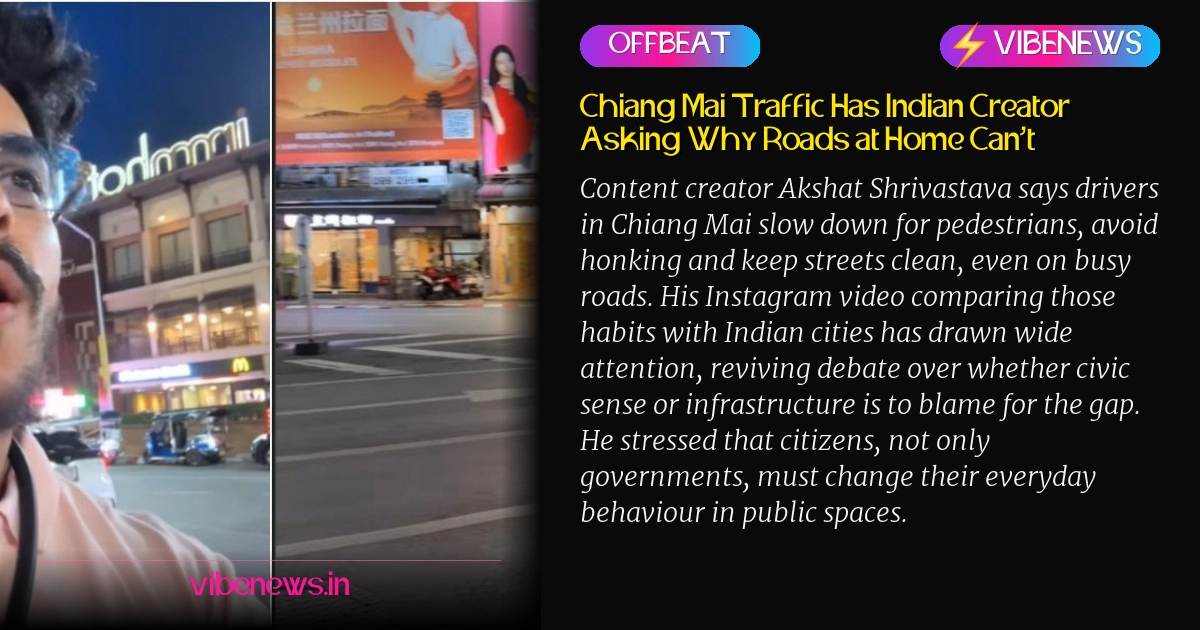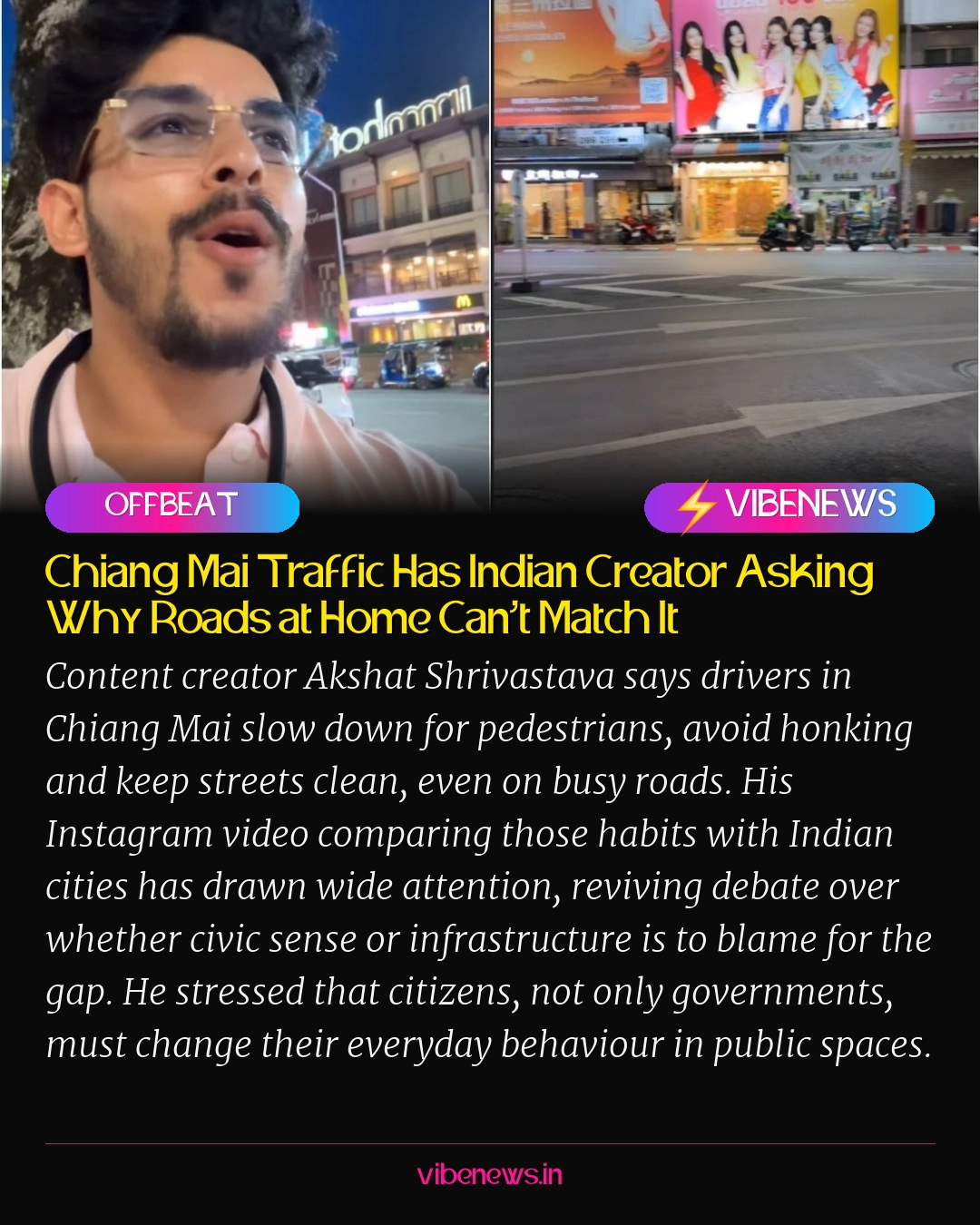

Indian content creator Akshat Shrivastava has used a short walk across a road in Chiang Mai, Thailand, to make a pointed argument about civic sense back home. In a video he shared on Instagram, he says Indian cities could learn a great deal from the way the city’s drivers and residents behave on the street.
During his visit, Shrivastava watched vehicles slow down and stop for people crossing the road. He noticed there was almost no incessant honking, and the streets struck him as remarkably clean. One sight stayed with him: a Tesla stopping to let a man cross, its hazard lights switched on. It was a small moment, but it captured the mood he wanted to show.
He was careful about what he was describing. He said he was not in a major tourist hub like Bangkok or Phuket, but in a relatively smaller city. Even on a busy road, traffic looked orderly, motorists followed basic rules and pedestrians were given the right of way. That detail matters to his point. The order he saw was not confined to places built for foreign visitors.
His memories of Chiang Rai reinforced the same impression. He had seen how well organised public spaces could be even outside the popular destinations that draw most travellers. For him, the pattern was not an accident of one busy street but a set of everyday habits that repeat across the places he visited.
In his caption, Shrivastava wrote that India could take lessons from countries such as Thailand, Vietnam and Sri Lanka. He named the habits he believes need more attention at home: keeping public spaces clean, avoiding littering, respecting pedestrians and following traffic rules. Then he added the line that has carried the post online:
“India needs to learn something from these small cities!”He described the surroundings as clean and the atmosphere peaceful, with no unnecessary honking.
The comparison that hits closest to home
Anyone who has crossed a busy Indian road will recognise the contrast he is drawing. Pedestrians often wait for a gap in the traffic rather than expecting cars to stop. Horns are part of daily driving. Litter collects in corners that should be kept clean. Shrivastava is not claiming that Thailand is free of such problems, and he does not present it as a perfect model. The point he makes is narrower and, for many readers, more uncomfortable: the habits that make a street safe and pleasant are within reach of ordinary people, not just planners and officials.
That is also why his framing has struck a nerve. A foreign example is easy to admire from a distance, but when a creator sets it against familiar streets at home, the question turns inward. If a Tesla can stop for a pedestrian in Chiang Mai, what stops a motorist in an Indian city from doing the same? The answer he points toward is not only money or machinery.
Infrastructure is not the whole answer
Shrivastava was clear that building better cities cannot be left to the government alone. In his view, infrastructure may provide the foundation, but its upkeep and effective use depend on how citizens behave. Roads, footpaths and public spaces only work when people use them with respect for others.
He put it in a single line:
“India has the resources, talent and potential to build world-class cities. But infrastructure alone cannot solve everything if people don’t cooperate,” he wrote.The sentence shifts part of the responsibility from the authorities to households, drivers and pedestrians alike. It is a deliberate choice. He said meaningful change would require people to examine their own habits rather than place the entire burden on those in power.
Shrivastava described his criticism as coming from affection for India. He said he wants to see the country become cleaner, safer and better organised. Critics of viral travel comparisons often argue that such videos flatten complicated realities, and he seems aware of that risk. He acknowledged that every country has its shortcomings. What he asked for was not imitation of another nation, but a willingness to adopt specific civic practices that could make Indian cities more liveable.
What the reaction shows
The post drew several reactions online. Those responses centred on civic responsibility and everyday public behaviour, which is exactly where Shrivastava wanted the conversation to go. The reports available do not detail how individual commenters responded, and it would be unfair to read more into the reaction than the discussion that followed. What is clear is that a short video from a small Thai city was enough to prompt people to think about their own roads.
There is a practical question underneath the debate. Traffic discipline, cleanliness and respect for pedestrians are rarely solved by one policy or one campaign. They depend on thousands of small decisions made each day, on crossings, in traffic jams and in public spaces. Shrivastava’s argument is that those decisions are where India’s cities can change, and that waiting for better infrastructure alone will not be enough.
Whether his video changes anything on the ground is an open question. For now, it has done what good viral commentary often does. It has taken a familiar frustration, the honking, the litter and the reluctant pedestrian, and made people look at it from a different angle. The gap he describes between Chiang Mai and Indian streets is one that many residents have noticed for years. What is new is that someone has asked everyone else to notice it too.
TL;DR
- Indian creator Akshat Shrivastava says drivers in Chiang Mai stop for pedestrians, avoid honking and keep streets clean.
- He said he was visiting a smaller city, not a major tourist hub like Bangkok or Phuket.
- His Instagram video argues that India could learn civic habits from Thailand, Vietnam and Sri Lanka.
- He listed clean public spaces, avoiding littering, respecting pedestrians and following traffic rules as key habits.
- Shrivastava said better infrastructure alone will not work unless citizens change their everyday behaviour.
- The post drew several reactions online, prompting discussion about civic responsibility and public behaviour.