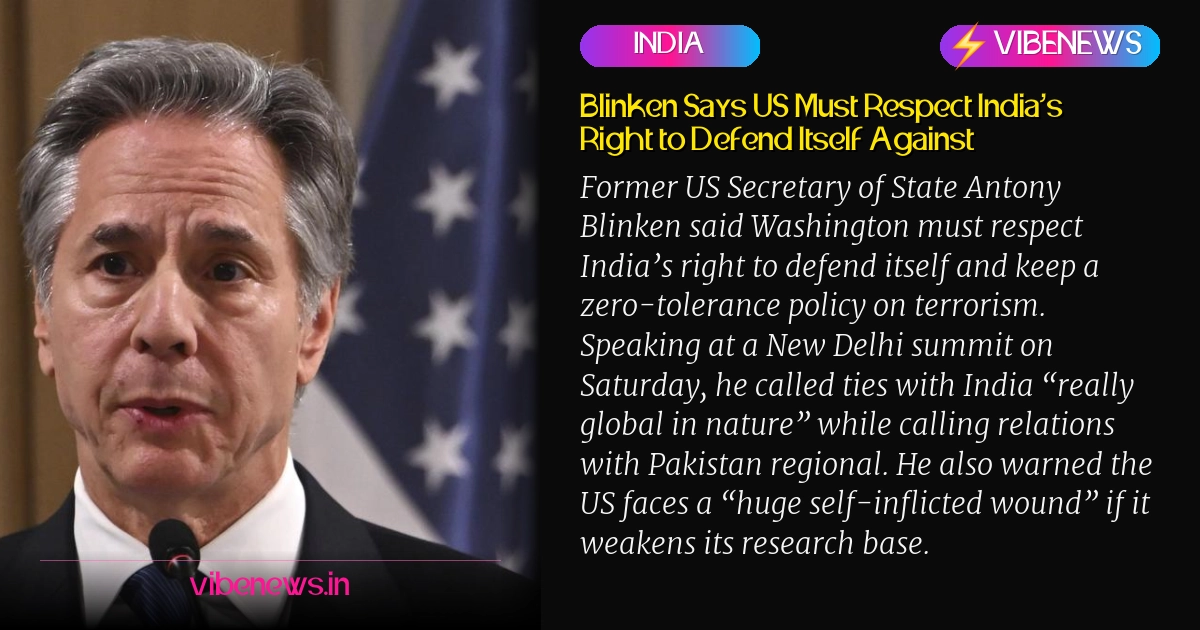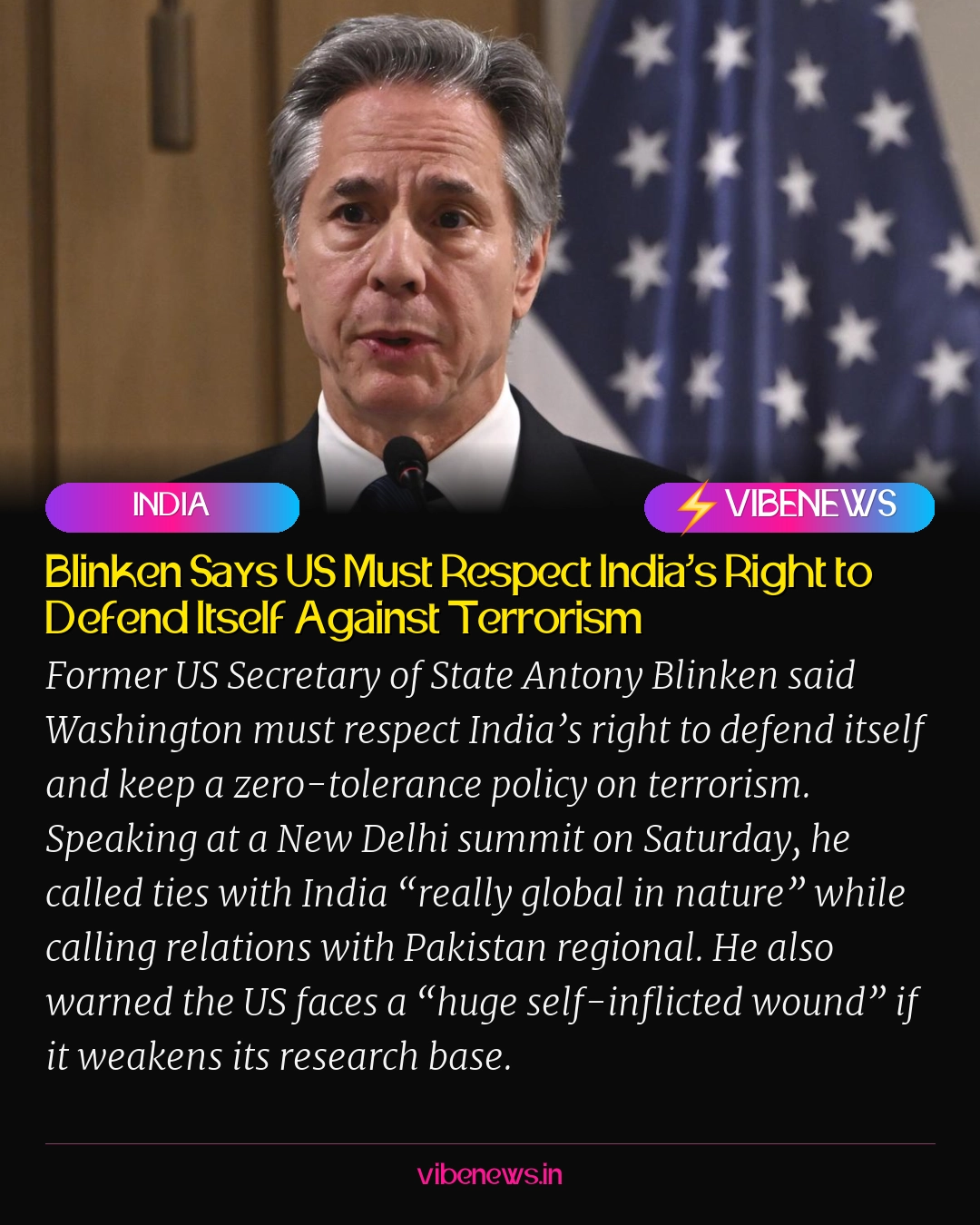
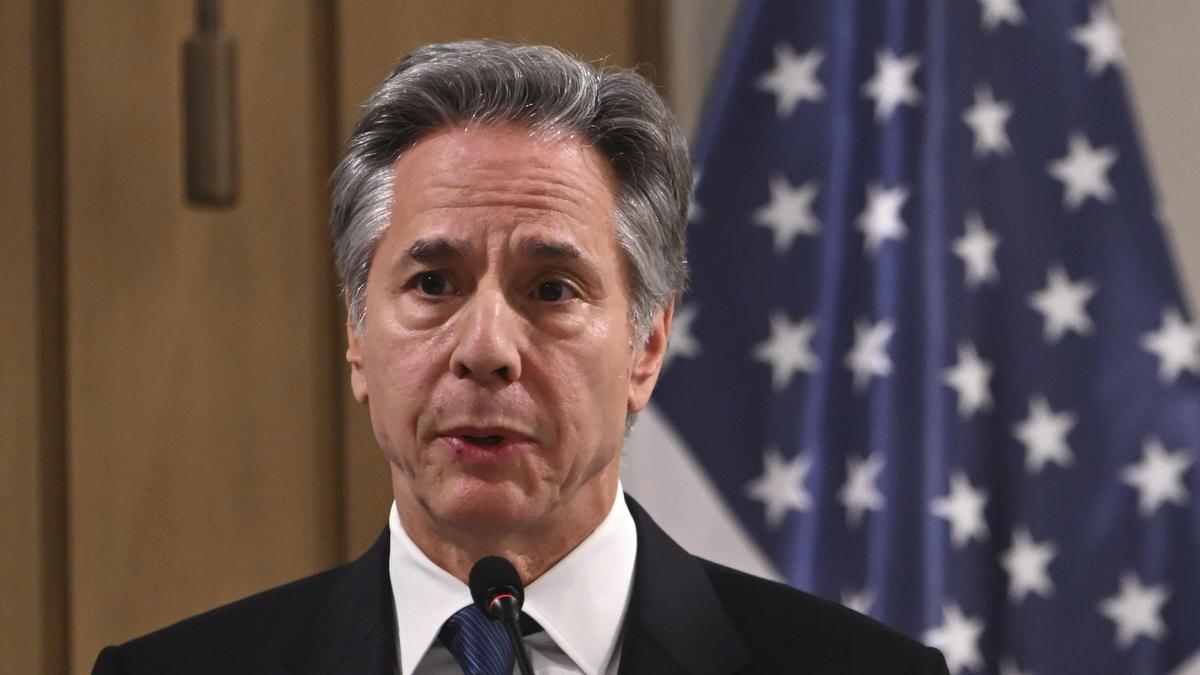
Former US Secretary of State Antony Blinken said on Saturday, November 14, that Washington must respect India’s right to defend itself and maintain a zero-tolerance policy towards terrorism. He made the remarks at a summit in New Delhi, where he described the relationships with India and Pakistan as fundamentally different.
Blinken spoke in a conversation with Jawed Ashraf, chairman of the India Trade Promotion Organisation. He did not hedge on where India stands in his view. “India is a global force,” he said, adding that the shared interests between Washington and New Delhi were “really global in nature.”
The US relationship with Pakistan, by contrast, is “regional,” Blinken said. He acknowledged that Washington still needs to work with Islamabad on certain issues, and he singled out counter-terrorism as one of them. Even so, he insisted the two relationships are not comparable.
The counter-terrorism line was the sharpest of his remarks. Blinken argued that Washington’s approach has to include support for India’s efforts to respond to attacks. It also has to include diplomatic work to stop tensions from escalating between New Delhi and Islamabad, the two nuclear-armed neighbours.
“We have to have a zero-tolerance policy for terrorism. Period. And that means that we have to have respect for India’s right to defend itself,” he said.
Blinken stressed the stakes of that diplomacy. Prevention matters, he said, because of the destructive potential of the weapons both countries possess. The message was clear: a crisis between India and Pakistan carries risks that extend well beyond the two capitals.
He also looked back at Washington’s record with Islamabad. Blinken said US strategic interests during the Cold War and the war in Afghanistan may have led successive administrations to be less critical of Pakistan’s civil-military establishment. “And there’s certainly an opportunity for the United States to do more,” he added.
On India-US relations, Blinken described a long arc. In his telling, the two countries moved from estrangement to a partnership that is genuine and, in some ways, unique. He said it rests on a convergence of strategic interests, along with deep people-to-people connections between the two societies.
The next phase, he argued, is technology. Blinken pointed to cooperation in space, quantum technology and artificial intelligence as the areas where the two countries can work most closely. “The next step is tech cooperation, our ability to work in space, tech, quantum, and artificial intelligence,” he said.
Russia came up as well. Blinken acknowledged the depth of the India-Russia partnership and said Washington does not expect New Delhi to sever those ties. He conceded the two countries will not always see eye to eye. “For Russia, we understand there is deep history between India and Russia. So, we don’t want them to end it,” he said.
Blinken, who served as the 71st Secretary of State from 2021 to 2025 under then-President Joe Biden, framed his wider argument around change. He said the world sits at a profound inflection point, shaped by rapid technological change, inequality and shifting power. The pace of that change, he said, is beyond anything he has seen in his lifetime.
To make the point, he noted that ChatGPT, an artificial intelligence chatbot, took one month to reach 50 million users. The telephone took 75 years to reach a comparable scale. Blinken said the private sector increasingly drives technological change, while governments struggle to keep up.
Inequality is part of the story too. Blinken said growing inequalities have left younger people feeling they are being “left out, left behind.”
His most pointed warning was aimed at his own country. Blinken said the US risks weakening its strength by damaging cooperation between government, universities and research institutions. It also risks becoming less welcoming to skilled people from abroad. “The biggest danger I think we face is a huge self-inflicted wound,” he said.
Blinken then turned to US domestic politics. He said the recent midterm results went beyond the usual setback for the party of a sitting President. He attributed the outcome partly to frustration over the cost of living and concerns about corruption. In the November 3 midterm elections, the Democratic Party won majorities in both the House of Representatives and the Senate, shifting control of the US Congress away from Republicans.
The sharpest geopolitical comments came on Iran. Blinken described the US-Israeli military campaign against Iran, launched in February by President Donald Trump, as “a war of choice.” He said the first Trump administration’s withdrawal from the 2015 nuclear agreement with Tehran had contributed to the current crisis.
That agreement, formally known as the Joint Comprehensive Plan of Action (JCPOA), required Iran to ship out 97% of its enriched uranium. It also placed limits on Iran’s centrifuges and allowed extensive inspections. After the US withdrew from the JCPOA in 2018, Blinken said, Iran accelerated its nuclear programme.
He argued that the ongoing military action will not resolve the issue. “It is very hard to try to force this Iranian regime to capitulate; it is possible to get it to negotiate. And these are very different things,” he said. Blinken called for an “off-ramp” to the conflict, warning that escalation could involve attacks on regional infrastructure, US bases and partner countries.
Energy markets are already feeling the pressure. Blinken said the Strait of Hormuz has become a major challenge for global energy supplies, something that was not a problem before the war. Since February, Iran has repeatedly restricted access to the narrow chokepoint, which is one of the world’s busiest oil shipping channels.
On the wider West Asia conflict, Blinken said a lasting settlement requires resolving the Palestinian question. He called for a sovereign Palestinian state alongside a secure Israel. He pointed to the population on the ground: seven million Jews in Israel, and seven million Arabs and Palestinians between Israel proper, the West Bank and Gaza. “No one is going anywhere despite what extremists on both sides would like to see happen,” he said.
Blinken acknowledged his view runs against the grain. “The solution remains, I fully believe, even though this is not a popular view, a secure Israel and a sovereign state of Palestine,” he added.
TL;DR
- Blinken says the US must respect India’s right to defend itself and keep zero tolerance for terrorism.
- He called US ties with India “really global in nature” and described relations with Pakistan as regional.
- Blinken warned the US could inflict a “huge self-inflicted wound” by weakening research cooperation and skilled immigration.
- He called the US-Israeli campaign against Iran “a war of choice” and urged an off-ramp to the conflict.
- Blinken said a lasting West Asia settlement requires a sovereign Palestinian state alongside a secure Israel.