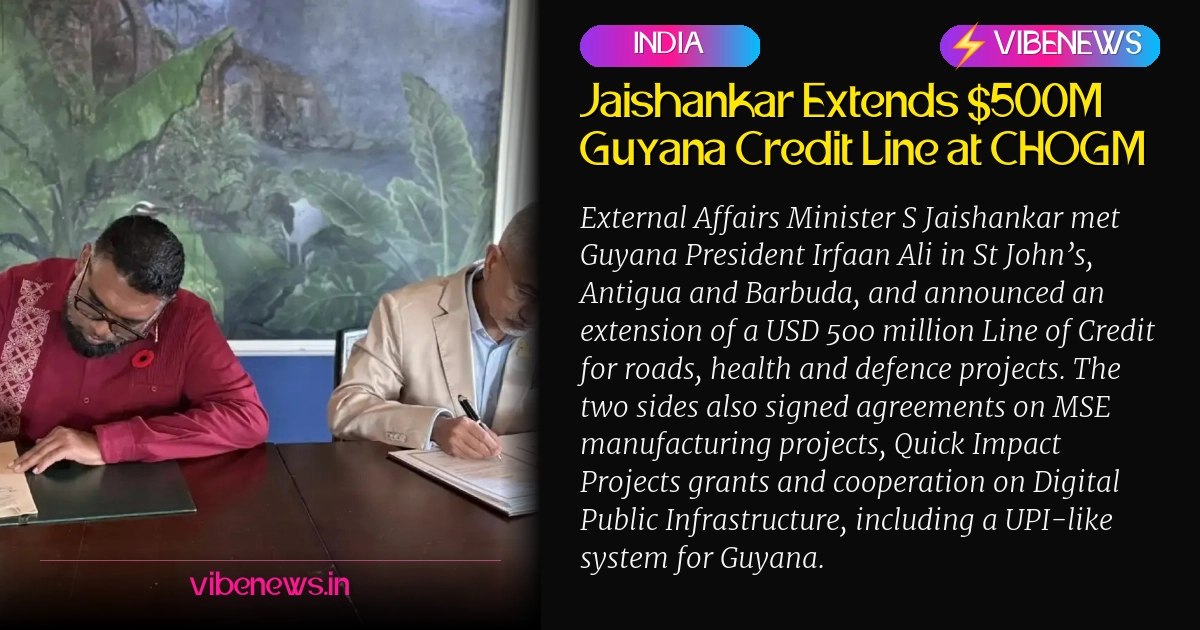
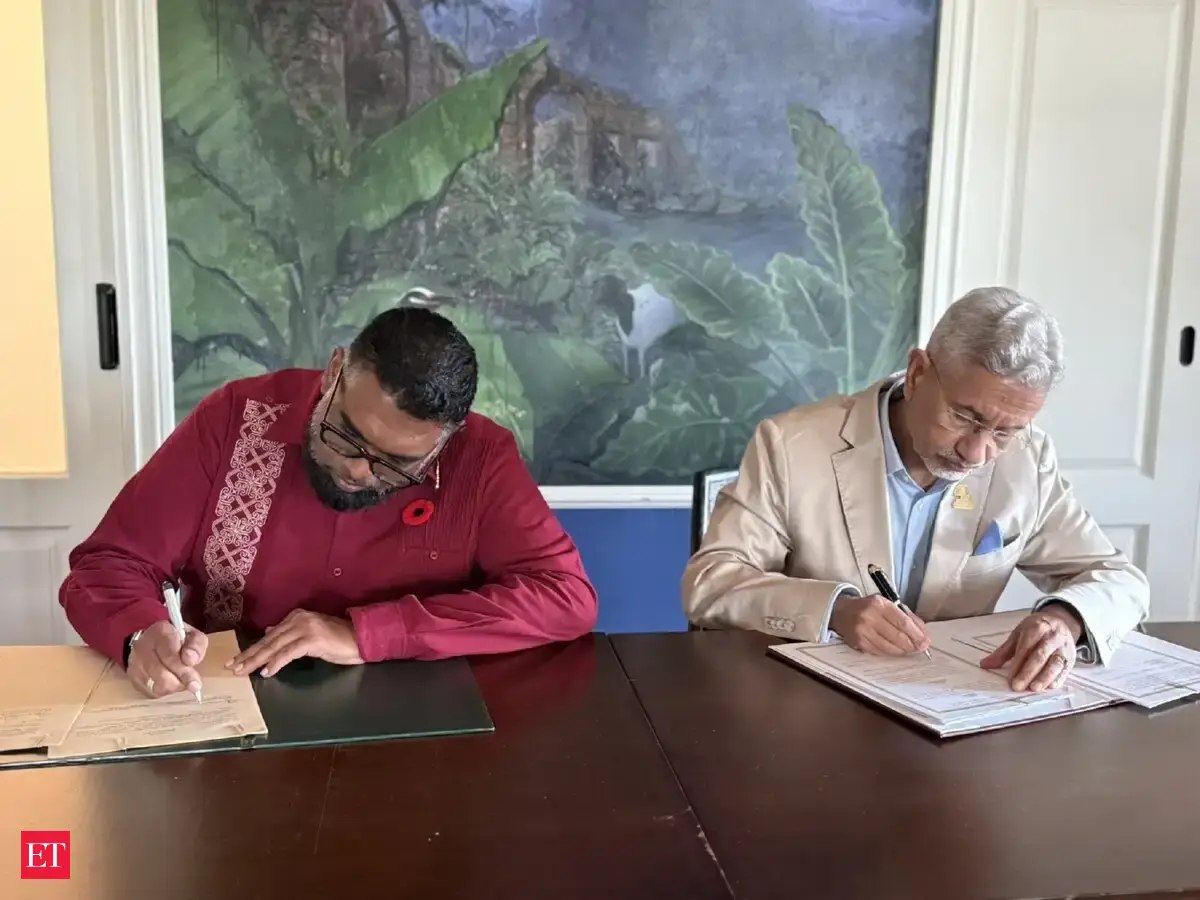
External Affairs Minister S Jaishankar met Guyana President Irfaan Ali on Thursday in St John’s, Antigua and Barbuda, and announced an extension of a USD 500 million Line of Credit for roads, health and defence projects. The meeting gave both governments a direct channel to review what they have built since Prime Minister Narendra Modi visited Guyana in November 2024.
Jaishankar used his X account to lay out the outcomes. Beyond the credit line, the two leaders signed agreements covering the supply and installation of MSE manufacturing projects, grant assistance for Quick Impact Projects, and cooperation on Digital Public Infrastructure and the functioning of a UPI-like system in Guyana.
“Announced extension of USD 500 mn Line of Credit for roads, health & defence projects.”
That single line carries most of the weight. It is a financing commitment that spans three sectors at once, and it arrives as a follow-up rather than a fresh start. Jaishankar described the ties as showing steady progress, which signals that this was a checkpoint on an existing relationship.
A credit line built around three sectors
Roads, health and defence are not a random mix. Infrastructure, public services and security are the core needs of any government trying to move from plans to delivery. By choosing those three areas, New Delhi and Georgetown put concrete targets on the table.
The announcement did not break down how the money will be split between the three sectors. It also did not outline timelines. Those details will matter more in the months ahead than the headline figure itself.
Digital public infrastructure goes abroad
The most unusual item on the list is the cooperation on Digital Public Infrastructure and the functioning of a UPI-like system in Guyana. India’s digital payments model has become one of its most visible technology exports, and this agreement shows that the model is now being discussed as a template for a partner country.
The source material places this within a wider effort. Prime Minister Modi’s 2024 visit already fostered ties on Digital Public Infrastructure and on creating a supportive ecosystem for farmers, particularly smallholders. Read together, the digital and agricultural pieces suggest a plan that reaches into everyday economic life, not just government-to-government paperwork.
Why the 2024 visit still anchors the relationship
Every agreement signed this week traces back to Modi’s trip to Guyana in November 2024. That visit set the direction, and Thursday’s meeting was the moment to confirm that momentum had held. Jaishankar’s choice to highlight the period since that visit tells you how both sides want the relationship framed: as steady, cumulative and measurable.
For Guyana, the agreements bring new support for manufacturing, grants for quick-impact projects and a digital framework. For India, they deepen a presence in the Caribbean that is anchored in concrete financing rather than symbolic gestures.
Three more conversations on the Antigua sidelines
The Guyana meeting was not the only one. On the sidelines of the Commonwealth Heads of Government Meeting (CHOGM) 2026 in Antigua and Barbuda, Jaishankar also met Australian Prime Minister Anthony Albanese. He then met United Kingdom Prime Minister Andy Burnham, whom he discussed strengthening economic partnership with in the context of the Comprehensive Economic and Trade Agreement (CETA).
Jaishankar posted that he had conveyed Prime Minister Modi’s warm wishes to Burnham. The UK conversation also touched on the wider global picture, a sign that trade talks and geopolitical positioning were being discussed side by side.
Put the Guyana meeting next to the Australia and UK talks and a pattern emerges. India is using a single international gathering to press economic ties on several fronts at once. Credit lines, digital systems, trade agreements and manufacturing support are all moving in the same direction.
What the day actually tells us
The core facts are simple. A minister met a head of state, a financing commitment was extended, several agreements were signed and three other bilateral conversations took place in the same setting. The strategic weight comes from how these pieces fit together.
Economic tools are doing most of the diplomatic work here. Lines of credit, digital infrastructure and trade frameworks create long-term dependencies and shared stakes that outlast any single summit. That is the kind of groundwork that rarely makes headlines when it is laid, but shapes outcomes for years.
The open questions are the ones the source material leaves unanswered. How the USD 500 million will be disbursed, which specific roads and health projects will benefit, and how fast the UPI-like system will move from agreement to operation are all still to be seen. Those answers will show whether Thursday’s announcements turn into delivery.
For now, the message from Antigua is clear. India is pushing its economic partnerships forward in the Caribbean, in the Pacific-facing Commonwealth and in Europe, all within one busy diplomatic window.
TL;DR
- Jaishankar announced a USD 500 million Line of Credit extension for Guyana covering roads, health and defence projects.
- India and Guyana signed agreements on MSE manufacturing projects and Quick Impact Projects grant assistance.
- Both sides agreed to cooperate on Digital Public Infrastructure, including a UPI-like system for Guyana.
- The meeting took place in St John’s, Antigua and Barbuda, on the sidelines of CHOGM 2026.
- Jaishankar also met Australian PM Anthony Albanese and UK PM Andy Burnham on the same day.
- The UK talks focused on strengthening economic ties under the Comprehensive Economic and Trade Agreement.