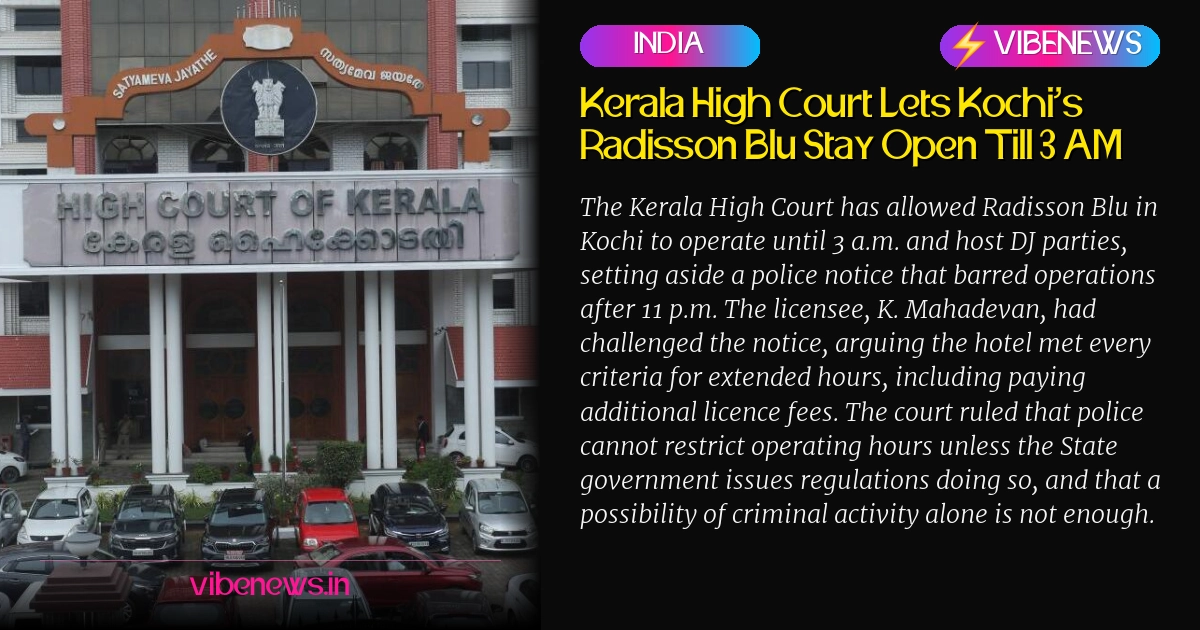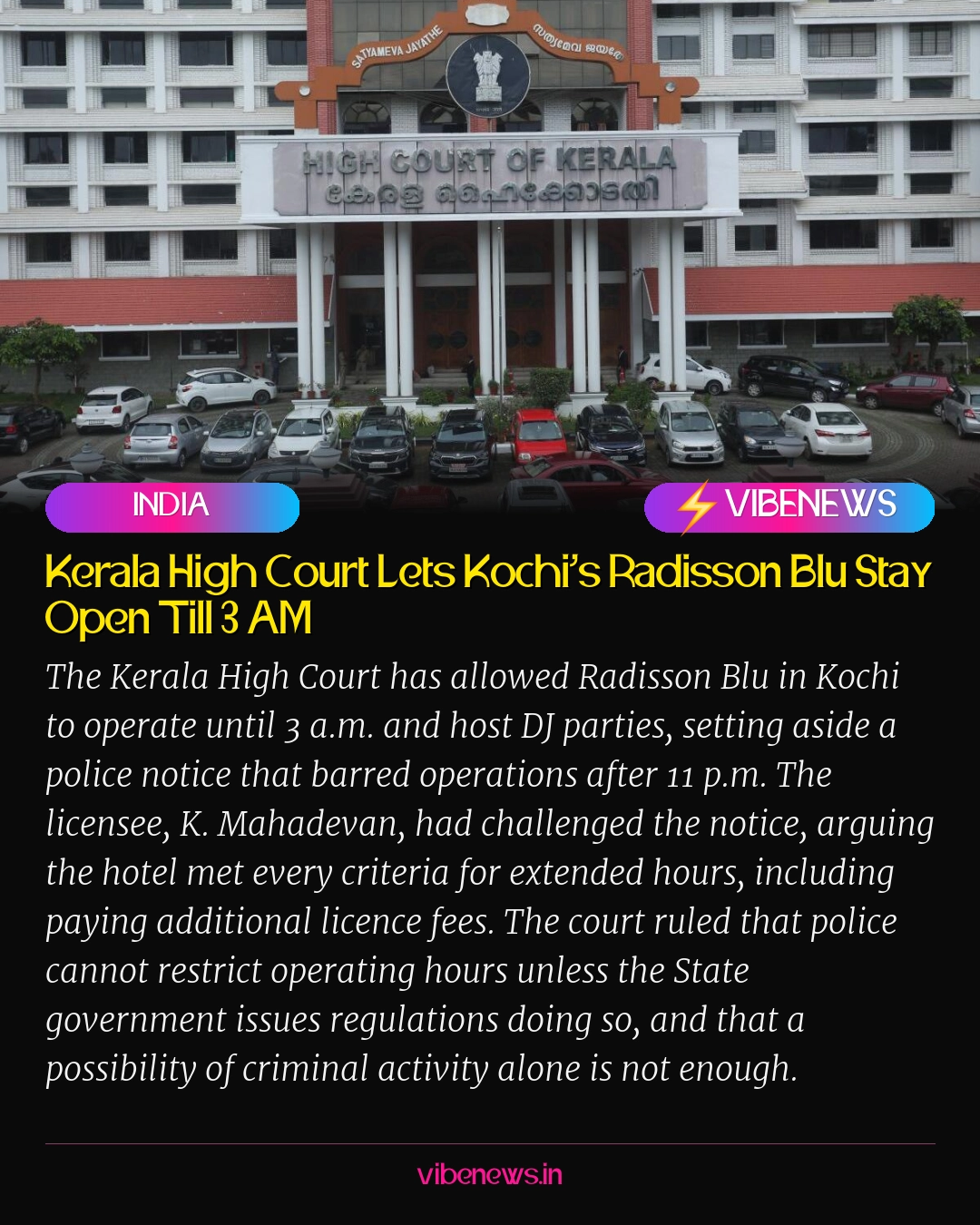
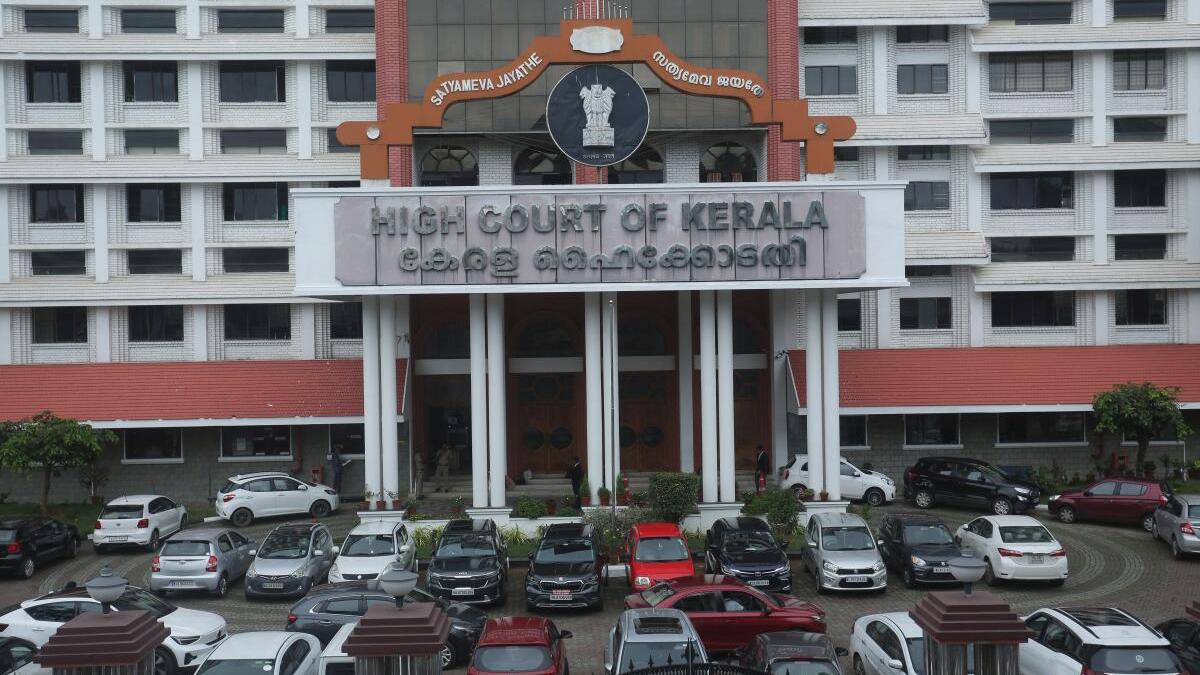
The Kerala High Court has allowed Hotel Radisson Blu in Kochi to keep operating until 3 a.m., striking down a police order that would have shut its doors and ended its DJ parties at 11 p.m.
Justice Murali Purushothaman set aside the notice issued by police authorities. The order had banned the hotel from operating and holding DJ parties after 11 p.m. For a city hotel built around late-night business, that cutoff was the whole ballgame, and the ruling puts the extended schedule back on the table.
The challenge came from K. Mahadevan, the hotel’s licensee. He argued that the hotel had earned the right to extended operation after meeting all the required criteria, and that this included paying additional licence fees. In other words, the hotel said it had done what the system asked for and should be allowed to trade under those terms.
The State pushed back. It contended that letting the hotel run DJ parties until 3 a.m. would disrupt public order and could turn the venue into a hub for drug-related transactions. Those were the concerns that police had used to justify the 11 p.m. restriction in the first place.
The court did not accept that the police had the power to act on those concerns alone. Its central finding was clear: the police could not curtail or restrict the operating hours of the hotel unless the State government had issued regulations doing exactly that. Without such regulations, the police had no legal footing to set a new closing time on their own.
The legal reasoning that tips the balance
The judgment also addressed the idea that criminal activity could justify the restriction. The court said that a mere possibility of criminal activities could not be used to impose restrictions under the Kerala Police Act on the extended operating hours of an FL3 hotel. That hotel category is permitted under the Foreign Liquor Amendment Rules, and the court treated that permission as the governing framework.
That distinction matters. The State’s argument rested on what might happen inside the venue. The court’s answer rested on what the law actually allows and who has the authority to change it. Speculation about trouble, in other words, was not enough to override a licensed operation that met the rules.
Why hospitality and tourism operators will be watching
For hotels, bars and entertainment venues across Kerala, the ruling is a clear signal that extended hours are not simply at the mercy of local police notices. A licensee that has met the criteria and paid the additional fees can expect the courts to hold authorities to the regulations, not to their own concerns about what could go wrong.
Tourism stakeholders have a stake too. Late-night entertainment and DJ events are part of how urban hotels attract guests and events, and a 3 a.m. window gives operators room that an 11 p.m. cutoff takes away. The ruling does not create a new policy for the whole state, but it does set a precedent in one high-profile case that other licensed operators will read closely.
The decision also points to a gap that the State has not yet filled, at least in the reasoning presented here. The court made it plain that the power to curtail operating hours sits with the State government through regulations. Until such regulations are issued, police restrictions of this kind face a steep legal hurdle.
What the ruling does and does not settle
The court’s order resolves the dispute over this particular hotel and this particular notice. It does not say that criminal activity or drug concerns are irrelevant. It says that such concerns, on their own, cannot justify restricting hours under the Kerala Police Act for an FL3 hotel permitted under the Foreign Liquor Amendment Rules.
Whether the State responds with new regulations, an appeal, or a different approach to policing late-night venues is not addressed in the material available. Those questions will shape how far this ruling travels beyond Kochi.
For now, the headline outcome is simple. Radisson Blu in Kochi can operate until 3 a.m., and police cannot cut that window short without a regulation behind them. The judgment was published on November 10, 2026, and it puts the spotlight on who holds the authority to decide when a licensed city venue must close.
Mere possibility of criminal activities could not justify imposing restrictions under the Kerala Police Act on the extended operating hours of an FL3 hotel permitted under the Foreign Liquor Amendment Rules.
TL;DR
- Kerala High Court allows Radisson Blu in Kochi to operate till 3 a.m.
- Justice Murali Purushothaman set aside a police notice that banned the hotel from DJ parties after 11 p.m.
- The licensee, K. Mahadevan, said the hotel met all criteria, including paying additional licence fees, for extended operation.
- The State argued extended hours would disrupt public order and could allow drug-related transactions.
- The court held police cannot curtail operating hours unless the State government issues regulations doing so.
- Mere possibility of criminal activity cannot justify restrictions on FL3 hotels permitted under Foreign Liquor Amendment Rules.