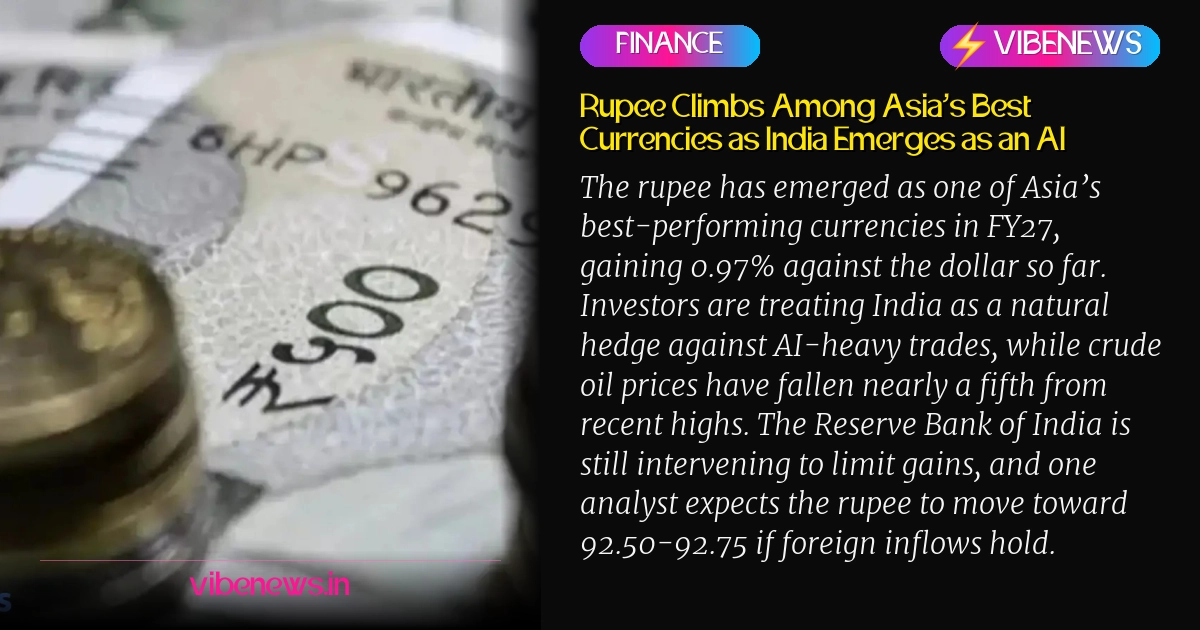
The rupee has become one of Asia’s best-performing currencies so far in FY27, closing Monday at 93.92 to the dollar, compared with 94.83 at the end of the last financial year.
That is a sharp turnaround for a currency that spent the first half of the fiscal year near the bottom of the regional table. The rupee has gained 0.97% in FY27 so far. Over the same period, South Korea’s won has appreciated more than 11% and China’s renminbi has gained 3.06%. At the other end of the list, the Indonesian rupiah has weakened 6.24%.
Investors have been rethinking where to park money as the AI trade cools. Money that once flowed heavily into artificial intelligence-linked investments has been pulling away from currencies like the won and the renminbi, both of which have been closely tied to that theme. India, which has far less direct exposure to AI-driven trades, has become a natural hedge against that concentration, and the rupee has benefited.
Falling oil prices have added to the rupee’s gains. Crude has retreated nearly a fifth from its recent highs, easing pressure on an economy that buys most of its oil from abroad and pays for it in dollars.
Foreign portfolio investors have also returned. Last week, they were net buyers of ₹38,971 crore in equities. Of that, about ₹452 crore came from the primary market, while exchange data showed ₹38,500 crore of stock bought in the secondary market. Market participants have noticed the shift in mood.
There has been a change in sentiment, with a pickup in foreign portfolio investor inflows into India. In the near term, there could be an appreciation bias for the rupee if there is a de-escalation in US-Iran tensions or if there is further correction in AI stocks.
That comment came from Gaura Sengupta, chief economist at IDFC First Bank. Her point captures the two forces now shaping the currency. One is geopolitics, particularly the US-Iran standoff, which keeps oil and risk sentiment jumpy. The other is the AI trade itself. If the rally in AI stocks keeps slowing or corrects further, capital may keep looking for alternatives, and India is one of the places it is looking.
The rupee’s climb is also a reminder of how far it has swung this year. The currency hit a record low of 96.96 to the dollar in late May and traded close to those levels again in October. On both occasions, it came within touching distance of the psychologically important 97 mark. The move from there to 93.92 is one of the sharpest reversals the currency has seen in a while, and it has left traders weighing how much further it can go.
The Reserve Bank of India is one of the main reasons it has not gone faster. The central bank reportedly intervened in the market on Monday, limiting the rupee’s appreciation, according to dealers. How far the rupee can strengthen from here depends largely on how much the RBI is willing to tolerate.
The central bank’s position is complicated. Its forward book stood at a net short dollar position of $239 billion as of September 2026, which implies a large future obligation to deliver dollars. That gives the RBI a strong incentive to rebuild its dollar reserves by buying foreign currency whenever capital inflows improve. Emkay Global’s chief economist Madhavi Arora expects the RBI to use any sustained improvement in inflows to replenish its foreign exchange buffers rather than let the rupee appreciate sharply.
Some analysts think the more effective tool may not be direct market buying at all. Anindya Banerjee, head of currency research at Kotak Securities, argued that the central bank is unlikely to absorb dollars and let the rupee strengthen freely. Instead, he said, the most likely way to cap appreciation is to stop supplying dollars to public sector oil companies. The RBI opened a special window for oil marketing companies in early October, which removed a key source of dollar demand from the spot market. Banerjee suggested that if the window closes or narrows, oil companies would have to tap dollars directly from the market, pushing the rupee back down. He also expects some hedging demand from exporters, who may sell dollars forward to lock in gains.
Banerjee’s near-term forecast is a move toward the 92.50 to 92.75 range. That outlook comes with conditions. Foreign portfolio inflows would need to stay strong, and crude oil prices would need to avoid a fresh spike.
For global investors, the story is less about the rupee alone and more about what it says about emerging market currencies as the AI rally loses momentum. A currency that is not heavily tied to AI-linked capital flows has suddenly looked like a useful counterweight. Whether that holds will depend on three things: whether the US-Iran situation calms, whether AI stocks correct further, and whether the RBI decides the rupee has gained enough.
TL;DR
- The rupee is one of Asia’s best-performing currencies in FY27, closing Monday at 93.92 to the dollar.
- India’s role as a natural hedge against AI-heavy trades has lifted the rupee past the won and the renminbi.
- The rupee has gained 0.97% this fiscal year, while the won has risen over 11% and the renminbi has gained 3.06%.
- Crude oil has retreated nearly a fifth from recent highs, easing pressure on India.
- Foreign investors were net buyers of ₹38,971 crore in equities last week.
- The RBI is reportedly limiting gains, and one analyst expects the rupee to reach 92.50-92.75 if inflows hold.